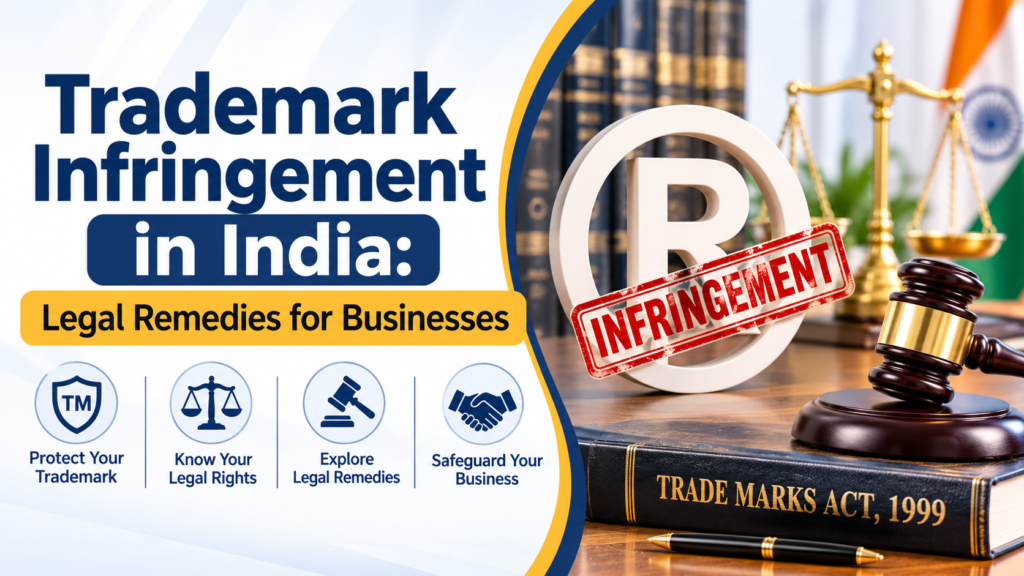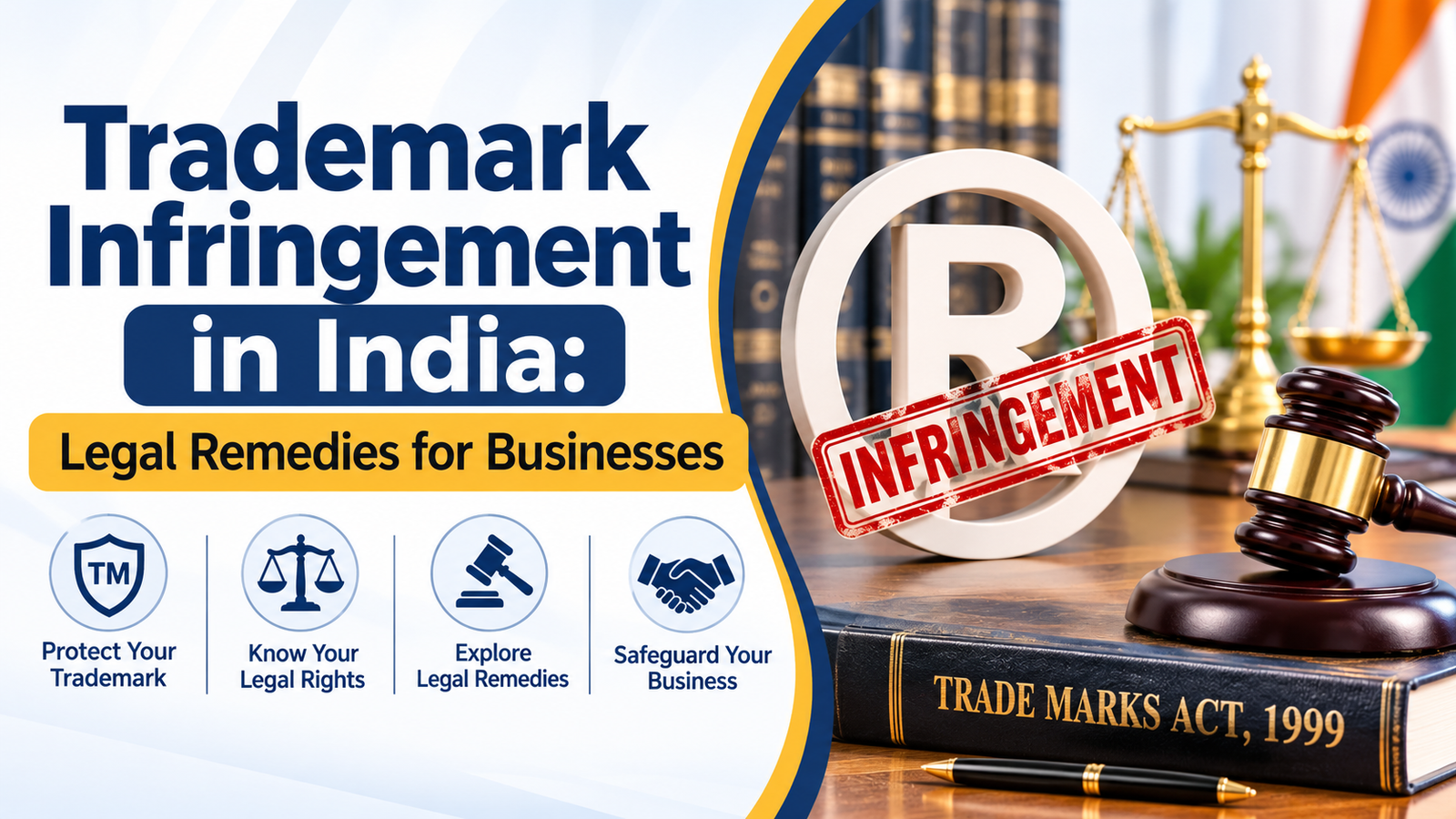
Understanding trademark infringement in India helps businesses protect their brand identity and commercial reputation. Trademark infringement in India can affect a company’s brand identity, customer trust, sales, and market reputation. A competing business may adopt a confusingly similar name, logo, packaging, domain name, or online listing, leaving customers uncertain about the source of goods or services.
The principal framework is the Trade Marks Act, 1999, read with the Trade Marks Rules, 2017, the Code of Civil Procedure, 1908 and, where applicable, the Commercial Courts Act, 2015. This guide explains the legal position, available civil and criminal remedies, practical enforcement steps and business safeguards as at 2 November 2026.
What Is Trademark Infringement Under Indian Law?
The legal framework for trademark infringement in India helps registered proprietors protect their exclusive trademark rights.
Section 28 gives a validly registered proprietor exclusive rights, subject to statutory conditions and limitations. Section 29 sets out circumstances in which unauthorized use in the course of trade infringes a registered mark. An identical mark on identical goods or services attracts the statutory presumption of likely confusion under Section 29(3), while other situations require assessment of the relevant legal tests.
Infringing conduct may include applying a mark to products or packaging, selling or stocking marked goods, importing or exporting them, using the mark in advertising or business papers, and certain uses as a trade or business name. Section 29(4) may also protect a reputed registered mark against use on dissimilar goods or services where its additional requirements are met.
Trademark Infringement vs. Passing Off
Businesses must understand the difference between trademark infringement in India and passing off before initiating legal action.
A registered proprietor may sue for infringement. Under Section 27(1), an unregistered mark does not support a statutory infringement action; however, Section 27(2) preserves the common-law action for passing off. Passing off generally requires goodwill, misrepresentation likely to deceive and resulting or likely damage. Registration is not an automatic answer to a prior user’s passing-off claim.
For example, a local business that has used a distinctive name for years may be able to challenge a later trader’s confusing presentation even if its own mark has not been registered. The outcome depends on proof of goodwill and other facts.
When Can a Business Take Action?
Recognising the warning signs of trademark infringement in India can help businesses respond before significant commercial damage occurs.
- A competitor adopts an identical or deceptively similar brand for related products or services.
- A seller markets counterfeit products bearing the brand’s mark.
- A business uses a protected mark in its trade name, packaging, advertising or listings in a manner covered by Section 29.
- An online seller, website or domain creates a misleading association with the brand.
- A reputed mark is used on unrelated goods in circumstances satisfying Section 29(4).
Similarity alone does not guarantee success. Courts examine the marks as a whole, relevant customers, products, channels of trade, likelihood of confusion and any statutory defenses.
Important Legal Provisions
The Trade Marks Act, 1999 provides the primary legal framework for addressing trademark infringement in India.
Section 9: Absolute grounds for refusal of registration
Section 9 prohibits registration of trademarks that lack distinctiveness, are descriptive or generic, or are likely to deceive the public or cause confusion. It also restricts marks that fall under other statutory prohibitions.
Section 11: Relative grounds for refusal of registration
Section 11 restricts registration of trademarks that conflict with earlier trademarks due to identity or similarity and the likelihood of public confusion. It also protects well-known trademarks, subject to statutory conditions and exceptions.
Sections 27–29: Rights and infringement
These provisions distinguish registered-mark infringement from passing off and describe the exclusive rights and prohibited uses.
Sections 30–35: Limitations and defenses
Honest descriptive or referential use, permitted use, certain dealings in genuine goods, acquiescence, prior continuous use and bona fide use of a name or description can affect liability. Section 34 is especially important where a defendant proves earlier continuous use.
Sections 47 and 57: Non-use and rectification
A registration may be challenged on applicable statutory grounds, including non-use under Section 47. Rectification and cancellation proceedings require attention to the current High Court jurisdiction and procedural rules.
Sections 134–135: Civil suits and relief
These govern the minimum court level, special jurisdiction for registered-mark claims, injunctions, damages or an account of profits, and delivery-up of infringing labels or marks.
Sections 103–105 and 115: Criminal enforcement
Specified acts involving false trademarks or trade descriptions can attract criminal sanctions. Search and seizure must comply with Section 115 and applicable criminal procedure; not every civil infringement constitutes a criminal offense.
Section 142: Groundless threats
Unjustified threats of infringement proceedings can themselves expose the sender to statutory relief; legal notices should be evidence-based.
Step-by-Step Legal Process for Trademark Infringement in India
A structured legal approach to trademark infringement in India can help businesses preserve evidence and select suitable remedies.
Step 1: Verify ownership and priority
Check the Trade Marks Registry record, registered classes, renewal status, ownership chain, licenses, disclaimers, actual use and any earlier competing rights. Preserve the registration certificate and evidence of first use.
Step 2: Collect and preserve evidence
Secure dated product photographs, original purchases and invoices, screenshots with URLs and timestamps, marketplace listings, advertisements, customer complaints, sales records and evidence of confusion. Preserve electronic evidence in a form suitable for court, including applicable Bharatiya Sakshya Adhiniyam, 2023 requirements.
Step 3: Assess infringement, passing off and defenses
Compare the marks and goods/services; consider prior use, genuine-goods resale, honest description, consent, exhaustion, and the defendant’s registration. Avoid assuming every similar word is unlawful.
Step 4: Issue a carefully drafted cease-and-desist notice
Where strategically appropriate, demand cessation, removal of listings, preservation of stock and records, undertakings and settlement discussions. A notice is common but not an absolute precondition to filing suit.
Step 5: Seek urgent interim relief
Where urgency and evidence justify it, seek a temporary or ex parte injunction. Courts consider a prima facie case, balance of convenience and irreparable injury. Section 135(2) also contemplates orders for discovery, evidence preservation, and asset-related protection.
Step 6: File a civil or commercial suit
Proceed before a competent court under Section 134, subject to territorial and pecuniary jurisdiction and the Commercial Courts Act where applicable. In commercial suits not contemplating urgent interim relief, pre-institution mediation under Section 12A of the Commercial Courts Act may be mandatory.
Step 7: Enforce the order and pursue final relief
After interim orders, monitor compliance, seek permitted disclosure or seizure assistance, and pursue permanent injunctions, damages or an account of profits and appropriate delivery-up orders. Settlement or licensing may be practical in some disputes.
Civil Remedies Available to Businesses
Civil remedies for trademark infringement in India may include injunctions, damages and delivery-up orders, subject to applicable legal requirements.
- Temporary, ex parte and permanent injunctions against infringing or passing-off conduct.
- Damages or, at the plaintiff’s option, an account of profits, subject to Section 135(3) limitations.
- Delivery-up of infringing labels and marks for destruction or erasure.
- Discovery, preservation and other interim orders permitted by Section 135(2).
- Costs and other procedural relief, subject to judicial discretion.
- Damages are not fixed by statute for ordinary civil infringement. Courts assess proof, conduct, loss and applicable principles; large awards should never be assumed.
Criminal Penalties and Counterfeit Goods
Criminal enforcement in trademark infringement in India applies to specified false-mark offenses and requires compliance with statutory safeguards.
Sections 103 and 104 address specified false-mark offenses, including falsifying or falsely applying marks and selling goods or providing services bearing false marks, subject to statutory defenses. The general punishment under these provisions is imprisonment of six months to three years and a fine of ₹50,000 to ₹2,00,000; courts may depart from the statutory minimum for adequate and special reasons recorded in the judgment. Section 105 provides enhanced minimum punishment for qualifying repeat convictions.
Criminal complaints and police action are fact-specific. Under Section 115, search and seizure involve prescribed safeguards, including the statutory requirement for the relevant police officer to obtain the Registrar’s opinion on facts relating to the offense before search and seizure.
Businesses should coordinate with qualified counsel and law enforcement rather than treating a civil similarity dispute as automatically criminal.
Online Infringement, Domain Names and Marketplaces
Businesses facing trademark infringement in India through online marketplaces should preserve digital evidence and assess appropriate enforcement options.
Businesses should document infringing websites, social profiles, sponsored advertisements and marketplace listings and use platform intellectual-property complaint channels. Domain disputes may also involve passing off and the applicable domain-dispute mechanism, such as INDRP for eligible .in domains or UDRP for covered domains. Platform take down is not a substitute for a court remedy and may be contested.
Jurisdiction, Limitation and Practical Timelines
Understanding jurisdiction and limitation is essential when pursuing a trademark infringement in India claim.
Section 134 requires infringement and passing-off suits to be instituted in a court not inferior to a competent District Court. The additional plaintiff-based jurisdiction under Section 134(2) applies to specified registered-mark claims, not automatically to standalone passing-off claims, and is subject to judicial interpretation. Commercial-court allocation and High Court original-side rules may also matter.
The Limitation Act, 1963 can affect monetary claims and litigation strategy. Continuing acts may raise recurring causes of action, but delay, acquiescence and interim-relief considerations must be assessed separately. No universal fixed time applies to obtaining an injunction or concluding litigation.
| Stage | Indicative duration (not guaranteed) |
| Evidence and legal assessment | Days to several weeks |
| Legal notice / response | Often 1–3 weeks, depending on circumstances |
| Urgent interim application | May be heard quickly; listing and outcome vary |
| Civil suit and trial | Months to several years |
| Appeal / enforcement | Depends on order and forum |
Documents Businesses Should Preserve
- Trademark application and registration particulars, renewals, assignments and licenses.
- First-use documents, invoices, advertising spend and historical product packaging.
- Samples or test purchases of suspected counterfeit or confusing goods.
- Dated screenshots, URLs, online listings and social-media records.
- Customer complaints, distributor communications and evidence of confusion.
- Sales, profitability and market-share records relevant to loss or unjust gains.
- Notices, responses, undertakings and prior settlement documents.
Important Judicial Principles
Cadila Health Care Ltd. v. Cadila Pharmaceuticals Ltd. (2001) emphasises the contextual assessment of deceptive similarity, including the nature of goods and purchasers, especially for medicinal products.
Satyam Infoway Ltd. v. Sifynet Solutions (2004) recognizes that domain names may attract passing-off protection.
Toyota Jidosha Kabushiki Kaisha v. Prius Auto Industries Ltd. (2017) underscores proof of reputation and goodwill in India in transborder-reputation disputes.
These decisions must be applied to the specific evidence and later binding authority.
How Businesses Can Reduce Trademark Risks
Preventive measures can help businesses reduce the risk of trademark infringement in India and protect their intellectual property rights.
- Conduct clearance searches before adopting company names, product names and logos.
- Register appropriate word and device marks for relevant goods and services; monitor renewals.
- Retain consistent, dated proof of genuine commercial use.
- Monitor competing applications, online marketplaces and distributors.
- Use written licensing, franchise and distributor agreements with brand-control provisions.
- Create an internal escalation process for suspected counterfeits and infringement.
How ELT Law Firm Can Help
ELT Law Firm can assist businesses in evaluating trademark disputes, reviewing registration and use records, preparing legal notices, coordinating evidence preservation, considering settlement options, and developing an enforcement or defense strategy.
Where litigation or criminal proceedings are required, representation and filings are subject to engagement with appropriately authorized legal professionals and the relevant court or authority.
Conclusion
Trademark infringement in India calls for prompt but proportionate action. The strongest response starts with confirming ownership and prior use, identifying the precise legal cause of action, preserving reliable evidence and selecting the appropriate remedy. Registered-mark infringement, passing off, criminal counterfeiting and online takedowns are related but legally distinct routes. Early assessment can protect commercial goodwill while reducing the risk of avoidable disputes and groundless threats.
Frequently Asked Questions
Q1. Can I sue if my trademark is not registered?
You cannot bring a statutory infringement claim for an unregistered mark under Section 27(1), but a passing-off claim may be available if its elements are proved.
Q2. Is a legal notice compulsory before filing a trademark suit?
No universal statutory rule requires a cease-and-desist notice. The Commercial Courts Act pre-institution mediation rules may separately apply when urgent interim relief is not contemplated.
Q3. Can I obtain an injunction immediately?
Urgent interim or ex parte relief is possible on the facts, but the court applies established legal tests and procedural safeguards.
Q4. Can a registered trademark be challenged by a prior user?
Yes. Prior continuous use under Section 34 and applicable validity or rectification grounds can materially affect the dispute.
Q5. Can a similar domain name amount to infringement?
Potentially. Depending on registration, use, confusion, and goodwill, infringement, passing off, or domain-dispute procedures may apply.
Q6. Can I claim both damages and an account of profits?
Section 135 generally provides an election between damages and an account of profits rather than cumulative recovery of both.
Q7. Does every infringement lead to imprisonment?
No. Civil infringement is distinct from the specific criminal offenses concerning false marks under the Act.
Q8. Can a seller of genuine branded products be sued?
The answer depends on Section 30, including exhaustion, the condition of goods, consent and any legitimate reasons for objection.