Introduction
IBC Legal Updates 2026 are important for businesses dealing with unpaid debts, financial distress, corporate restructuring, and recovery proceedings. The Insolvency and Bankruptcy Code, 2016 aims to preserve enterprise value while providing a time-bound framework for resolving insolvency. Businesses, financial creditors, operational creditors, promoters, and investors should understand the latest legal developments to make informed decisions and manage potential insolvency risks.
The Insolvency and Bankruptcy Code (Amendment) Act, 2026 (Act 6 of 2026) received assent on 6 April 2026. Notification S.O. 2625(E), issued on 25 May 2026, commenced specified provisions on 26 May 2026. Not every section commenced simultaneously. Accordingly, businesses must distinguish between enacted reforms, operative amendments, and frameworks awaiting separate commencement or implementation rules.
Understanding IBC Legal Updates 2026 can help companies identify relevant legal responsibilities, review existing financial arrangements, and prepare for changes affecting corporate insolvency proceedings.
What Changed Under IBC Legal Updates 2026?
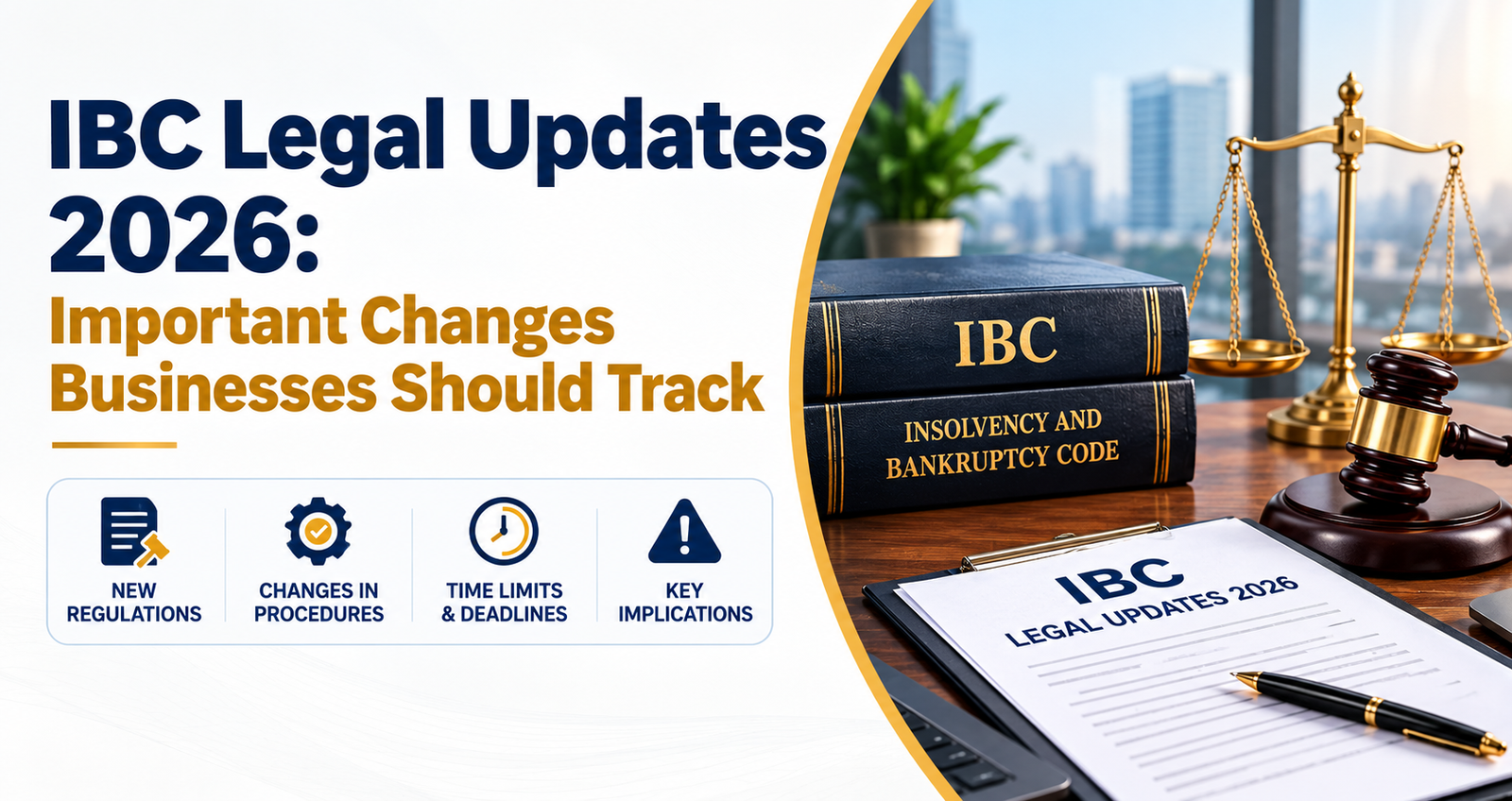
IBC Legal Updates 2026 cover several important areas of insolvency law, including creditor participation, admission of applications, resolution plans, liquidation, and the treatment of guarantors.
The major changes highlighted in the 2026 framework include:
- Tighter statutory discipline for admission and resolution-plan orders.
- Revised safeguards for withdrawal of admitted insolvency cases.
- Clarification of security interests, creditor claims, and plan distributions.
- Greater Committee of Creditors (CoC) involvement in liquidation.
- Enhanced scrutiny of avoidance transactions and wrongful trading.
- New statutory architecture for creditor-initiated, group, and cross-border insolvency, subject to commencement and implementing rules.
These developments may affect businesses differently depending on their financial position, role in insolvency proceedings, and applicable regulatory requirements.
IBC Legal Updates 2026 – Admission of Insolvency Applications
Faster Decisions and Better Evidence
Applications under Sections 7, 9, and 10 remain central to corporate insolvency. The 2026 amendments strengthen the expectation that the adjudicating authority decide applications within the statutory period and record reasons for delay.
Financial creditors should preserve loan documents, default records, information-utility evidence, and acknowledgments. Operational creditors should maintain invoices, delivery records, demand notices, and evidence concerning pre-existing disputes.
The minimum default threshold for corporate insolvency under Section 4 remains ₹1 crore. This threshold should not be confused with the amount needed to bring an ordinary civil recovery claim. Insolvency is a collective resolution process, not a substitute for routine debt collection.
IBC Legal Updates 2026 – Withdrawal After Admission Under Section 12A
The substituted Section 12A, commenced on 26 May 2026, imposes a narrower statutory withdrawal window. In the permitted stage, withdrawal requires the prescribed procedure and approval of 90% of the voting share of the CoC.
The amendment restricts withdrawal before CoC constitution and after the first invitation for submission of resolution plans.
Businesses negotiating settlements should therefore consider timing carefully. An agreement between two parties does not itself end an admitted Corporate Insolvency Resolution Process.
IBC Legal Updates 2026 – Resolution Plan Reforms
Distribution, Transparency and Approval
Amendments to Sections 30 and 31 address dissenting financial creditors, reasons for CoC approval, plan implementation, and adjudication timelines.
The CoC must assess feasibility, viability, legal compliance, and distribution outcomes. The framework also clarifies the binding consequences of an approved plan for prior claims against the corporate debtor, while preserving distinct liabilities where the law so provides.
For investors acquiring distressed businesses, due diligence should cover pending claims, statutory approvals, asset title, litigation, employee liabilities, and plan implementation conditions.
An approved plan does not automatically absolve promoters or guarantors of their independent obligations.
IBC Legal Updates 2026 – Liquidation Process Changes
A Larger Role for the Committee of Creditors
The 2026 amendments and corresponding IBBI Liquidation Process (Fourth Amendment) Regulations shift important liquidation oversight toward the CoC.
The CoC constituted during CIRP continues into liquidation, with approval roles over specified costs and sale decisions. The framework also allows creditor involvement in recommending or replacing the liquidator in the prescribed manner.
Claims already verified during CIRP are generally carried forward rather than subjected to unnecessary re-verification. The regulations tighten timelines and reporting and strengthen safeguards around related-party asset sales and private sales.
Businesses purchasing assets from liquidation should independently verify eligibility, approvals, and sale conditions.
IBC Legal Updates 2026: Avoidance Transactions and Wrongful Trading
Sections 43, 45, 49, 50, and 66 address preferential, undervalued, fraudulent, extortionate, and wrongful-trading conduct.
The 2026 reforms strengthen routes for examining questionable transactions, including provisions allowing specified stakeholders to act when relevant transactions have not been pursued by the insolvency professional, subject to statutory conditions.
Directors should preserve contemporaneous board minutes, related-party registers, valuation reports, and records supporting transfers or repayments made when the company was financially stressed.
Ordinary transactions are not automatically avoidable. The statutory tests and relevant look-back periods matter.
IBC Legal Updates 2026: Guarantor Assets and Personal Liability
New Section 28A introduces a framework for transferring specified guarantor assets during insolvency proceedings, subject to applicable creditor approvals and safeguards.
The treatment differs depending on whether the guarantor is a corporate guarantor or a personal guarantor and whether a separate insolvency or bankruptcy process is underway.
A corporate debtor’s CIRP does not automatically discharge a personal guarantor. Banks, promoters, and guarantors should review guarantee deeds, security arrangements, and parallel proceedings before restructuring.
IBC Legal Updates 2026: Creditor-Initiated Insolvency Resolution
The Amendment Act establishes a creditor-initiated insolvency resolution framework for specified corporate debtors, with creditor-led initiation and a distinct timetable.
However, the provisions establishing this route must be checked against their specific commencement notification and applicable procedural regulations before it is presented as an available filing option.
Companies should not assume that the new mechanism is operational merely because the Amendment Act has been enacted.
Group and Cross-Border Insolvency
The 2026 legislation creates enabling architecture for group insolvency coordination and cross-border insolvency rules.
These are significant for corporate groups with shared lenders, guarantees, common assets, or overseas operations. Their practical operation depends on notified provisions and detailed rules.
Until those conditions are satisfied, businesses should not describe a proposed coordinated mechanism as an automatically available statutory remedy.
IBBI Regulatory Changes and Compliance Monitoring
IBBI issued multiple 2026 amendments affecting CIRP, liquidation, pre-packaged insolvency, information utilities, personal guarantor processes, reporting, and valuation.
The IBBI legal-framework register includes the CIRP Regulations consolidated through 9 June 2026 and related June 2026 amendments. A September 2026 circular also addresses due diligence by insolvency professionals to prevent misuse of the IBC framework.
In practice, insolvency teams should maintain a live register of applicable IBBI regulations, circulars, prescribed forms, and filing dates rather than relying only on the text of the principal Code.
Penalties and Misuse of the IBC Framework
The Amendment Act introduces or revises consequences for specified frivolous or vexatious proceedings, non-disclosure of disputes, and contraventions relating to moratorium or approved plans.
The applicable offence, commencement status, monetary range, and procedural requirements must be checked against the relevant amended section before alleging liability.
Businesses should use the IBC for genuine insolvency resolution, not merely as a coercive recovery tactic.
Key IBC Timelines and Thresholds Businesses Should Know
Understanding the important timelines and financial thresholds is essential for creditors, corporate debtors, promoters, and businesses involved in insolvency proceedings.
| IBC provision / stage | Timeline or threshold |
| Minimum default for corporate CIRP | ₹1 crore |
| Operational creditor demand notice | 10 days to pay or notify dispute |
| Normal CIRP period | 180 days from admission |
| Extension of CIRP | Up to 90 additional days, subject to approval |
| Overall CIRP period | 330 days including litigation time, subject to judicial interpretation |
| CoC approval of resolution plan | At least 66% voting share |
These timelines and thresholds should be read alongside the applicable statutory provisions, amendments, regulations, and judicial decisions.
How IBC Legal Updates 2026 Affect Indian Businesses
Businesses should review their financial records, contractual arrangements, and insolvency preparedness to understand how the latest legal developments may affect them.
The following steps can help companies improve their legal and financial preparedness:
- Review outstanding receivables, guarantees, defaults, and limitation dates.
- Maintain authenticated financial records and information-utility documentation.
- Identify related-party transactions and preserve valuations and board approvals.
- Update internal protocols for insolvency notices, claim submission, and CoC participation.
- Recheck the commencement status of any new 2026 statutory mechanism before filing.
- Track current IBBI regulations, forms, circulars, and applicable NCLT directions.
Taking these steps early can help businesses identify potential legal risks and prepare appropriate responses to insolvency-related situations.
How ELT Corporate Can Assist With IBC Legal Updates 2026
ELT Corporate Private Limited can support businesses with debt and default documentation review, creditor and debtor record organisation, insolvency compliance tracking, claims documentation, regulatory research, and coordination with insolvency professionals and qualified legal counsel for NCLT-related matters.
The appropriate strategy depends on whether the client is a creditor, corporate debtor, promoter, guarantor, or prospective resolution applicant.
Businesses dealing with insolvency-related challenges may benefit from reviewing their legal position, understanding applicable statutory requirements, and obtaining professional guidance before taking important financial or legal decisions.
You can explore ELT Corporate and ELT Law Partners LLP to learn more about corporate legal and regulatory support.
Conclusion
IBC Legal Updates 2026 represent an important shift toward tighter timelines, stronger creditor oversight, and clearer accountability throughout corporate insolvency and liquidation.
The practical impact will differ depending on the provision’s commencement status and the regulations governing its operation. Businesses should respond through better record-keeping, earlier restructuring decisions, careful transaction review, and timely professional advice.
Understanding the latest IBC developments can help creditors, companies, promoters, and investors make better-informed decisions and manage insolvency-related legal responsibilities.
Frequently Asked Questions
Q1. What is the most important IBC change in 2026?
The 2026 Amendment Act changes multiple stages of insolvency, including admission, plan approval, withdrawal, and liquidation. Its provisions have staggered commencement.
Q2. Did the entire IBC Amendment Act, 2026 come into force?
No. Notification S.O. 2625(E) commenced specified provisions on 26 May 2026. The remaining provisions require separate verification.
Q3. What is the minimum default for corporate insolvency?
The minimum default threshold under Section 4 is ₹1 crore, subject to the relevant statutory requirements.
Q4. Can CIRP be withdrawn after a settlement?
Only through the applicable statutory process. The amended Section 12A imposes timing restrictions and generally requires 90% CoC voting approval in the permitted window.
Q5. Can promoters automatically regain control during CIRP?
No. CIRP involves statutory management changes. Any return of control depends on the applicable process and approved outcome.
Q6. Are creditor-initiated and group insolvency available now?
Businesses should not assume so. They must verify specific commencement notifications and implementing rules for each new mechanism.
Q7. Does an approved resolution plan release guarantors?
Not automatically. Guarantor liability must be assessed separately under the guarantee and applicable law.
Q8. What should directors preserve before insolvency?
Directors should preserve financial statements, contracts, board minutes, bank records, valuations, and evidence supporting related-party transactions.Records, valuations, and evidence supporting related-party transactions.