Introduction
When a company faces financial difficulties and cannot repay its debts on time, it may need to consider legal options to manage its financial position. Two important terms in this situation are corporate insolvency and liquidation. Although they are related, they have different meanings and purposes under Indian law.
Understanding Corporate Insolvency vs Liquidation is important for business owners, directors, lenders, investors, and creditors. Corporate insolvency resolution generally focuses on finding a way to revive a financially distressed company, while liquidation involves collecting and selling the company’s assets and distributing the proceeds according to the applicable legal priority.
In India, the Insolvency and Bankruptcy Code, 2016 provides the main legal framework for corporate insolvency resolution and liquidation in relevant cases. The National Company Law Tribunal acts as the adjudicating authority for these corporate insolvency proceedings.
What Is Corporate Insolvency?
Corporate insolvency refers to a company’s financial inability to meet its payment obligations when they become due. A business may experience insolvency because of cash-flow problems, excessive borrowing, declining sales, unpaid invoices or other financial difficulties.
In India, when the applicable requirements are met, a financial creditor, operational creditor or the corporate debtor itself may initiate the Corporate Insolvency Resolution Process under the IBC.
The main objective of CIRP is to assess whether the company can be rescued through a resolution plan, restructuring, a change in ownership or another legally permissible solution.
Key Features of Corporate Insolvency
- Focus on resolution: The process provides an opportunity to explore whether the company can continue operating.
- Creditor participation: Creditors participate in the process according to the applicable provisions of the IBC.
- Professional management: An appointed insolvency professional performs the functions prescribed by law.
- Legal supervision: The NCLT oversees the process in accordance with the IBC.
- Potential business revival: An approved resolution plan may allow the company to continue under new or restructured arrangements.
The outcome depends on the facts of the case, the available resolution options and compliance with the applicable legal requirements.
What Is Liquidation?
Liquidation is a legal process through which a company’s assets are collected, realised or sold, and the proceeds are distributed among eligible stakeholders according to the applicable legal order of priority.
Under the IBC, liquidation may follow a corporate insolvency resolution process when the statutory conditions for liquidation are met. For example, liquidation may be ordered when no eligible resolution plan is received or approved, or when the Committee of Creditors makes the relevant decision in accordance with the Code.
Liquidation does not automatically mean that every business activity must stop immediately. The liquidator may continue certain activities when legally permitted and considered necessary for beneficial liquidation.
Key Features of Liquidation
- Asset realisation: The company’s assets are collected and may be sold.
- Creditor payments: Available proceeds are distributed according to the applicable statutory priority.
- Liquidator’s role: A liquidator carries out the responsibilities prescribed under the law.
- Business closure: The process generally moves towards the company’s eventual dissolution, subject to legal requirements.
- Stakeholder interests: Creditors, employees and other eligible stakeholders may have claims handled under the relevant provisions.
The liquidation process must follow the applicable statutory requirements. It does not guarantee that every creditor will recover the full amount owed.
Corporate Insolvency vs Liquidation: Key Differences
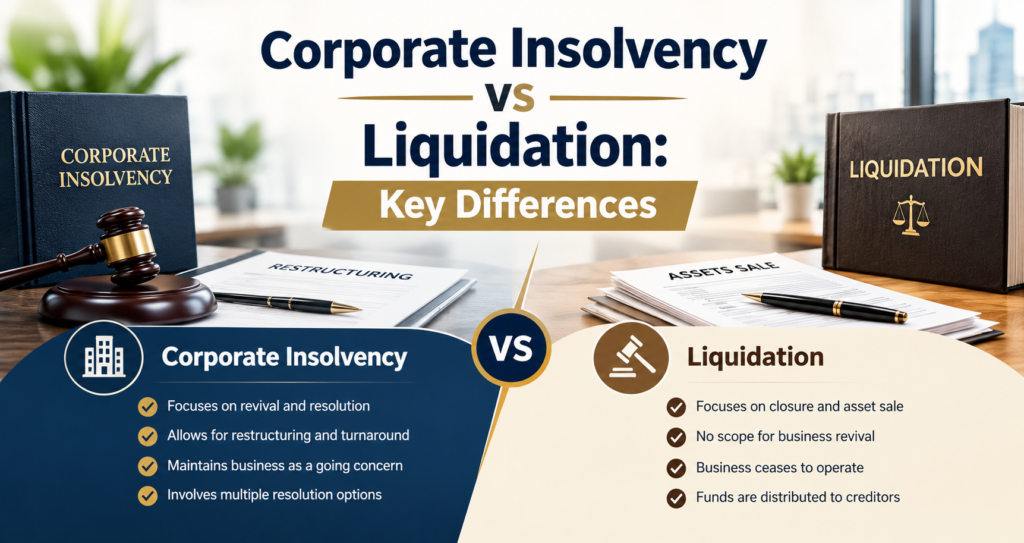
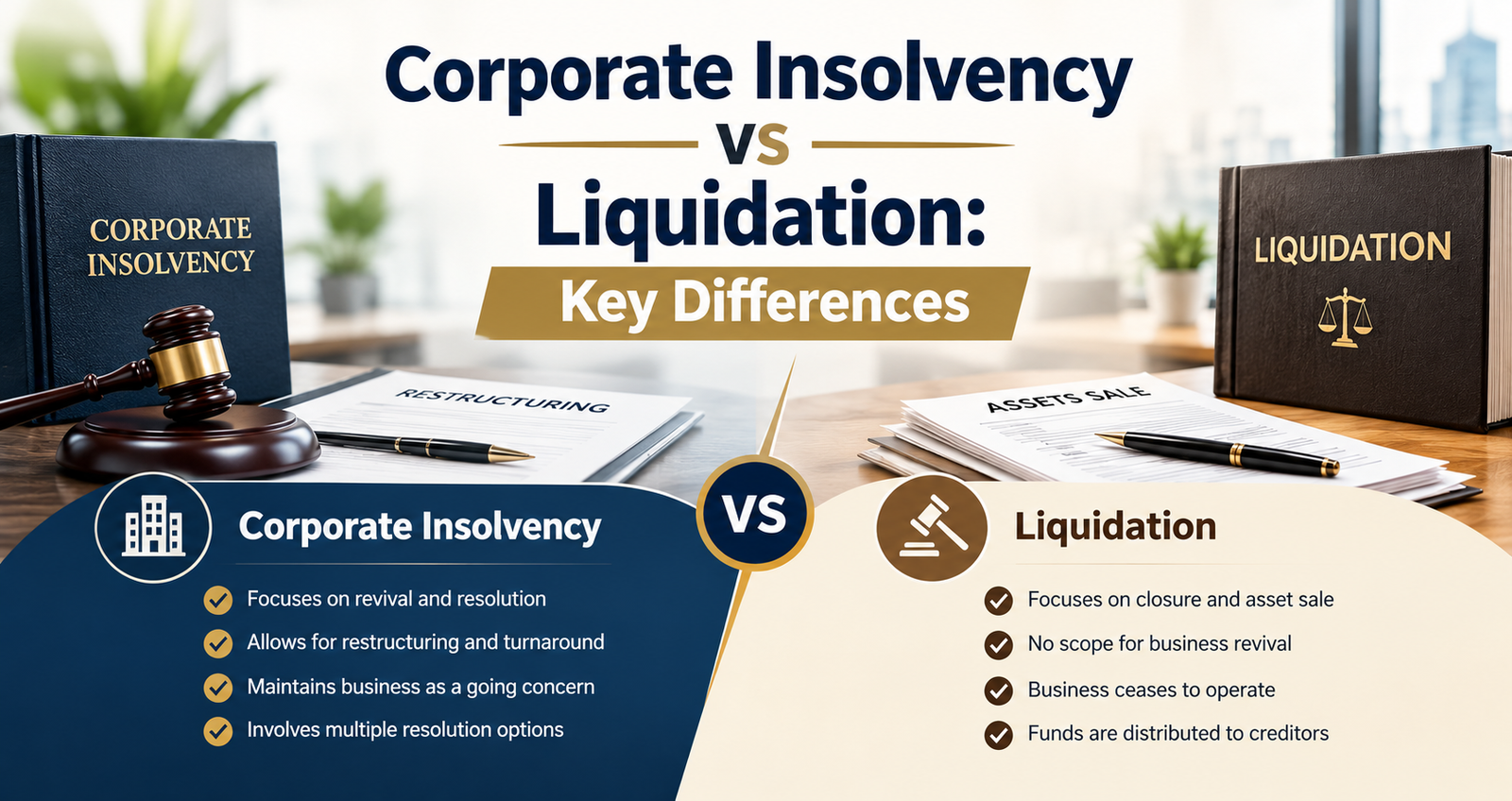
The main difference between these two concepts is their purpose. Corporate insolvency resolution explores whether a financially distressed business can be rescued, while liquidation focuses on realising assets and distributing the proceeds in accordance with the law.
| Basis of comparison | Corporate insolvency resolution | Liquidation |
| Main objective | Explore business revival or resolution | Realise assets and distribute proceeds |
| Business continuity | Aims to preserve the business where feasible | Generally moves towards closure and dissolution |
| Management | An insolvency professional performs the role prescribed under the IBC | A liquidator administers the liquidation process |
| Creditor involvement | Creditors participate in evaluating resolution options | Stakeholder claims are dealt with under liquidation rules |
| Outcome | An approved resolution plan or another outcome permitted by law | Distribution of proceeds and eventual dissolution, subject to the law |
| Assets | Business assets may be preserved as part of a viable resolution | Assets are collected and realised as appropriate |
| Legal stage | Resolution is generally attempted before liquidation under the CIRP framework | May follow CIRP when the statutory conditions are met |
These differences reflect the general framework under the IBC. Specific rights, duties, and outcomes depend on the facts and applicable legal provisions.
How Does the Corporate Insolvency Resolution Process Work?
The Corporate Insolvency Resolution Process is a structured legal procedure designed to address qualifying defaults and assess possible solutions for a financially distressed company.
Step 1: Identify the Default
The first step is to assess whether the company has defaulted on a debt and whether the legal requirements for initiating CIRP are satisfied.
A financial difficulty alone does not automatically mean that a CIRP application will be admitted.
Step 2: File an Application Before the NCLT
An eligible financial creditor, operational creditor or the corporate debtor may initiate proceedings through the applicable route under the IBC. The application must satisfy the relevant statutory requirements and be supported by the required information and documents.
Step 3: Appointment of an Insolvency Professional
After the application is admitted, the Adjudicating Authority appoints an Interim Resolution Professional in accordance with the IBC. The process includes managing the corporate debtor’s affairs as required by law and handling creditor claims.
Step 4: Evaluation of Resolution Options
The resolution process examines the company’s financial position and potential ways to address its liabilities. Eligible resolution applicants may submit plans, which are considered under the applicable legal framework.
Step 5: Approval or Another Legal Outcome
A resolution plan must satisfy the applicable legal requirements and receive the necessary approvals. If resolution fails or a statutory ground for liquidation arises, liquidation may follow.
The process and its timelines are governed by the IBC and applicable regulations.
How Does the Liquidation Process Work?
Liquidation follows a different objective from business rescue. It focuses on dealing with the company’s assets and claims under the applicable legal framework.
Step 1: Liquidation Order
Where a statutory ground for liquidation is established, the NCLT may pass the relevant liquidation order under the IBC.
Step 2: Appointment of a Liquidator
The liquidator takes responsibility for the functions prescribed by law, including custody and control of the corporate debtor’s assets where applicable.
Step 3: Collection and Valuation of Assets
The liquidator identifies and evaluates the company’s assets and takes the steps required to realise their value.
Step 4: Verification of Claims
Claims submitted by creditors and other stakeholders are handled according to the applicable liquidation regulations.
Step 5: Distribution of Proceeds
The available proceeds are distributed according to the statutory order of priority. The amount recovered by each creditor depends on the available assets, admitted claims, and applicable law.
Step 6: Dissolution
After the required liquidation steps have been completed, the liquidator may apply for dissolution in accordance with the IBC.
For the relevant statutory provisions, refer to the Insolvency and Bankruptcy Code, 2016 and the IBBI official website.
India Code+1
Corporate Insolvency vs Liquidation: Practical Example
Consider a manufacturing company that has borrowed money from a bank and purchased raw materials on credit. Due to falling sales and delayed customer payments, the company is unable to pay its debts.
Situation A: Resolution may be possible
The company has valuable machinery, an established customer base, and a business model that could become profitable after restructuring. During the insolvency resolution process, a suitable resolution plan may provide a way to address the company’s financial difficulties and continue operations, subject to legal approvals.
Situation B: Liquidation may be necessary
The company’s debts are substantial, its business is no longer viable and no acceptable resolution plan is available. If a statutory ground for liquidation is established, the company’s assets may be realised and the proceeds distributed according to the applicable legal priorities.
This example illustrates why Corporate Insolvency vs Liquidation is an important distinction for companies and their creditors. The appropriate outcome depends on the company’s circumstances and the legal requirements.
When Should a Company Consider Insolvency Resolution or Liquidation?
The appropriate legal route depends on the company’s financial position, business viability, debts, assets and the applicable statutory framework.
In general, insolvency resolution may be relevant when:
- The company has defaulted on qualifying debts.
- There is a realistic possibility of restructuring or business revival.
- Creditors and potential resolution applicants may be able to develop a viable solution.
- The company needs a formal process to address financial distress.
Liquidation may become relevant when:
- The statutory conditions for liquidation are satisfied.
- No acceptable resolution plan is available or approved.
- The Committee of Creditors makes a liquidation decision permitted under the IBC.
- Another applicable legal ground for liquidation has arisen.
Businesses should obtain professional advice before choosing a course of action. Liquidation is not necessarily a voluntary alternative to CIRP in every case, and separate rules may apply to voluntary liquidation of a solvent corporate person.
Important Laws Governing Corporate Insolvency and Liquidation in India
The legal framework includes the following important sources:
- Insolvency and Bankruptcy Code, 2016: Provides the main statutory framework for corporate insolvency resolution and liquidation.
- IBBI regulations: Govern important procedural and compliance requirements for insolvency professionals and insolvency proceedings.
- NCLT: Adjudicates corporate insolvency matters and issues orders under the applicable laws.
- NCLAT: Hears appeals within its statutory jurisdiction.
You can review the official India Code legislation portal, the Insolvency and Bankruptcy Board of India, and the National Company Law Tribunal for relevant legislation, regulations, and procedural information.
How ELT Corporate Helps
ELT Corporate assists businesses in understanding regulatory and corporate compliance requirements and identifying appropriate professional support for complex legal matters.
When a company faces financial difficulties, understanding its options early can help directors and stakeholders make better-informed decisions.
ELT Corporate can help businesses with:
- Initial compliance review: Organising relevant corporate records, financial information and supporting documents.
- Understanding legal procedures: Explaining the general requirements and stages involved in corporate insolvency and liquidation.
- Documentation support: Helping businesses organise relevant information for review by the appropriate legal and insolvency professionals.
- Professional coordination: Helping businesses identify the need for specialist advice on NCLT proceedings, creditor disputes and insolvency matters.
- Corporate compliance guidance: Supporting businesses in understanding related regulatory obligations and documentation requirements.
For matters requiring legal representation or statutory functions reserved for authorised professionals, the appropriate qualified legal counsel or registered insolvency professional should be engaged.
Visit ELT Law Partners LLP to learn more about corporate legal services, or explore its NCLT Lawyers in India page for related legal assistance.
Conclusion
In conclusion, Corporate Insolvency vs Liquidation represents two different approaches to dealing with corporate financial distress. Understanding Corporate Insolvency vs Liquidation helps companies and creditors evaluate the distinction between business resolution and asset liquidation. Businesses should assess their financial position, review the applicable provisions of the IBC and seek professional guidance to understand their legal options.
Understanding Corporate Insolvency vs Liquidation helps business owners, creditors and directors recognise the difference between attempting to rescue a financially distressed company and proceeding towards the realisation of its assets.
Corporate insolvency resolution focuses on evaluating whether a business can be restructured or revived. Liquidation generally involves collecting and selling assets, distributing available proceeds according to the law and completing the steps required for dissolution.
The right approach depends on the company’s financial position, the viability of its operations, creditor interests and the applicable provisions of the IBC. Early professional guidance can help businesses understand their legal responsibilities, organise documents and evaluate available options.
Frequently Asked Questions
Q1. What is the main difference between corporate insolvency and liquidation?
Corporate insolvency resolution generally aims to address financial distress and explore the possibility of business revival. Liquidation focuses on realising assets and distributing the proceeds among eligible stakeholders according to the applicable legal rules.
Q2. Is corporate insolvency the same as liquidation?
No. Corporate insolvency describes a company’s financial difficulties and, in the relevant legal context, the process of resolving them. Liquidation is a separate process for dealing with the company’s assets and liabilities under the law.
Q3. Can a company continue operating during insolvency proceedings?
Yes. A company may continue operating during CIRP, subject to the IBC, the role of the appointed insolvency professional, and applicable legal requirements. The circumstances of each case determine how the business is managed.
Q4. When does a company enter liquidation under the IBC?
Liquidation may begin when a statutory ground under the IBC is established. Examples include the absence of an acceptable resolution plan, rejection of a plan on relevant legal grounds, a qualifying Committee of Creditors decision or contravention of an approved resolution plan.
Q5. Who manages a company during liquidation?
A liquidator manages the liquidation process and performs the duties prescribed under the IBC and applicable regulations. The liquidator’s appointment and powers are governed by law.
Q6. Do creditors always recover their money during liquidation?
No. Recovery depends on the value of the assets realised, the admitted claims, and the statutory order of priority. Some creditors may recover only part of their claims or may receive no distribution.
Q7. What is the role of the NCLT in corporate insolvency and liquidation?
The NCLT acts as the adjudicating authority for relevant corporate insolvency matters under the IBC. Its functions include deciding applications and passing orders within its statutory jurisdiction.
Q8. Can ELT Corporate help a business understand insolvency-related requirements?
ELT Corporate can assist businesses with compliance guidance, document organisation, and understanding the general process. Case-specific legal advice and representation should be obtained from suitably qualified legal professionals, and statutory insolvency functions should be performed by authorised professionals.