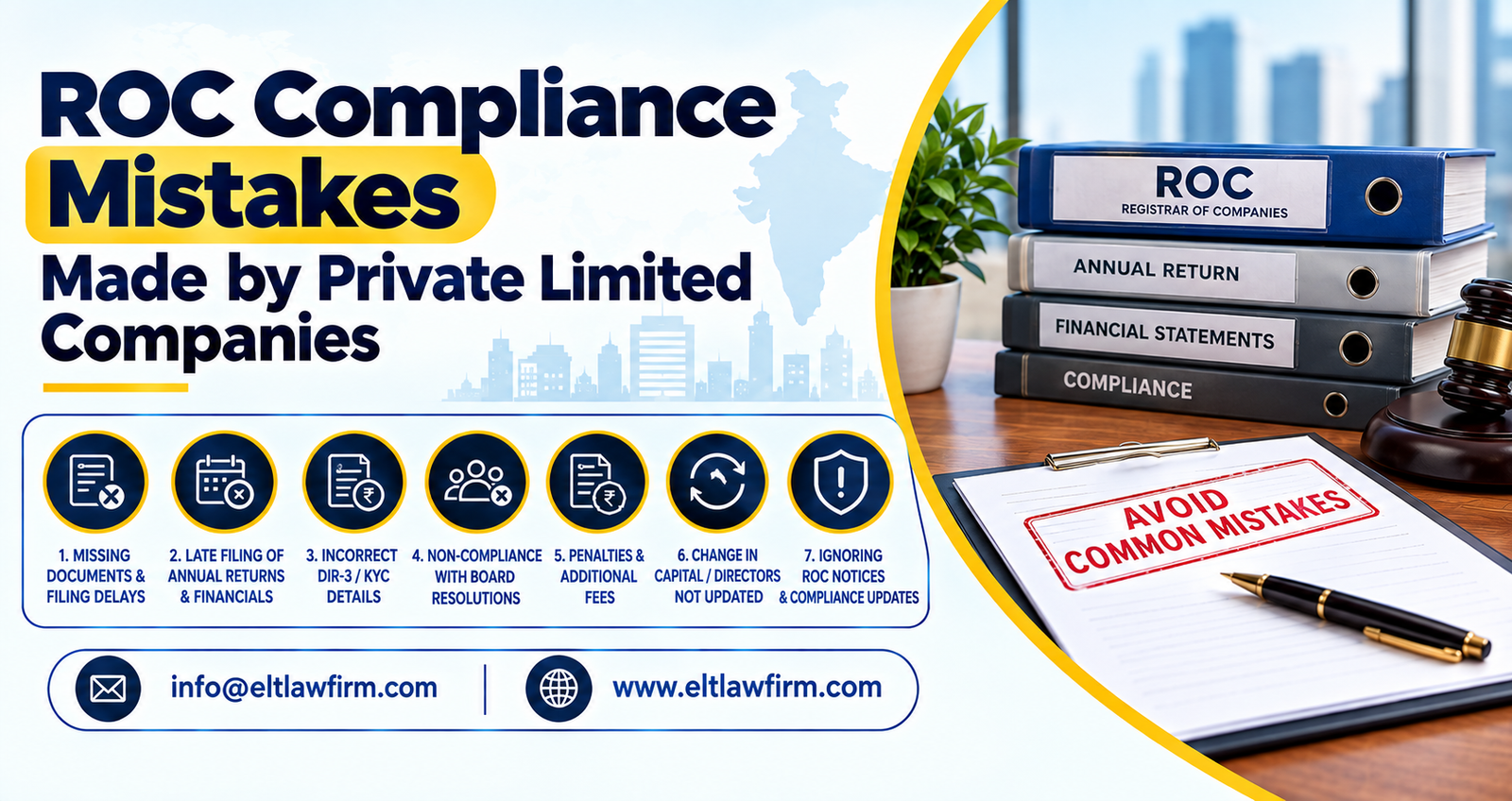
Introduction
Most private limited companies in India are set up carefully. The incorporation documents are filed correctly, the PAN and GST registrations are obtained, and the bank account is opened. And then, as the business gets busy, compliance quietly falls behind.
ROC compliance — filings and obligations under the Companies Act, 2013 administered by the Registrar of Companies — is one of the most routinely neglected areas of corporate governance in Indian private companies. Annual returns are filed months late. Board meetings are not held at the required intervals. Statutory registers are not maintained or are maintained incorrectly. DIR-3 KYC is forgotten until a DIN deactivation notice arrives. And because the consequences do not arrive immediately, the problem compounds quietly until it surfaces in a due diligence process, a bank loan application, or a show-cause notice from the ROC.
This article covers the most common ROC compliance mistakes made by private limited companies, what each one costs, and how to fix them. It is written for directors, founders and company secretaries who want to understand their obligations clearly and practically — not in the language of the statute, but in the language of what actually needs to be done and when.
Why ROC Compliance Is More Serious Than Most Directors Realise
Proper ROC compliance helps companies avoid unnecessary filing issues and regulatory complications.
The most common misconception about ROC compliance is that the consequences are purely financial — a late filing fee that can be paid later. This is wrong on two levels.
First, the financial cost compounds faster than most people expect. Late filing fees under the Companies Act are not fixed amounts — they are calculated per day of default. For certain forms, the additional fee is INR 100 per day with no cap. A form that was due in October and is filed the following September has accumulated over INR 36,000 in late fees on that form alone. Multiply that across multiple forms for multiple years and the accumulated arrears can run into lakhs before the company realises it.
Second, and far more seriously, ROC compliance failures have personal consequences for directors that go beyond money. A director of a company that defaults on its annual filings for three consecutive years can be disqualified from acting as a director of any Indian company for five years under Section 164(2) of the Companies Act. This is not a theoretical risk — the Ministry of Corporate Affairs has run disqualification drives that have disqualified lakhs of directors across the country. A disqualified director cannot sign board resolutions, cannot be appointed to any new board, and cannot hold existing directorships — a career-ending outcome for a professional director or a founder who sits on multiple boards.
Third, a company that does not file its annual returns for two consecutive years is at risk of being struck off the register by the ROC under Section 248. A struck-off company’s assets vest in the government, and the directors face disqualification. Restoring a struck-off company is possible but requires a petition to the NCLT — a slow, expensive process.
Mistake 1 — Missing or Late Annual Filings
These filings are a core part of ROC compliance for private limited companies.
The two most important annual filings for a private limited company are AOC-4 (financial statements) and MGT-7 or MGT-7A (annual return). These two forms, filed with the ROC through the MCA21 portal, are the company’s primary annual statutory disclosures and the first thing any due diligence process checks.
AOC-4 must be filed within 30 days of the Annual General Meeting. The AGM itself must be held by 30 September each year (within six months of the end of the financial year ending 31 March). So in practice, AOC-4 must be filed by 30 October at the latest for a company that holds its AGM at the last possible date. Companies that do not hold the AGM on time compound the problem — the AOC-4 due date moves, but the penalty for not holding the AGM also begins to accrue.
MGT-7 (for most private companies) or MGT-7A (for small companies and OPCs) must be filed within 60 days of the AGM — so by 29 November at the latest, where the AGM is held on 30 September. MGT-7A was introduced specifically to simplify annual return compliance for small companies by allowing a condensed disclosure format.
The additional fee for late filing of both AOC-4 and MGT-7 is INR 100 per day of default. There is no cap. A company that is six months late on both forms has accumulated approximately INR 18,000 in additional fees on AOC-4 and INR 18,000 on MGT-7 — INR 36,000 before any other defaults are considered. A company that is two or three years behind faces tens of thousands in accumulated late fees on these two forms alone, plus the additional consequences discussed below.
⚠ A company that has not filed AOC-4 or MGT-7 for two or more consecutive years is a candidate for ROC strike-off action under Section 248 of the Companies Act. Non-filing also triggers director disqualification under Section 164(2) if it continues for three consecutive years. Do not treat annual filing delays as a minor administrative issue — they are the gateway to the most serious compliance consequences a private company faces.
Mistake 2 — Not Holding Board Meetings as Required
Following the required meeting rules is also an important part of ROC compliance.
Section 173 of the Companies Act requires every company to hold at least four board meetings per year, with no more than 120 days between consecutive meetings. For a private company with only two directors, this means four meetings every calendar year, with none of the gaps between them exceeding four months.
This is one of the most routinely violated ROC compliance requirements in Indian private companies, particularly in startups and small businesses where the two co-founder directors are effectively running the same office and find formal board meetings unnecessary. The operational reality is understandable — but the legal reality is that decisions made without a valid board meeting are not validly made by the company. Contracts signed, loans taken, investments approved, employees hired without the required board authorisation all carry a legal irregularity that surfaces in due diligence.
The first board meeting of a newly incorporated company must be held within 30 days of incorporation — not 30 days from the first financial year, but 30 days from the date on the Certificate of Incorporation. Companies that incorporate in October and plan to start operations in January frequently miss this first meeting.
Each board meeting must have a quorum of one-third of the total directors or two directors, whichever is higher. For a two-director company, both directors must be present for the meeting to be valid. For a company with three or more directors, two directors constitute a quorum. A meeting held without quorum is not a valid board meeting.
Notice of board meetings must be given to every director at least seven days before the meeting. Emergency meetings can be called at shorter notice if the majority of directors consent. Board meetings can be held by video conferencing for most matters, but certain matters — approval of financial statements, approval of the Board Report, decisions relating to amalgamation or reconstruction — cannot be transacted by circular resolution and require a properly called meeting.
Minutes of every board meeting must be maintained in a bound book or digital equivalent, numbered consecutively, and signed by the chairman of the meeting or the chairman of the next meeting, within 30 days of the meeting. Minutes of a meeting not signed within 30 days create a compliance gap on the statutory record.
Board meeting compliance is not just about ticking the four-meeting box. Every significant decision the company makes — borrowing money, signing major contracts, issuing shares, appointing auditors, approving related-party transactions — must be backed by a valid board resolution passed at a properly convened meeting. A board resolution that cannot be defended procedurally is a defective authorisation for the underlying transaction.
Mistake 3 — Skipping or Defective AGMs
The Annual General Meeting is the shareholders’ equivalent of the board meeting — the annual occasion on which the company presents its financial statements to its shareholders, has its auditor appointed or re-appointed, declares dividends (if any) and conducts whatever other business is on the agenda. For a wholly owned subsidiary with a single foreign parent shareholder and no minority, the AGM may feel like an irrelevant formality. It is not.
Section 96 of the Companies Act requires every private company to hold its first AGM within nine months of the end of its first financial year, and subsequent AGMs within six months of the end of each financial year. For most companies with an April-to-March financial year, the AGM must be held by 30 September each year. The gap between two consecutive AGMs cannot exceed fifteen months.
Not holding the AGM on time is an offence under Section 99 of the Companies Act. The company and every officer in default are liable to a fine. More practically, not holding the AGM on time delays the signing and filing of the financial statements, which in turn delays the AOC-4 filing, which in turn accumulates late fees and creates the annual return backlog.
A defective AGM is as problematic as a missed one. Common AGM defects include: notice not given to all shareholders in the prescribed form with the required 21 clear days’ notice; quorum not present (for a private company, two members present in person constitute quorum); chairman of the meeting not properly elected; resolutions not passed in the correct form (ordinary resolution vs special resolution); and minutes not maintained or not signed within 30 days. Any of these defects means the business transacted at the AGM — including the adoption of financial statements and the appointment of the auditor — may not be validly transacted.
Mistake 4 — Not Maintaining Statutory Registers
Maintaining these records properly supports ongoing ROC compliance.
Every private limited company is required to maintain a set of statutory registers — physical or electronic records that document the company’s key corporate information. These are not just paper exercises; they are the primary evidence of a company’s corporate history and are required to be produced during ROC inspections, due diligence, and legal proceedings.
The statutory registers that every private company must maintain include the Register of Members (Form MGT-1), which records the name, address, shareholding and folio number of every shareholder, including all historical transfers and transmissions.
The Register of Directors and Key Managerial Personnel (Form MBP-1) records the details of every director and KMP including their other directorships, shareholding in the company, and changes over time.
The Register of Contracts or Arrangements in which Directors are Interested (Form MBP-4) records every contract or arrangement in which a director has a direct or indirect interest, which must be disclosed to the board under Section 184.
The Register of Loans, Guarantees, Security and Acquisition (Form MBP-2) records all loans given by the company to other entities, guarantees provided, and investments made.
The Register of Charges records every charge created on the company’s assets, which must also be registered with the ROC within 30 days of creation.
Mistake 5 — Missing DIR-3 KYC
DIR-3 KYC should therefore be treated as an important ROC compliance requirement.
DIR-3 KYC is an annual compliance requirement for every individual who holds a Director Identification Number (DIN), whether or not they are currently an active director. The filing must be done once every financial year, by 30 September, through the MCA21 portal using the director’s own DSC. For directors who already have a validated mobile number and email address on MCA record, the web-based DIR-3 KYC form is used. For directors with updated records, the e-form DIR-3 KYC is used.
The consequence of missing the DIR-3 KYC deadline is immediate and severe: the DIN is deactivated. A deactivated DIN means the director cannot digitally sign any MCA filing, cannot be named in any board resolution or annual return, and cannot be appointed to any board. The company cannot file any form requiring a digital signature from that director — including the AOC-4, MGT-7, and any other compliance filing — until the DIN is reactivated.
DIN reactivation requires filing the DIR-3 KYC form with a late fee of INR 5,000. This is a flat fee, not a per-day charge, so the cost is capped — but the disruption is significant. If the company’s only signing director has a deactivated DIN, the company is effectively frozen from making any MCA filing until the DIN is reactivated.
This is one of the most commonly missed annual requirements because it does not appear on standard compliance calendars drafted by accountants who focus on tax filings. Directors who moved on from active management, who hold nominal directorships in group companies, or who are foreign nationals managing Indian subsidiaries from overseas, are the most frequent defaulters. The 30 September deadline aligns with the AGM deadline and the financial statement filing season — a period when compliance teams are busy with other things and DIR-3 KYC can slip through.
Mistake 6 — Defective Board Reports and Financial Statements
Accurate reports and financial statements are essential for proper ROC compliance.
The Board Report is the directors’ annual statement to the shareholders, required under Section 134 of the Companies Act. It must accompany the financial statements laid before the AGM and contains mandatory disclosures specified by the Act and the Companies (Accounts) Rules, 2014. It is not a marketing document — it is a statutory disclosure, and omissions or inaccuracies in it are contraventions.
The mandatory contents of a Board Report for a private company include an extract of the annual return, the number of board meetings held during the year, directors’ responsibility statements confirming that the financial statements have been prepared in accordance with applicable accounting standards, that proper books of account have been maintained, that the internal financial controls are adequate, and that the applicable laws have been complied with. It must also disclose details of loans, guarantees and investments made under Section 186, the policy on related-party transactions, the conservation of energy and technology absorption statement (where applicable), and the explanation for any adverse auditor observations.
The most common Board Report defects are omissions rather than false statements. Companies copy last year’s Board Report and change the date without updating the disclosures. The number of board meetings stated in the report does not match the minutes book. The directors’ responsibility statement is copied without the directors actually confirming its contents. Related-party transactions are not disclosed because the directors are not aware that transactions with associated entities are related-party transactions requiring disclosure.
Financial statements that are not prepared in accordance with the applicable accounting standards — Indian Accounting Standards (Ind AS) for companies above the threshold, or Accounting Standards (AS) for others — or that contain errors in the presentation of share capital, reserves or related-party balances, are a common source of auditor qualifications. An auditor qualification must be explained in the Board Report. A Board Report that does not address an auditor qualification that appears in the audit report is itself defective.
Mistake 7 — Ignoring Strike-Off Risk
Section 248 of the Companies Act empowers the ROC to strike off a company from the register of companies if the ROC has reasonable cause to believe that the company is not carrying on any business or operation, or has not filed its financial statements or annual return for two or more consecutive years.
The strike-off process begins with a show-cause notice to the company and its directors at the registered office. If the company does not respond or does not provide a satisfactory explanation, the ROC publishes a notice in the Official Gazette and strikes off the name. Once struck off, the company ceases to exist as a legal entity. Its assets (if any) vest in the Crown — effectively, the Government of India. The directors of a struck-off company are disqualified under Section 164(2).
Strike-off is not only triggered by regulatory action — but companies can also file for voluntary strike-off under Section 248(2) if they have not commenced business within one year of incorporation or have not carried on business for two or more immediately preceding financial years. But the danger for most companies is involuntary strike-off triggered by non-filing, which arrives without warning if the registered office address is wrong or the directors are not monitoring communications from the ROC.
Restoration of a struck-off company is possible under Section 252 by filing a petition before the NCLT within twenty years of strike-off. But the NCLT process is slow, requires a hearing, and in the meantime the company cannot trade, collect debts or defend legal proceedings in its own name. Preventing strike-off by maintaining current annual filings is incomparably easier than restoring a struck-off company.
Director Disqualification Under Section 164
Section 164(2) of the Companies Act is the provision that most directors are not aware of until it affects them. It provides that a person shall be disqualified from being appointed or reappointed as a director of any company if they are, or have been, a director of a company that has not filed its financial statements or annual returns for any continuous period of three years.
The disqualification is automatic — it does not require a court order or an ROC notice. The moment the three-year period of default is completed, the director is disqualified by operation of law. The disqualification lasts for five years from the date on which the disqualification accrues.
During the period of disqualification, the director cannot be appointed to any new board, cannot continue as a director of any other company (not just the defaulting company), cannot sign any board resolution or MCA filing in a director capacity, and cannot be named as a director in the annual return of any company. A disqualified director who continues to act as a director of a company — even a company that is itself compliant — is committing an offence under Section 167 of the Companies Act.
⚠ The Ministry of Corporate Affairs has run multiple mass disqualification drives — in 2017, 2019 and subsequent years — in which lakhs of DINs were deactivated, and directors were identified as disqualified under Section 164(2). These drives cross-reference MCA annual filing data with the DIN database. A director who is casually attached to a non-compliant company as a nominee or non-executive director faces the same disqualification as the founders. Check your DIN status on the MCA portal and verify the filing status of every company you are associated with.
Late Fees and Penalties: What Non-Compliance Actually Costs
Delayed filings can increase the cost of ROC compliance through additional fees and penalties.
Late fees under the Companies Act are calculated as an “additional fee” on top of the normal filing fee. The additional fee for most ROC forms is INR 100 per day of default, with no cap on the total amount. This means a form that is one year late attracts an additional fee of approximately INR 36,500 on top of the standard fee.
For AOC-4 (financial statements), the standard filing fee depends on the company’s authorised share capital; the additional late fee is INR 100 per day. For MGT-7 and MGT-7A (annual returns), the same structure applies. For DIR-3 KYC, the late fee is a flat INR 5,000 regardless of how late it is. For charge creation forms (CHG-1), the additional fee structure is more complex and can be significantly higher.
Beyond filing fees, the Companies Act prescribes substantive penalties for specific defaults. A company that fails to hold its AGM is liable to a fine of up to INR 1 lakh, with a further INR 5,000 per day for a continuing default after a court order directs the AGM to be held. Failure to maintain proper minutes books attracts a fine on the company and every officer in default of up to INR 25,000. Failure to maintain the register of members attracts a fine on the company and every officer in default of up to INR 50,000, with a further INR 1,000 per day for a continuing default.
For listed companies, the penalties are significantly higher and the ROC has more active enforcement machinery. For private companies, the ROC typically acts through adjudication proceedings under Section 454 of the Companies Act, in which an adjudication officer — a ROC officer — hears the matter and passes a penalty order. Penalty orders can be appealed to the Regional Director. The enforcement environment for private company ROC defaults has become more active since the introduction of e-adjudication, which allows the ROC to process penalty orders more quickly than manual proceedings.
How to Fix Past Defaults
Businesses should review their previous filings and identify any pending ROC compliance requirements.
The approach to fixing ROC defaults depends on the nature and age of the default. There are three routes.
For recent filing defaults — forms that are late but not yet the subject of any ROC notice — the simplest approach is to file immediately with the applicable additional late fee. The MCA21 portal calculates the additional fee automatically based on the date of filing. No prior ROC permission is needed to file a late form. File the overdue forms first, pay the late fees, and then build the compliance calendar to prevent recurrence. The priority sequence should be: DIR-3 KYC first (to reactivate any deactivated DINs), then AOC-4 (financial statements), then MGT-7 (annual return), then any other overdue forms.
For older defaults — companies that have not filed for multiple years — a detailed assessment is needed before filing. Filing out-of-sequence years (for example, filing 2024-25 without filing 2022-23 and 2023-24) can create inconsistencies in the ROC record. The correct approach is to file all outstanding years in chronological order, with all required attachments, and pay the accumulated late fees. Where the accumulated fees are very large, a legal and financial assessment of the company’s compliance position is advisable before filing — because filing makes the default officially on record, and if the company is already subject to ROC inquiry, filing without legal advice can create additional issues.
For companies that are already struck off or are subject to a show-cause notice, the options are: respond to the show-cause notice with a satisfactory explanation and evidence of filings; file a restoration petition under Section 252 before the NCLT if the company is already struck off; or, if the company genuinely no longer needs to operate, apply for voluntary strike-off under Section 248(2) to regularise the position formally. Companies that have been struck off by ROC action (as opposed to voluntary strike-off) face a five-year bar on the directors’ appointment to other boards during the restoration process.
Amnesty and condonation schemes: the government has periodically offered one-time schemes — such as the Companies Fresh Start Scheme (CFSS) — that allow companies to file overdue forms without late fees or with reduced fees. Check whether any such scheme is currently active at the time you are reading this. If one is active, it dramatically reduces the cost of clearing old defaults and should be used immediately.
The Annual Compliance Calendar
A well-maintained calendar makes it easier to manage ROC compliance deadlines.
The most effective way to avoid ROC compliance mistakes is a live compliance calendar — a document that lists every filing obligation, its due date, the responsible person, and the current status, updated throughout the year. This is not a luxury for large companies; it is a basic governance tool for any private company.
The core annual ROC compliance items that every private company must track are as follows.
In April, the company should schedule its board meeting calendar for the year — four meetings, maximum 120 days apart, with notice periods planned in advance. The first meeting of the year should also confirm the auditor’s appointment (or reappointment), review the statutory registers, and address any compliance gaps from the previous year.
By 30 June, the company must hold a board meeting to approve the draft financial statements for the year ending 31 March. The auditor’s report must accompany the financial statements. Any auditor qualifications must be noted and addressed in the Board Report.
By 30 September, the AGM must be held. At the AGM, the financial statements are adopted, the auditor is reappointed, directors due for retirement by rotation are reappointed (if applicable), and any other required resolutions are passed. The 30 September deadline is absolute — missing it requires applying to the ROC for an extension, which is not routinely granted.
By 30 September, DIR-3 KYC must be filed by every DIN holder. This runs in parallel with the AGM and should be treated as a separate calendar item with the same deadline.
By 30 October, AOC-4 must be filed — within 30 days of the AGM.
By 29 November, MGT-7 or MGT-7A must be filed — within 60 days of the AGM.
By 31 December, the company must ensure all statutory registers are current — the Register of Members reflects all share transfers during the year, the Register of Directors is current, and the Register of Contracts has all required entries.
Throughout the year: board meeting notices must go out seven days before each meeting; minutes must be signed within 30 days of each meeting; any charge created on the company’s assets must be registered with the ROC within 30 days of creation; any change in directors, registered office, shareholding above prescribed thresholds or other specified events must be reported to the ROC in the prescribed form within the prescribed time.
The compliance calendar should be maintained by the company secretary or an external compliance professional, reviewed by a director monthly, and treated as a live document — not a once-a-year exercise. The cost of maintaining the calendar is a fraction of the cost of the late fees and legal advice required to fix the defaults that accumulate when it is not maintained.
How ELT Law Partners LLP Can Help
ELT Law Partners LLP provides ROC compliance services for private limited companies, foreign-owned subsidiaries and group companies across India. Our corporate compliance practice covers annual filings — AOC-4, MGT-7 and MGT-7A — board meeting support including notice drafting, agenda preparation and minute writing, AGM management, statutory register maintenance and review, DIR-3 KYC filing for all DIN holders, assessment and regularisation of past defaults including multi-year arrear filings, response to ROC show-cause notices and e-adjudication proceedings, NCLT restoration petitions for struck-off companies, and preparation of annual compliance calendars with ongoing monitoring. We work with founders, company secretaries, CFOs, and board teams to ensure that compliance obligations are met as a routine, not managed as a crisis.
Conclusion
Maintaining ROC compliance regularly can help a company keep its statutory filings and records up to date.
ROC compliance for a private limited company is not complicated. The obligations are well-defined, the deadlines are fixed, and the forms are standardised. What makes it go wrong is not complexity — it is the absence of a system. When compliance is no one’s specific job, when the company secretary changes and the calendar does not transfer, when the directors are focused on the business and assume someone else is handling the filings, defaults accumulate quietly until they become expensive or, in serious cases, disqualifying.
The remedy is equally simple: build a compliance calendar, assign ownership of each item, and treat ROC filings as non-negotiable deadlines rather than approximate targets. A company that does this consistently will never face an ROC show-cause notice, will never accumulate material late fees, and will never have a director disqualified under Section 164(2). A company that does not will eventually.
If your company has a compliance backlog, or if you are not certain whether your annual filings are current, contact ELT Law Partners LLP. We will review your MCA filing status, identify the defaults, calculate the costs, and file everything needed to bring the company back to full compliance.
FAQs
Q1. What is the penalty for filing the Annual Return (MGT-7) late?
The additional fee for late filing of MGT-7 is INR 100 per day of default, with no cap on the total amount. A form that is one year late attracts approximately INR 36,500 in additional fees on top of the standard filing fee. For small companies and OPCs that file MGT-7A, the same fee structure applies.
Q2. What happens if a private limited company does not hold its AGM on time?
The company and every officer in default are liable to a fine of up to INR 1 lakh, plus INR 5,000 per day for continuing default after a court order to hold the AGM. The delay also pushes back the AOC-4 and MGT-7 filing deadlines, accumulating additional late fees, and can trigger ROC scrutiny if the pattern continues for two or more years.
Q3. Can a director be disqualified for the company’s ROC compliance failures?
Yes. Under Section 164(2) of the Companies Act, a director of a company that fails to file its financial statements or annual returns for three consecutive years is automatically disqualified from being a director of any company for five years. The disqualification is by operation of law — no court order is needed. A disqualified director who continues to act as a director commits an additional offence under Section 167.
Q4. What is DIR-3 KYC and what happens if it is not filed by 30 September?
DIR-3 KYC is an annual filing that every holder of a Director Identification Number must make to keep their DIN active. The deadline is 30 September each year. Non-filing results in immediate deactivation of the DIN, which prevents the director from signing any MCA filing, board resolution, or company return. Reactivation requires filing the form with a late fee of INR 5,000.
Q5. What are statutory registers and which ones must a private company maintain?
Statutory registers are mandatory company records under the Companies Act. A private company must maintain the Register of Members (MGT-1), Register of Directors and KMP (MBP-1), Register of Contracts in which Directors are Interested (MBP-4), Register of Loans, Guarantees and Investments (MBP-2), and Register of Charges. These must be kept at the registered office, be current and accurate, and be available for inspection.
Q6. What is the minimum number of board meetings required in a year?
Section 173 of the Companies Act requires a minimum of four board meetings per year, with the gap between any two consecutive meetings not exceeding 120 days. The first board meeting must be held within 30 days of incorporation. Each meeting requires proper notice (seven days minimum), quorum and signed minutes within 30 days.
Q7. Can past ROC defaults be regularised and how?
Yes. Recent defaults can be regularised by filing the overdue forms on the MCA21 portal with the applicable additional late fee — no prior permission is needed. Multi-year defaults should be filed in chronological order. Where the ROC has issued a show-cause notice or the company is subject to strike-off action, legal advice is needed before filing. When government condonation schemes such as CFSS are active, they should be used to clear arrears at reduced or zero late fee.
Q8. What is the risk of a company being struck off by the ROC?
Under Section 248, the ROC can strike off a company that has not filed its financial statements or annual returns for two or more consecutive years. Once struck off, the company ceases to exist and its assets vest in the government. Directors of a struck-off company are disqualified. Restoration is possible by NCLT petition within twenty years but is slow and expensive.
Q9. Do small private companies have any compliance relaxations?
Yes. Companies that qualify as “small companies” under Section 2(85) — currently paid-up capital up to INR 4 crore and turnover up to INR 40 crore (thresholds have been revised periodically; verify the current limit) — can file the simplified MGT-7A annual return instead of the full MGT-7. Small companies also have relaxations on certain Board Report disclosures and are exempt from some internal financial controls requirements. However, the core obligations — four board meetings, AGM by 30 September, AOC-4 within 30 days of AGM, DIR-3 KYC by 30 September — apply to all private companies regardless of size.
Q10. What is a compliance calendar and why does every private company need one?
A compliance calendar is a live document listing every statutory filing obligation, its due date, the responsible person, and the current status. It is the most effective tool to prevent ROC defaults. Without a compliance calendar, filings are managed reactively — someone remembers the MGT-7 deadline in November when it was due in September. With one, every obligation has a named owner and a visible deadline. The cost of maintaining a compliance calendar is a fraction of the late fees that accumulate without one.