When a company takes a loan from a bank or financial institution, its directors or promoters may provide a personal guarantee to support the borrowing. If the company fails to repay the loan, the lender may take legal action against the personal guarantor, subject to the guarantee terms and applicable law.
The Personal Guarantor Insolvency Under IBC framework provides a legal process for dealing with insolvency involving individuals who have guaranteed debts of corporate borrowers. It is particularly relevant to company directors, promoters, business owners, and other individuals who have signed personal guarantees..
What Is Personal Guarantor Insolvency Under IBC?
Personal Guarantor Insolvency Under IBC refers to the insolvency resolution and related bankruptcy framework applicable to individuals who have provided personal guarantees for corporate debtors under the Insolvency and Bankruptcy Code, 2016.
A personal guarantor is an individual who promises to meet a borrower’s obligations if the borrower fails to do so, subject to the terms of the guarantee and applicable law.
For example, suppose a company borrows ₹5 crore from a bank, and its director provides a personal guarantee. If the company defaults, the bank may pursue remedies against the company and the guarantor, depending on the circumstances and legal requirements.
The relevant provisions for personal guarantors to corporate debtors came into force on 1 December 2019. The framework includes a specific insolvency resolution process and a separate bankruptcy process.
Why Is Personal Guarantor Insolvency Important Under the IBC?
Why should directors and promoters understand this process?
A personal guarantee can create financial and legal exposure beyond the individual’s role in the company. A company entering insolvency does not automatically mean that the personal guarantor’s obligations disappear.
Understanding Personal Guarantor Insolvency Under IBC can help individuals and businesses:
- Understand the potential consequences of a personal guarantee.
- Respond appropriately to lender notices and legal proceedings.
- Assess the amount claimed by a creditor.
- Prepare relevant financial and legal documents.
- Understand the available legal remedies and resolution procedures.
- Avoid missing important filing deadlines.
The actual liability depends on the guarantee, the underlying debt, applicable law, and the facts of the case.
Who Can Be Treated as a Personal Guarantor Under the IBC?
A person may fall within this framework if they have provided a personal guarantee for a corporate debtor.
Common examples include:
- Directors who personally guarantee company loans.
- Promoters who guarantee borrowing by their companies.
- Business owners who provide personal guarantees to lenders.
- Individuals who sign guarantees supporting corporate credit facilities.
However, a person’s designation alone does not make them a personal guarantor. The guarantee documents and the relevant legal circumstances must be examined.
Does a Company Director Automatically Become Liable for Company Debt?
No. A director does not automatically become personally liable for every company debt merely because of their position.
Personal liability may arise from a personal guarantee or another applicable legal basis. The scope of liability must be assessed by reviewing the relevant documents and law.
What Is the Legal Process for Personal Guarantor Insolvency Under IBC?
The process depends on who initiates the proceedings, the nature of the application, and the circumstances of the case.
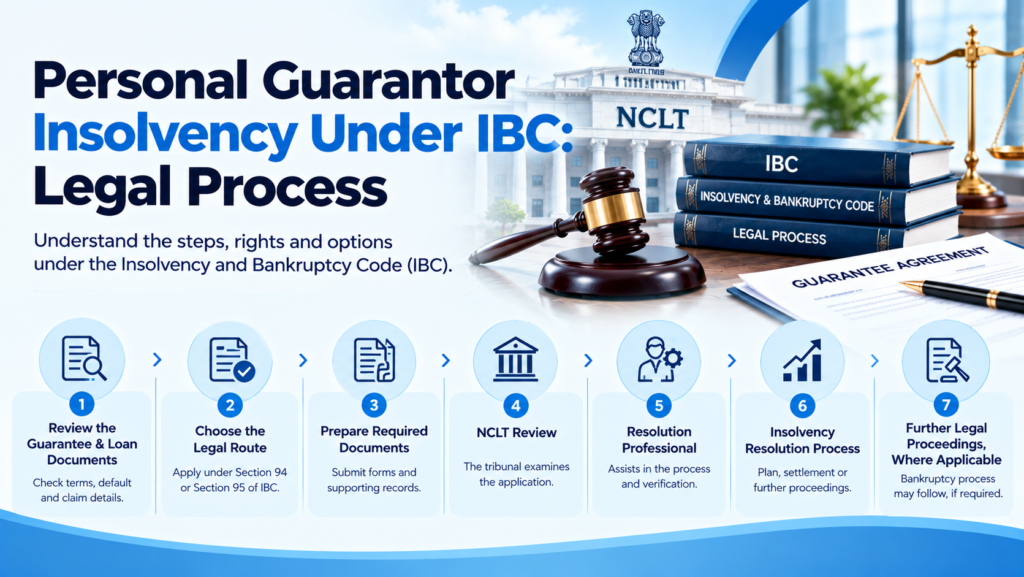
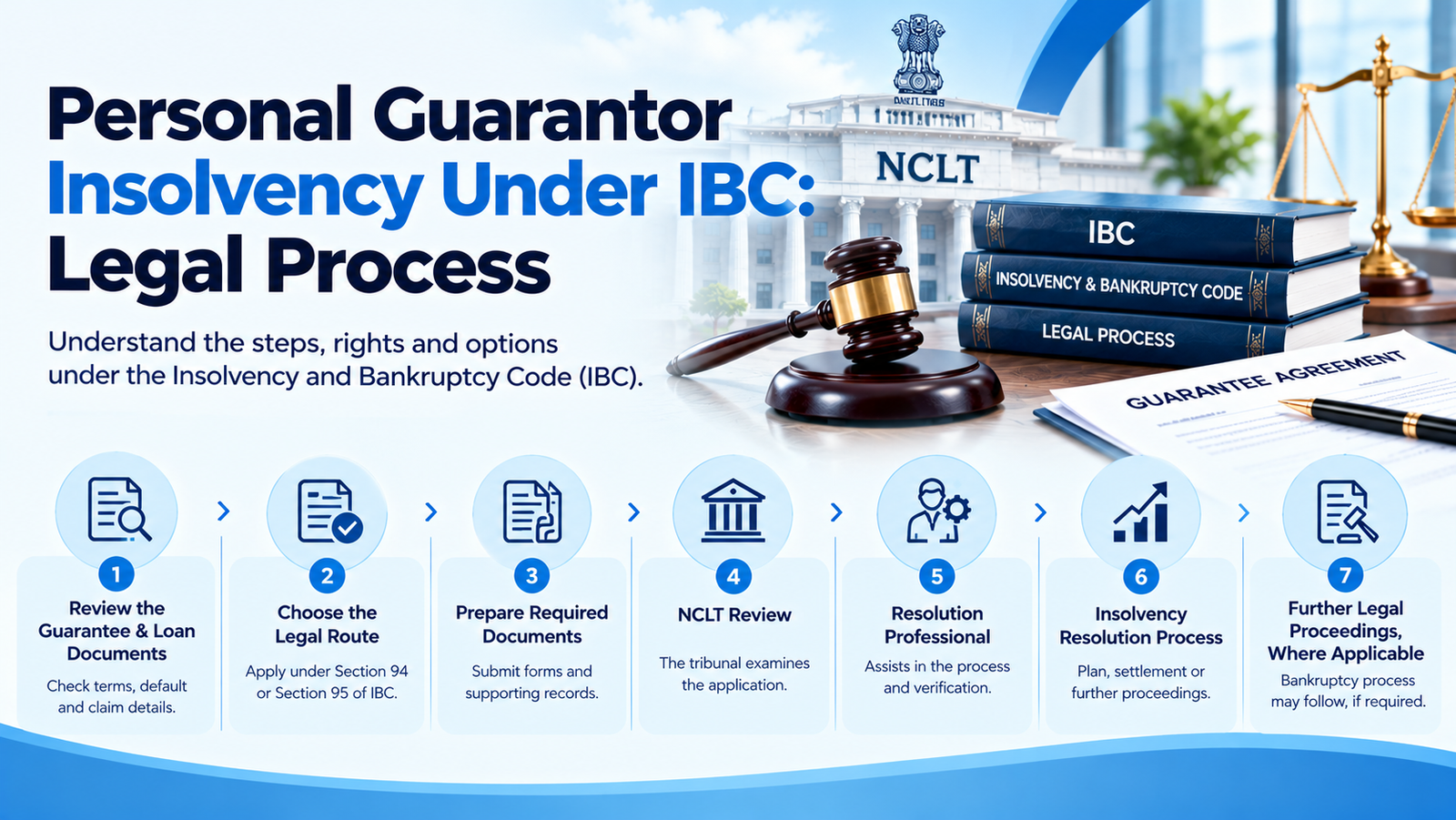
The following steps provide a general overview of the insolvency resolution process.
Step 1: Review the Personal Guarantee and Loan Documents
The first step is to examine the guarantee agreement, loan documents, repayment records, default notices, and the lender’s claim.
This review helps establish the terms of the guarantee, the nature of the alleged default, and the amount being claimed.
Step 2: Determine the Appropriate Legal Route
The Insolvency and Bankruptcy Code provides different application routes for debtors and creditors.
A personal guarantor may apply to initiate an insolvency resolution process under Section 94, while a creditor may apply under Section 95, subject to the applicable statutory requirements. The correct procedure depends on the facts, eligibility, and current law.
Step 3: Prepare the Required Application and Supporting Documents
The applicant must prepare the prescribed application and relevant supporting information.
Depending on the route and current regulations, this may include details of the debt, default, guarantee, financial position, assets, liabilities, and supporting evidence.
The application must follow the applicable rules and filing requirements.
Step 4: Examination by the Appropriate Authority
For personal guarantors to corporate debtors, Section 60 of the IBC provides for the National Company Law Tribunal to act as the adjudicating authority in the circumstances covered by that provision.
The tribunal’s jurisdiction and the procedural requirements should be verified for the specific case.
Step 5: Appointment and Role of the Resolution Professional
Where required under the applicable procedure, a resolution professional is appointed to examine the application and perform the duties assigned under the IBC and relevant regulations.
The professional’s role may include reviewing the application, examining financial information, and carrying out other statutory responsibilities.
Step 6: Consideration of the Insolvency Resolution Process
The process may involve examining claims, reviewing the debtor’s financial position, and considering a repayment plan in accordance with the applicable legal framework.
The outcome depends on the facts, statutory requirements, and decisions made during the proceedings.
Step 7: Further Legal Proceedings, Where Applicable
If the insolvency resolution process does not result in an approved repayment plan, or another statutory condition for further proceedings is met, a bankruptcy process may become relevant.
Bankruptcy is a separate legal process and should not be treated as an automatic outcome in every insolvency case.
Important: The exact steps, forms, deadlines, and consequences should be checked against the latest IBC provisions and IBBI regulations applicable on the filing date. The IBBI has published amendments to the personal guarantor regulations in 2026.
Which Documents Are Required for Personal Guarantor Insolvency?
The documents depend on whether the application is filed by the personal guarantor or the creditor and on the applicable statutory requirements.
Commonly relevant records may include:
| Document | Purpose |
| Personal guarantee agreement | Establishes the guarantee terms |
| Loan or facility agreement | Explains the underlying borrowing |
| Default notice and lender correspondence | Records the alleged default and communications |
| Debt statements and repayment records | Help establish the amount claimed |
| Financial statements and income details | Help explain the guarantor’s financial position |
| Asset and liability details | Support the required financial disclosures |
| Identity and address documents | Help establish the applicant’s identity |
| Court or tribunal orders, where applicable | Provide relevant procedural and case history |
This is a general list, not a complete statutory checklist. Current prescribed forms, disclosures, and supporting documents must be confirmed for the relevant application. The IBBI’s 2026 regulatory amendments and circulars should also be reviewed before filing.
What Are the Consequences of Personal Guarantor Insolvency?
The consequences depend on the legal stage, the terms of the guarantee, and the orders or decisions made in the proceedings.
Potential implications may include:
- Scrutiny of the guarantor’s financial position and assets.
- Legal proceedings concerning the guaranteed debt.
- Requirements to provide financial information and supporting documents.
- Consideration of a repayment plan under the applicable process.
- Further proceedings where the statutory conditions are satisfied.
An insolvency application does not, by itself, establish that every amount claimed by a creditor is correct. The debt, guarantee, and applicable legal issues must be assessed.
Does Corporate Insolvency Automatically Protect a Personal Guarantor?
No. Corporate insolvency proceedings do not automatically remove a personal guarantee or prevent every possible action against the guarantor.
The Supreme Court has considered the legal framework for insolvency proceedings involving personal guarantors to corporate debtors. The effect on an individual case depends on the applicable law and its facts.
A guarantor should obtain legal advice before assuming that proceedings against the company have ended their own obligations.
What Is the Difference Between Personal Guarantor Insolvency and Corporate Insolvency?
Although both processes operate under the IBC framework, they concern different legal persons.
| Personal guarantor insolvency | Corporate insolvency |
| Concerns an individual who has guaranteed corporate debt | Concerns the company or other eligible corporate debtor |
| Examines the individual’s guarantee obligations and financial position | Examines the corporate debtor’s financial position and resolution |
| Follows the applicable personal guarantor provisions and regulations | Follows the applicable corporate insolvency provisions and regulations |
| May involve a personal guarantor resolution or bankruptcy process | May involve corporate resolution or liquidation, as applicable |
The two processes may interact, particularly where proceedings involving the corporate debtor are pending. The appropriate tribunal and procedural route should be assessed under Section 60 and other relevant provisions.
What Legal Rights and Options May Be Available to a Personal Guarantor?
A personal guarantor should not ignore a legal notice or tribunal communication. The available options depend on the facts and procedural stage.
Relevant steps may include:
- Reviewing whether the guarantee covers the amount claimed.
- Checking the lender’s calculation of the outstanding debt.
- Examining whether the applicable procedure has been followed.
- Preparing accurate financial disclosures and supporting records.
- Seeking legal advice on objections, responses, settlement possibilities, or other remedies available under the law.
A guarantor should not transfer or conceal assets to avoid legal obligations. Financial disclosures must be accurate, and any proposed settlement should be assessed carefully.
Conclusion
Personal Guarantor Insolvency Under IBC is an important legal framework for individuals who have guaranteed debts of companies. It establishes a specific process for dealing with insolvency involving personal guarantors to corporate debtors.
Understanding the guarantee agreement, reviewing the debt claim, preparing the necessary financial information, and following the correct legal procedure are essential steps. The consequences vary from case to case, so guarantors should not assume that corporate insolvency automatically removes their personal obligations.
Taking timely professional advice can help individuals understand their rights, responsibilities, and available legal options.
How ELT Corporate Helps with Personal Guarantor Insolvency
ELT Corporate can help individuals and businesses understand the legal and regulatory issues involved in insolvency-related matters through its relevant professional services. For legal representation and case-specific advice, the appropriate legal professional should be engaged.
Depending on the agreed scope of service, support may include:
- Document review: Organising and reviewing guarantee agreements, loan records, notices, and other relevant documents.
- Legal process guidance: Explaining the general insolvency resolution process and the applicable procedural requirements.
- Application preparation support: Helping identify relevant information and documents required for the appropriate legal route.
- Claim assessment: Helping organise information relevant to the creditor’s claim and the guarantor’s financial position.
- Compliance guidance: Identifying applicable procedural requirements and the need to check current IBC and IBBI rules.
- Professional coordination: Helping clients understand when advice or representation from an appropriately qualified insolvency professional or lawyer is needed.
If you are facing a personal guarantee dispute or insolvency-related notice, contact ELT Corporate through ELT Law Firm to enquire about relevant legal support. The availability and scope of assistance should be confirmed directly. No particular case outcome or legal result is guaranteed.
Frequently Asked Questions
Q1. What is personal guarantor insolvency under the IBC?
It is the legal process applicable to individuals who have provided personal guarantees for corporate debtors and who are subject to the relevant insolvency provisions of the Insolvency and Bankruptcy Code, 2016.
Q2. Can a bank initiate insolvency proceedings against a personal guarantor?
A creditor may initiate proceedings under Section 95 of the IBC, subject to the applicable statutory conditions and procedural requirements. Whether a particular application is maintainable depends on the facts and law.
Q3. Which authority handles personal guarantor insolvency cases?
Section 60 of the IBC provides for the NCLT to handle matters concerning personal guarantors to corporate debtors in the circumstances covered by that provision. The correct forum should be verified for the particular case.
Q4. Does a personal guarantor become liable when a company defaults?
A personal guarantee may create liability when the conditions in the guarantee and applicable law are met. The extent of liability depends on the guarantee terms, the debt, and the facts of the case.
Q5. What documents are needed for personal guarantor insolvency?
Relevant documents may include the guarantee agreement, loan documents, default notices, debt statements, financial information, asset disclosures, and prescribed application forms. The exact requirements depend on the application route and current regulations.
Q6. Can personal guarantor insolvency proceedings affect personal assets?
The process may require disclosure and examination of the guarantor’s financial position and assets. The legal effect on particular assets depends on applicable law, the stage of proceedings, and relevant orders.
Q7. Is personal guarantor insolvency the same as corporate insolvency?
No. Corporate insolvency concerns the corporate debtor, while personal guarantor insolvency concerns an individual who has guaranteed the corporate debtor’s obligations. The processes can interact but are governed by the applicable provisions for each.
Q8. How can ELT Corporate help with personal guarantor insolvency matters?
ELT Corporate can be contacted to enquire about relevant legal and compliance support, document organisation, and procedural guidance. Case-specific legal advice and representation should be obtained from an appropriately qualified professional