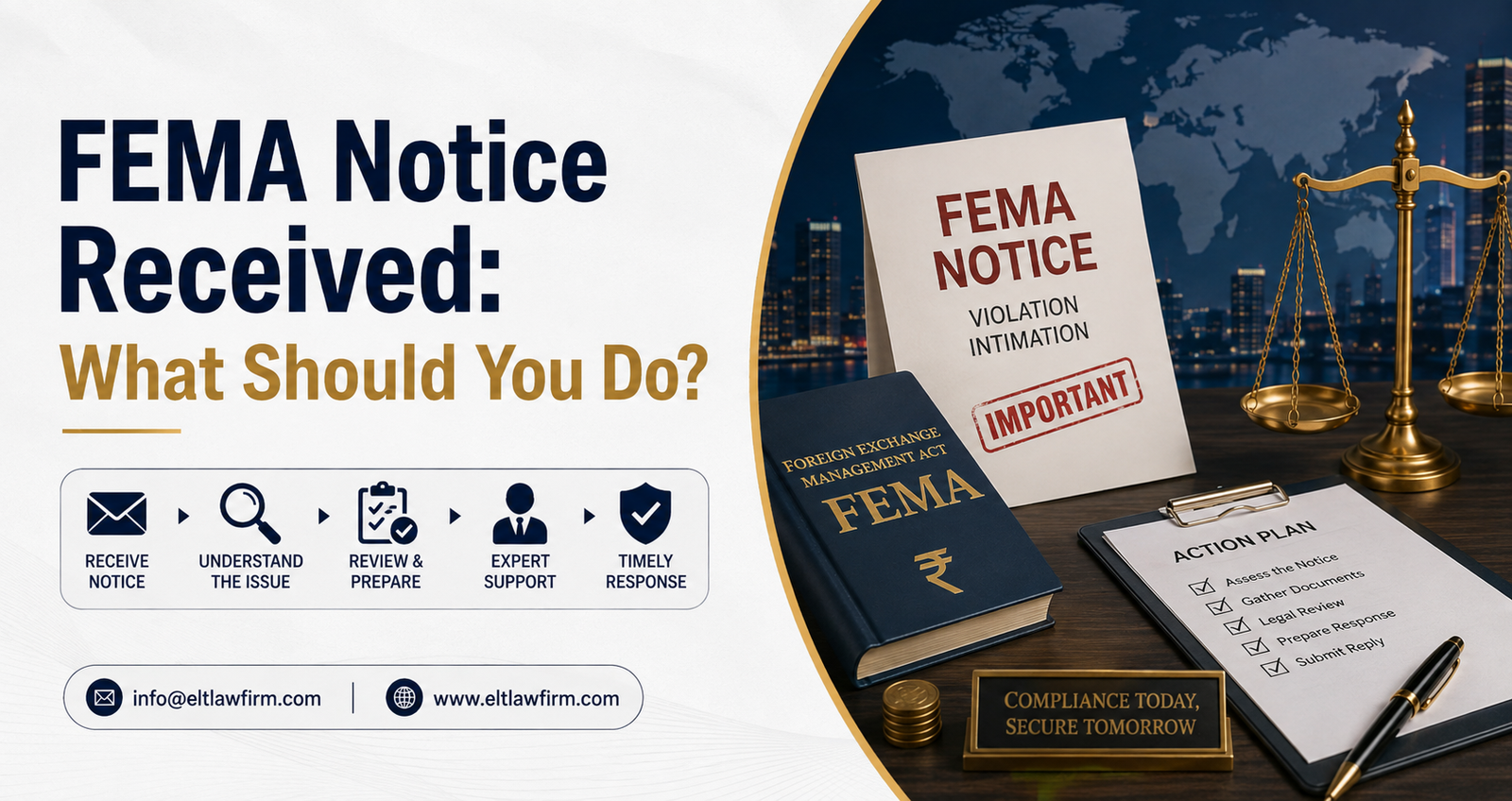
FEMA Notice Received: What Should You Do?
If you have received a FEMA notice from the ED, RBI, or another regulatory authority, it is important to understand the notice and respond within the prescribed time. A proper review of the allegations, supporting documents, and applicable FEMA provisions can help you prepare an appropriate response.
The first thing to remember is: do not panic, but do not ignore the notice either.
A FEMA notice does not automatically mean that you have committed a serious violation. In many situations, the authorities may simply require an explanation, additional documents, clarification about a transaction, or correction of a compliance issue.
The right response depends on the authority that issued the notice, the allegations or questions mentioned in it, the transaction involved, and the documents available in your case.
What Is FEMA?
FEMA stands for the Foreign Exchange Management Act, 1999.
FEMA provides the legal framework for regulating foreign exchange transactions in India. It covers various matters involving foreign exchange and cross-border transactions, including certain foreign investments, remittances, overseas assets, foreign accounts, imports, exports, and other transactions.
For example, FEMA-related questions may arise when a person or company:
Sends money outside India
Receives money from abroad
Makes an overseas investment
Holds certain foreign assets or accounts
Purchases property outside India
Receives foreign investment
Makes cross-border business payments
Has reporting or documentation gaps
Undertakes a transaction that may require regulatory approval
Under FEMA, Section 3 restricts certain dealings in foreign exchange except as permitted under the law and applicable regulations. Section 13 provides for penalties for contraventions.
What Does It Mean If You Receive a FEMA Notice?
Question: Does receiving a FEMA notice mean I have violated the law?
Answer: Not necessarily.
A FEMA notice may be issued because an authority wants more information or an explanation about a particular transaction.
For example, the authority may want to understand:
Where the money came from
Where the money was transferred
Why was the transaction made
Whether the required reporting was completed
Whether supporting documents are available
Whether the transaction complied with FEMA and applicable regulations
Therefore, receiving a notice should be treated seriously, but it should not automatically be viewed as proof that you have committed a violation.
Which Authorities Can Send a FEMA Notice?
A FEMA-related communication may come from different authorities or institutions depending on the nature of the issue.
You may receive communication from or in relation to:
Enforcement Directorate (ED)
Reserve Bank of India (RBI)
An authorised dealer bank
Other competent authorities
Regulatory or investigating authorities dealing with the transaction
The authority and type of communication matter because the appropriate response can differ from case to case.
FEMA Notice Received: What Should You Do?
If you have received a FEMA notice, follow these steps.
1. Read the Notice Carefully
Do not immediately start writing a reply.
First, read the entire notice carefully.
Look for:
Name of the issuing authority
Date of the notice
Reference or case number
Transaction involved
Questions or allegations
Documents requested
Date of appearance, if any
Deadline for submitting a response
Consequences mentioned for non-compliance
Understanding exactly what the authority is asking is the first step toward preparing an appropriate response.
2. Do Not Ignore the Deadline
One of the biggest mistakes you can make after receiving a FEMA notice is simply doing nothing.
Your notice may provide a specific period within which you must:
Submit a written reply
Provide documents
Attend a hearing
Appear before an authority
Provide additional information
Your response should be prepared and submitted within the applicable deadline unless an extension or other relief is appropriately sought.
ELT Law Partners also notes that FEMA notices commonly require a response within a specified period and may require supporting transaction and compliance documents.
3. Identify the Transaction Mentioned in the Notice
Question: Why is identifying the transaction important?
Answer: Because your response needs to explain the facts accurately.
Try to identify:
Date of the transaction
Amount involved
Sender
Recipient
Bank used
Purpose of payment
Source of funds
Documents connected with the transaction
Applicable filings or approvals
Do not rely only on memory.
Bank statements, invoices, agreements, tax documents, investment records, and other financial records can help you understand what actually happened.
4. Collect All Relevant Documents
A strong FEMA notice response is usually supported by documents.
Depending on your case, you may need documents such as:
Bank statements
Foreign bank statements
Remittance records
Invoices
Contracts
Investment documents
Shareholding documents
Loan agreements
Property documents
Tax returns
Form filings
RBI-related correspondence
FEMA compliance documents
Foreign investment records
Proof of source of funds
Correspondence with banks
Earlier regulatory approvals or permissions
Your documents should tell a clear and consistent story.
5. Understand Why the Notice Was Issued
Question: What are common reasons for receiving a FEMA notice?
Answer: The reason can vary significantly.
Some common issues include:
Foreign Investment Issues
A company or individual may face questions about foreign investment, ownership, reporting, valuation, or related documentation.
Overseas Investment Issues
Questions may arise regarding investments or transactions involving an overseas company or asset.
Foreign Bank Accounts
An authority may ask for information regarding certain foreign accounts, transactions, or balances.
Cross-Border Payments
A payment to or from another country may require clarification regarding its purpose, source, recipient, or documentation.
Reporting Delays
A transaction may have been completed, but a required filing or reporting obligation may have been delayed or missed.
Documentation Problems
Sometimes the underlying transaction may be explainable, but the supporting records may be incomplete.
This is why it is important to examine the specific facts of your case rather than assuming that every FEMA notice involves the same issue.
6. Prepare a Clear FEMA Notice Reply
Your reply should be:
Accurate
Clear
Fact-based
Properly documented
Consistent with your financial records
Limited to relevant information
Submitted within the applicable timeline
Avoid emotional explanations or unnecessary statements.
A FEMA notice response should directly address the questions or allegations raised by the authority.
A well-prepared reply may explain:
What happened → Why it happened → Documents supporting it → Applicable compliance position → Corrective action, if required.
7. Do Not Submit an Inaccurate Explanation
Question: Can I simply give the explanation that seems most convenient?
Answer: No.
You should never provide a false, incomplete, or misleading explanation to an authority.
If there is a mistake in your previous filing or transaction, it is generally better to identify the issue and obtain professional advice about the appropriate way to address it.
Inconsistencies between your reply, bank records, tax records, and other documents can create additional complications.
8. Consider Speaking to a FEMA Lawyer
Question: When should I consult a FEMA lawyer?
Answer: You should consider obtaining legal advice, particularly when:
The notice is issued by the ED
A significant amount of money is involved
You are accused of a FEMA contravention
You are asked to appear personally
Foreign assets or investments are involved
There are multiple transactions
You have missing or delayed filings
You are unsure about the legal position
A penalty or adjudication proceeding may follow
You are considering compounding
Professional advice can help you understand the notice before you submit your response.
What Documents Should You Keep Ready for a FEMA Notice?
A practical document checklist may include:
| Document | Why It May Be Relevant |
| Bank statements | Shows movement of funds |
| Remittance documents | Explains cross-border transfers |
| Invoices | Supports business transactions |
| Contracts | Explains contractual relationships |
| Investment documents | Supports investment details |
| Tax records | Helps establish financial background |
| Foreign account records | Helps explain overseas transactions |
| FEMA/RBI filings | Shows regulatory compliance |
| Ownership documents | Helps establish ownership structure |
| Correspondence | Provides transaction history |
The exact documents required will depend on the notice and the transaction.
What Happens After You Submit a FEMA Notice Reply?
Question: Is the case automatically closed after I submit my reply?
Answer: Not necessarily.
After receiving your response, the relevant authority may review:
Your explanation
Supporting documents
Transaction records
Applicable FEMA provisions
Compliance history
Nature of the alleged contravention
Depending on the circumstances, the matter may be resolved, further information may be requested, or proceedings may continue.
ELT Law Partners explains that FEMA matters can involve review of the transaction, documentation, and compliance position and, depending on the circumstances, may proceed toward adjudication, penalty, or compounding.
What Happens If You Ignore a FEMA Notice?
Ignoring a FEMA notice is generally not a good strategy.
Failure to respond may mean that the authority proceeds based on the material available to it.
Depending on the nature of the proceedings, this can make it more difficult to properly present your explanation and supporting evidence.
In simple words:
Do not ignore the notice.
If you cannot respond within the given time, seek professional advice immediately about the available options, including whether an extension or other procedural step may be appropriate.
Can a FEMA Violation Be Compounded?
Question: What is FEMA compounding?
Answer: In eligible cases, compounding provides a mechanism for resolving certain FEMA contraventions by paying an amount determined by the competent authority, subject to the applicable legal framework and procedure.
Compounding is not something that should be assumed to be available in every situation.
Whether it is appropriate depends on factors such as:
Nature of the contravention
Facts of the transaction
Applicable regulations
Documents available
Previous compliance
Relevant procedural requirements
Therefore, you should first understand the nature of the alleged FEMA violation before deciding whether compounding is appropriate.
Can Past FEMA Non-Compliance Be Corrected?
Question: What if I made a FEMA compliance mistake several years ago?
Answer: A past compliance issue does not necessarily mean that the situation cannot be addressed.
Depending on the facts, possible steps may include:
Completing pending documentation
Correcting reporting issues
Making appropriate filings
Seeking professional advice
Applying for compounding where legally available
Responding to regulatory correspondence
Making representations before the relevant authority
The correct solution depends on the particular transaction and applicable rules.
What Should You NOT Do After Receiving a FEMA Notice?
Avoid these common mistakes:
Do not ignore the notice
A deadline may be important.
Do not destroy or alter documents
Keep all original records safely.
Do not submit a rushed reply
A quick response is not always a good response.
Do not guess facts
Verify dates, amounts, and transactions from actual records.
Do not provide false information
Your reply should be truthful and supported by documents.
Do not assume every FEMA notice is the same
The legal and factual position can vary significantly.
Do not wait until the last day
Legal review and document collection can take time.
FEMA Notice vs. FEMA Summons: Are They the Same?
Question: Is a FEMA notice the same as an ED summons?
Answer: No.
A notice and a summons can serve different purposes and have different procedural implications.
A notice may ask you to provide an explanation, documents, or information. A summons may require a person to appear before an authority and/or provide information or documents.
If you receive a summons from the Enforcement Directorate, you should take it seriously and obtain appropriate legal advice before appearing or responding.
How Can a FEMA Lawyer Help?
A FEMA lawyer can assist with different stages of the matter, including:
Notice Review
Reviewing the notice and explaining what the authority is asking.
Transaction Analysis
Examining the relevant financial and cross-border transactions.
Document Review
Checking whether your supporting documents are complete and consistent.
FEMA Notice Reply
Preparing a clear and legally appropriate response.
Representation
Representing or assisting you in proceedings before the relevant authority, where appropriate.
Compounding
Advising on the possibility and process of compounding an eligible contravention.
Compliance Correction
Helping identify and address past compliance gaps.
ELT Law Partners states that its FEMA practice includes transaction analysis, preparation of responses, representation before authorities, compounding applications where appropriate, and assistance with regularising past non-compliances.
Why Early Legal Advice Matters in a FEMA Matter
A FEMA matter can involve complicated financial transactions, multiple documents, and regulatory requirements.
Getting advice early can help you:
Understand the notice
Identify the real issue
Preserve important evidence
Organise financial documents
Avoid inconsistent explanations
Prepare a focused reply
Understand potential consequences
Evaluate available legal options
The earlier you understand the issue, the more effectively you can plan your response.
Final Takeaway: Received a FEMA Notice? Don’t Panic—Don’t Ignore It.
Receiving a FEMA notice does not automatically mean that you have committed a serious offence or that a penalty is unavoidable.
However, it is important to take the notice seriously.
Start by:
Reading the notice carefully.
Checking the response deadline.
Identifying the transaction involved.
Collecting relevant financial and legal documents.
Understanding the issue raised by the authority.
Preparing an accurate and properly supported response.
Taking professional legal advice where necessary.
The right approach can make a significant difference in how a FEMA matter is handled.
If you have received a FEMA notice, summons, inquiry, or communication relating to foreign exchange compliance, professional legal guidance can help you understand the issue and determine the appropriate next step.
Contact ELT Law Partners for FEMA Legal Assistance
Q1. What should I do immediately after receiving a FEMA notice?
Read the notice carefully, identify the deadline, preserve all relevant documents, and seek professional advice if the matter is complex or potentially serious.
Q2. Does a FEMA notice mean I will have to pay a penalty?
Not automatically. The outcome depends on the facts, nature of the alleged contravention, evidence, applicable law, and proceedings.
Q3. Can I reply to a FEMA notice myself?
You may be able to respond yourself in some straightforward situations. However, professional legal advice can be valuable where the notice involves significant transactions, alleged violations, ED proceedings or potential penalties.
Q4. What documents are needed for a FEMA notice reply?
This depends on the matter. Common documents can include bank statements, remittance records, invoices, contracts, investment records, tax documents, and FEMA/RBI filings.
Q5. What happens if I miss the FEMA notice deadline?
Do not simply ignore the situation. Obtain legal advice immediately about the procedural options available in your case.
Q6. Can FEMA impose a penalty?
Yes. FEMA provides for penalties for certain contraventions. The applicable amount depends on the nature and circumstances of the contravention.
Q7. Can a FEMA case be settled through compounding?
Certain eligible FEMA contraventions may be capable of being compounded under the applicable legal framework. Eligibility and procedure must be assessed based on the specific facts.
Q8. Can a company receive a FEMA notice?
Yes. FEMA-related proceedings and compliance issues can involve companies as well as individuals, depending on the transaction and circumstances.
Q9. What if my FEMA notice involves an overseas bank account?
You should collect the relevant account statements, transaction history, source-of-funds information, and other supporting documents. The legal position will depend on the nature of the account and transaction.
Q10. Should I contact a FEMA lawyer after receiving an ED notice?
If the notice involves the Enforcement Directorate, significant financial transactions, allegations of contravention, or a requirement to appear, obtaining legal advice promptly can help you understand your rights and obligations and prepare an appropriate response.