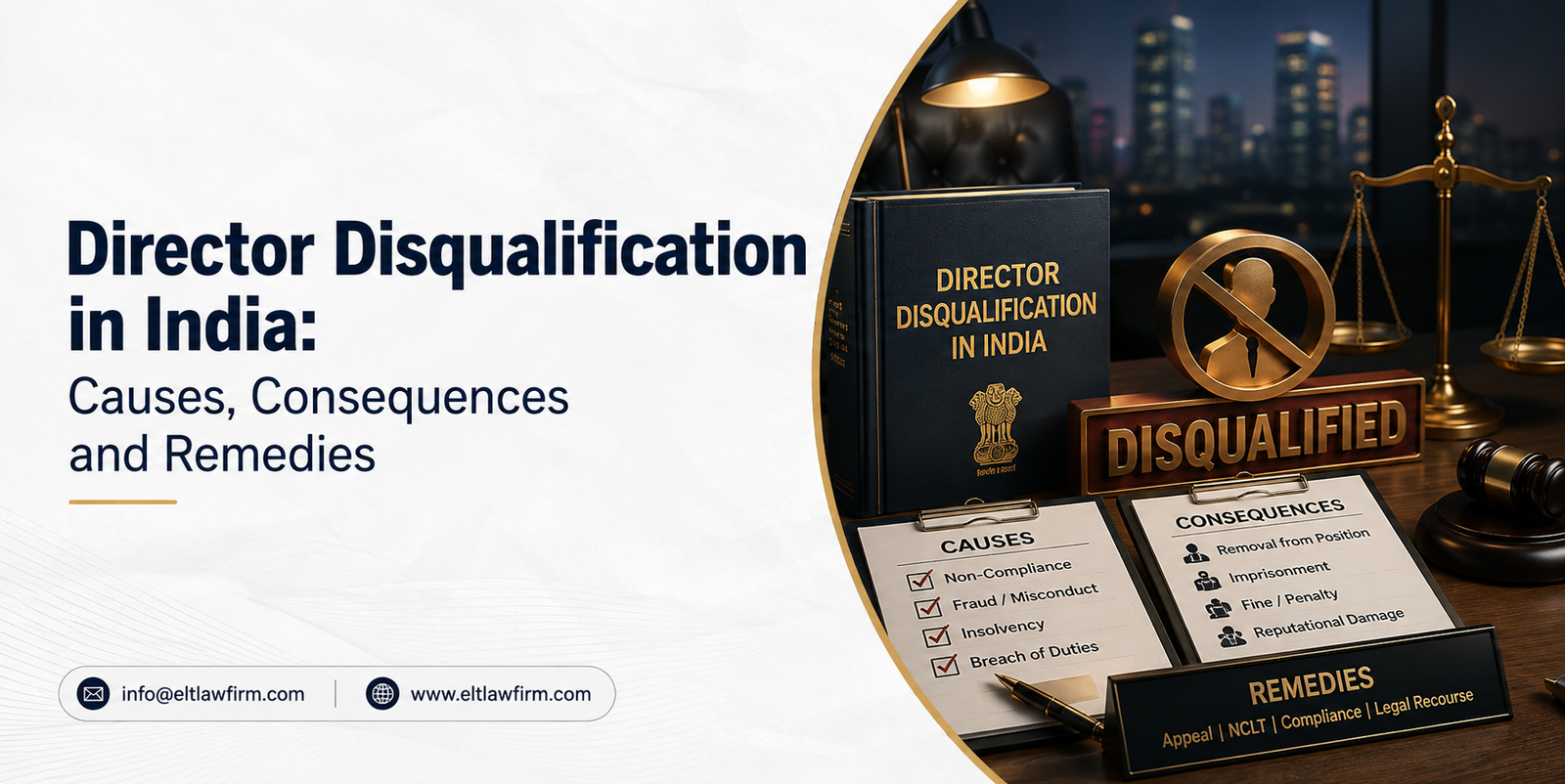
Director disqualification in India can arise from personal grounds under Section 164(1) or company default grounds under Section 164(2), and the applicable remedy depends on the nature of the disqualification.
What Is Director Disqualification?
Disqualification under the Companies Act, 2013 means that a person is legally barred from being appointed or continuing as a director of any company under section 164. Once a person is disqualified, they cannot accept a new directorship, cannot continue existing directorships (other than in the defaulting company itself in some circumstances), and cannot sign board resolutions or company filings in a director capacity.
Disqualification is different from removal. Removal under Section 169 is an act of the shareholders — they vote a director out. Disqualification under Section 164 is a legal status that attaches to the individual automatically or by order, regardless of what the shareholders want. A disqualified director who is not removed is still legally disqualified; their signature on any board document after the date of disqualification is the signature of an unauthorised person.
Two Tracks: Section 164(1) and Section 164(2)
Section 164 creates two completely different disqualification tracks. Confusing them leads to wrong advice about remedies, because the cause and the cure are different in each track.
Section 164(1) lists personal grounds — things the individual director did or had done to them. These include being of unsound mind as declared by a court, being an undischarged insolvent, having applied to be adjudicated as insolvent, having been convicted of an offence involving moral turpitude and sentenced to imprisonment of six months or more, having been convicted of an offence under the Companies Act and sentenced to seven years or more, having an order disqualifying them from being a director passed by a court or tribunal, not paid calls in respect of shares held in a company for six months, having been convicted of an offence dealing with related-party transactions under Section 188 in the last five years, and not complying with Section 152(3) (failure to file DIR-12 for DIN).
Section 164(2) is the company default ground. A director is disqualified under this provision if they are, or have been, a director of a company that has not filed its financial statements or annual returns for any continuous period of three years. This provision applies to the director personally, regardless of whether they were responsible for the filing failure. The disqualification attaches to the individual because they held the directorship during the period of default.
⚠ The most important distinction: Section 164(1) disqualification arises from personal conduct and can sometimes be challenged on factual grounds. Section 164(2) disqualification arises from the company’s filing default — the director’s personal innocence is not a statutory defence. High Courts have accepted natural justice arguments (no notice before deactivation) but have not accepted “I did not know” as a ground to set aside the disqualification itself.
Section 164(1) — Individual Grounds
The most practically significant grounds under Section 164(1) for most directors are conviction for an offence involving moral turpitude with a sentence of six months or more and insolvency. These are the grounds that typically arise in criminal prosecution or personal financial failure.
A director convicted under the Companies Act itself for fraud under Section 447 and sentenced to seven years or more is disqualified. This is the criminal fraud track discussed in our article on director liability in financial fraud cases.
A director who has an order of disqualification passed against them by the NCLT — for example, in connection with oppression and mismanagement proceedings under Section 241 — is also disqualified under Section 164(1)(f).
The IBC connection: Section 29A of the Insolvency and Bankruptcy Code creates a separate disqualification regime for resolution applicants. A person who is a promoter or director of a company undergoing insolvency resolution, or who is an undischarged insolvent, or who has been convicted of any offence with imprisonment of two years or more, cannot be a resolution applicant. This is not a Companies Act disqualification but it operates alongside Section 164 in practice.
Disqualification under Section 164(1) lasts for the period specified in the relevant sub-clause — for conviction-based grounds, typically five years from the date of conviction or from release from imprisonment. The director can apply for removal of the disqualification when the specified period expires.
Section 164(2) — Company Default Grounds
This is the provision that has affected the largest number of directors in India and is the most misunderstood.
Section 164(2) provides that no person who is, or has been, a director of a company that has not filed its financial statements or annual returns for any continuous period of three financial years shall be eligible to be reappointed as a director of that company or appointed as a director of any other company for a period of five years from the date on which the said company fails to do so.
Three things about this provision that directors frequently get wrong. First, it is automatic — no court order, no notice, no hearing is required for the disqualification to take effect. The moment the three-year continuous default period is completed, the director is disqualified by operation of law. Second, it applies to every director who was on the board during the default period — not just the director responsible for compliance. A non-executive independent director who attended every meeting, raised concerns and was overruled on compliance matters is disqualified on the same basis as the MD who refused to file. Third, it affects all other companies on which the director sits, not just the defaulting company. A disqualified director cannot continue as a director of any other company — including fully compliant companies with which they have no compliance issues.
The five-year disqualification runs from the date on which the company failed to file — not from the date the director found out, not from the date the MCA deactivated the DIN, and not from the date a court confirmed the disqualification.
The filing history test: a company defaults on financial statements or annual returns for FY 2021-22, FY 2022-23 and FY 2023-24. On the date the FY 2023-24 filing was due and not made, every director who was on the board during any part of this three-year period became disqualified for five years. Any director appointed after the third year of default does not carry the disqualification — but any director present during all three years does.
The MCA Disqualification Drives
In September 2017, the Ministry of Corporate Affairs ran its first major mass disqualification exercise. It identified over 3 lakh directors associated with companies that had not filed annual returns or financial statements for three or more consecutive years, and deactivated their DINs. The exercise was conducted without individual notice to the directors affected — the deactivation was processed centrally through the MCA21 database.
The legal challenge to this process produced a significant body of High Court jurisprudence. Multiple High Courts — Delhi, Bombay, Madras, Calcutta — heard writ petitions from affected directors. The courts held consistently that while the substantive disqualification under Section 164(2) was valid and could not be challenged simply on the ground that the director was not personally responsible for the default, the procedure adopted by the MCA violated principles of natural justice because no notice was given to the directors before their DINs were deactivated. Many courts directed the MCA to give directors an opportunity to be heard before deactivating DINs, and in cases where the company had already filed the outstanding returns (removing the basis for disqualification), courts directed reactivation.
The drives continued in 2019 and subsequently. As of 2026, the MCA continues to run periodic compliance verification exercises cross-referencing filing data with DIN records. The risk of disqualification from the 2017 drive has largely worked through the system, but directors of companies with current filing gaps face the same risk in the next exercise. The MCA now has significantly better data infrastructure than it did in 2017 — detection is faster and more systematic.
Consequences of Disqualification
The immediate consequence of disqualification under Section 164(2) is that the director cannot be appointed to any new board and cannot be re-appointed to the defaulting company’s board. But the more disruptive practical consequence is the impact on existing directorships.
A disqualified director must vacate their office in every company they are associated with, not just the defaulting company. This follows from Section 167(1)(a), which requires a director to vacate office if they become subject to any disqualification under Section 164. The vacation happens automatically on the date the disqualification accrues — it is not triggered by notice and it does not require a board resolution removing the director.
The practical consequences that follow from this are significant. The disqualified director cannot sign any MCA filing. Any annual return, financial statement, or event-based form that requires a director’s digital signature cannot be signed by a disqualified director. If all directors of a company are disqualified simultaneously — which happened to many companies in the 2017 drive — the company cannot make any ROC filing until compliant directors are appointed, which itself requires an MCA filing, creating a circular problem that requires legal intervention to resolve.
The disqualified director also cannot sign any board resolution that requires director authority — loan approvals, banking mandates, contract authorisations, share allotments. Any such resolution signed by a disqualified director after the date of disqualification is signed by an unauthorised person and is legally defective.
Beyond the immediate corporate mechanics, the professional and reputational consequences are severe. A director of a listed company who is disqualified must disclose the disqualification and may be required to resign under SEBI regulations. A partner or director in a professional services firm who holds a disqualified DIN faces practice restriction consequences. And in any due diligence — for a fundraising, M&A transaction or bank loan — disqualified directors are an immediate red flag that delays or kills the transaction.
Impact on DIN
A Director Identification Number is the permanent individual identifier for a director under the Companies Act. When a director is disqualified under Section 164, the MCA deactivates the DIN on the MCA21 portal. A deactivated DIN cannot be used to sign any MCA filing, cannot be used to file DIR-3 KYC, and shows as “Deactivated” in the MCA director search.
It is important to distinguish between two different reasons a DIN can be deactivated. The first is non-filing of DIR-3 KYC — the annual KYC compliance required by 30 September each year. A DIN deactivated for DIR-3 KYC non-filing can be reactivated by filing the DIR-3 KYC form with a late fee of INR 5,000. This is a simple administrative reactivation and does not involve disqualification. The second is deactivation pursuant to disqualification under Section 164(2). This cannot be reversed by paying a fee or filing a form. The DIN remains deactivated for the five-year disqualification period unless the disqualification is successfully challenged in the High Court.
Checking DIN status is straightforward: go to the MCA21 portal, use the Director Details search, and enter the DIN. The status will show as Active, Deactivated, or Disqualified. Every director should check their DIN status periodically — and particularly before any significant transaction, fundraising or board appointment.
Section 167 — The Offence of Acting While Disqualified
Section 167 of the Companies Act provides that a director must vacate office if they become subject to any disqualification under Section 164. Vacation is automatic — it happens on the date the disqualification accrues, not on the date the director learns of it.
A director who continues to act as a director after disqualification — signing board resolutions, attending and voting at board meetings, signing annual returns or financial statements — commits an offence under Section 167(2). The penalty is imprisonment up to one year and a fine between INR 1 lakh and INR 5 lakh. This is a criminal offence, not a civil penalty.
The practical implication is stark: from the date of disqualification, every act the director takes in a director capacity is both legally ineffective and personally criminal. Directors who do not check their status and continue acting are unknowingly accumulating criminal exposure with every board action they take. When this is discovered in a due diligence — and it is increasingly discovered because advisors now routinely check DIN status — it creates a serious problem for the company as well as the individual.
Legal Remedies — How to Challenge or Remove Disqualification
The remedies available depend entirely on whether the disqualification is under Section 164(1) or Section 164(2), and whether it was validly imposed.
Writ Petition to the High Court — for Section 164(2)
The primary remedy for a director disqualified under Section 164(2) who believes the disqualification was wrongly applied or procedurally defective is a writ petition to the High Court under Article 226 of the Constitution. This is not a challenge to Section 164(2) itself — the High Courts have consistently upheld the provision as constitutionally valid. The challenge is to the application of the provision in the specific case.
Grounds on which High Courts have granted relief include: the company did file the outstanding returns (removing the factual basis for disqualification), and the MCA failed to update its records before deactivating the DIN; the director was appointed after the three-year default period was already complete, so they were not a director during any part of the continuous default period; or the MCA deactivated the DIN without giving the director any opportunity to be heard, violating principles of natural justice.
The strongest ground is the first: if the defaulting company’s outstanding filings have been cleared — all overdue AOC-4 and MGT-7 forms filed, late fees paid — the factual basis for the Section 164(2) disqualification no longer exists. Several High Courts have directed DIN reactivation in this situation, though the legal position is not uniform across all High Courts. Filing the outstanding returns is therefore always the first step, even before filing the writ petition.
The writ petition should be supported by evidence that the company has filed all outstanding returns, that the petitioner was a director of the company during the relevant period, the date of their appointment and (if applicable) resignation, and evidence of the DIN deactivation. The petition should be filed promptly — courts look unfavourably on long delays in challenging administrative action.
Company Restoration Under Section 252 — NCLT
Where the company was struck off by the ROC — and the disqualification flows from the struck-off status — the director can file a restoration petition before the NCLT under Section 252. If the NCLT restores the company to the register, the director can then argue that the basis for the disqualification (the company’s non-filing) has been remedied. Restoration does not automatically undo the disqualification, but it removes the ongoing basis for it and strengthens the High Court writ.
NCLT restoration petitions can be filed by a member, creditor or workman of the struck-off company within twenty years of strike-off. The NCLT will order restoration if satisfied that the company was carrying on business at the time of strike-off or that it is just and equitable to restore it.
Waiting Out the Period
Where the disqualification is valid, the court challenge fails or is not pursued, the five-year period eventually ends. At the expiry of the five years, the disqualification ceases automatically and the director can be appointed to boards again. The MCA should be notified to reactivate the DIN. This is not a remedy in any active sense, but it is the reality for directors who do not have a viable legal challenge.
No Remedy for Continuing to Act
There is no remedy for the offence of acting as a director while disqualified. The only approach is to stop acting as a director immediately upon discovering or suspecting disqualification, check the DIN status, take legal advice, and not sign any further board documents until the legal position is clear.
Documents Required
Whether filing a writ petition, pursuing NCLT restoration or responding to an MCA notice, a director dealing with disqualification needs to gather the following:
• DIN certificate and proof of DIN status from the MCA portal — showing the DIN number, date of issuance and current status.
• Director appointment documentation — Form DIR-12 filed at the time of appointment, board resolution appointing the director, and the letter of appointment, confirming the exact date from which the directorship began.
• Evidence of resignation if the director resigned before or during the default period — the resignation letter, the board resolution accepting the resignation, and Form DIR-12 filed with the ROC for the cessation.
• MCA filing history of the defaulting company — extract from the MCA21 portal showing which annual returns and financial statements were filed and which were not, covering the three-year default period.
• Proof of filing the outstanding returns — acknowledgement receipts from the MCA21 portal for all overdue AOC-4 and MGT-7 forms, along with the additional late fee payment receipts.
• DIR-3 KYC status — confirmation that the director’s own DIR-3 KYC is current, to exclude the possibility that the DIN was deactivated for a different reason.
• Copy of any MCA notice or communication relating to the disqualification — including any show-cause notice, DIN deactivation notification or official communication from the ROC.
• Board minutes for the period of alleged default — to establish the director’s attendance, participation and any recorded concerns or objections raised about compliance.
Preventive Compliance Steps
Disqualification under Section 164(2) is entirely preventable. The steps are not complicated — they require discipline, not expertise.
Every director should periodically check the filing status of every company they are associated with on the MCA21 portal. The company search shows the most recent AGM and annual return filed. If a company is more than one financial year behind, the director should take immediate steps to ensure the filings are made — or resign from the board with proper documentation if the company refuses to comply.
DIR-3 KYC must be filed by 30 September every year without exception. Build it into your personal compliance calendar alongside your income tax return. The late fee is only INR 5,000, but the operational disruption of a deactivated DIN is far more expensive than that.
When resigning from a board — particularly a board of a company that has compliance issues — follow the process correctly. Send a formal resignation letter specifying the effective date. Ensure the company files Form DIR-12 with the ROC recording the cessation. Keep a copy of the resignation letter and proof that DIR-12 was filed. An undocumented resignation does not protect a director from Section 164(2) disqualification for defaults that occurred during their tenure — but a documented resignation before the default period completes does.
If you sit on the boards of group companies, portfolio companies or entities where you are not operationally involved, do not assume the compliance is being handled. Check it personally at least once a year. A nominee director whose portfolio company defaults for three consecutive years is disqualified on the same basis as the founder-director who was running the business. The law makes no distinction.
For companies with compliance gaps, file the outstanding returns immediately. Every month of further delay increases the accumulated late fees and moves the three-year disqualification clock forward. The cost of filing — late fees plus professional fees — is a fraction of the cost of dealing with a disqualification that has already accrued.
Check your DIN status right now on the MCA portal — Director Details search. If your DIN shows as Deactivated or Disqualified, do not sign any board documents until you have legal advice. If it shows Active, check the filing history of every company you are associated with.
How ELT Law Partners LLP Can Help
ELT Law Partners LLP advises directors, founders, independent directors and nominee directors on disqualification matters across all stages. We provide DIN status assessment and filing history review, outstanding return filing and late fee regularisation to remove the factual basis for disqualification, writ petition drafting and representation before High Courts for wrongfully applied disqualifications, NCLT restoration petitions for struck-off companies, legal advice on the Section 167 offence and steps to mitigate ongoing exposure, resignation protocol advice to protect directors from future disqualification from companies they are exiting, and preventive compliance calendar setup for directors associated with multiple companies.
Conclusion
Director disqualification under Section 164(2) is unusual in Indian law because it is a serious personal consequence that arises not from personal wrongdoing but from the company’s administrative failure. A director who did everything right — who attended every meeting, raised compliance concerns, kept their own records — can be disqualified because the company did not file its annual returns.
That is the law. The remedy is not to argue innocence — courts have not accepted that as a standalone ground for reversal of Section 164(2) disqualification. The remedy is to prevent it from happening by checking the filing status of every company you are associated with, and to challenge it swiftly through the High Court when the factual basis for the disqualification does not exist or has been remedied.
If you are a director and are concerned about your DIN status, the filing history of any company you sit on, or have already received a disqualification notice, contact ELT Law Partners LLP. The earlier advice is taken, the more options are available.
FAQs
1. What is director disqualification under the Companies Act?
Disqualification under Section 164 of the Companies Act, 2013 is a legal bar on being a director of any Indian company. It can arise from personal conduct grounds under Section 164(1) or from a company’s failure to file financial statements or annual returns for three consecutive years under Section 164(2). A disqualified director cannot be appointed to any board and must vacate all existing directorships.
2. What is the difference between Section 164(1) and Section 164(2)?
Section 164(1) covers personal grounds — conviction, insolvency, court orders. The director did or had something done to them personally. Section 164(2) covers company default grounds — the company failed to file annual returns or financial statements for three consecutive years. Section 164(2) attaches regardless of the director’s personal conduct and affects all their other directorships, not just the defaulting company.
3. If my company defaulted on filing, am I automatically disqualified?
Yes, if the default covers three consecutive financial years. Disqualification under Section 164(2) is automatic — no court order or individual notice is required. It attaches to every director who was on the board during any part of the three-year default period, regardless of whether they were personally responsible for the failure to file.
4. Does disqualification affect my directorships in other companies?
Yes. Section 164(2) disqualification affects all companies, not just the defaulting one. Section 167 requires the director to vacate office in every company with which they are associated on the date the disqualification accrues. A disqualified director cannot continue any existing directorship and cannot accept any new one for five years.
5. What happens to my DIN when I am disqualified?
The MCA deactivates the DIN on the MCA21 portal. Unlike a DIN deactivated for DIR-3 KYC non-filing (which can be reactivated by paying INR 5,000), a DIN deactivated for Section 164(2) disqualification cannot be reactivated by paying a fee. It requires either a successful High Court challenge or waiting out the five-year period.
6. Can I challenge my disqualification in court?
Yes, by writ petition to the High Court under Article 226 of the Constitution. The strongest grounds are that the company has since filed all outstanding returns (removing the factual basis for disqualification), that the director was not on the board during the three-year default period, or that the MCA deactivated the DIN without giving any opportunity to be heard. The High Courts have upheld Section 164(2) as valid but have granted relief on procedural and factual grounds.
7. How long does the disqualification last?
Five years from the date on which the company failed to make the filing that completed the three-year default period. It is not five years from the date the director found out or from the date the DIN was deactivated. After five years, the disqualification ceases automatically and the director can resume appointments.
8. What is the fastest way to remove disqualification?
The fastest route is to first ensure all outstanding company filings are made, then file a writ petition in the High Court with evidence that the factual basis for the disqualification has been remedied. Several High Courts have directed DIN reactivation in this situation. There is no faster administrative route — filing a form or paying a fee does not reverse a Section 164(2) disqualification.
9. What documents do I need to challenge disqualification?
DIN certificate and MCA portal status extract; director appointment documentation (DIR-12 and board resolution); resignation documents if resigned before the default period completed; MCA filing history of the defaulting company; proof that outstanding returns have been filed with late fees paid; any MCA notice or communication received; and board minutes from the default period showing attendance and any concerns raised.
10. How can I check whether I am currently disqualified?
Go to the MCA21 portal (mca.gov.in), use the Director Details or DIN search, and enter your DIN number. The status will show as Active, Deactivated or Disqualified. Also check the annual filing history of every company you are associated with through the Company Master Data search. If any company shows more than two consecutive years of non-filing, take legal advice immediately.