Introduction
The Corporate Insolvency Resolution Process under the IBC is a structured legal mechanism designed to resolve corporate insolvency while preserving business value and protecting the interests of creditors and other stakeholders.
When a company faces financial difficulties and fails to meet its debt obligations, insolvency does not necessarily mean that the business must close. The Insolvency and Bankruptcy Code, 2016 (IBC) provides a framework for restructuring financially distressed companies through a collective resolution process.
The Corporate Insolvency Resolution Process under IBC is primarily governed by the Insolvency and Bankruptcy Code, 2016, the IBBI (Insolvency Resolution Process for Corporate Persons) Regulations, 2016, applicable NCLT rules, and judicial decisions.
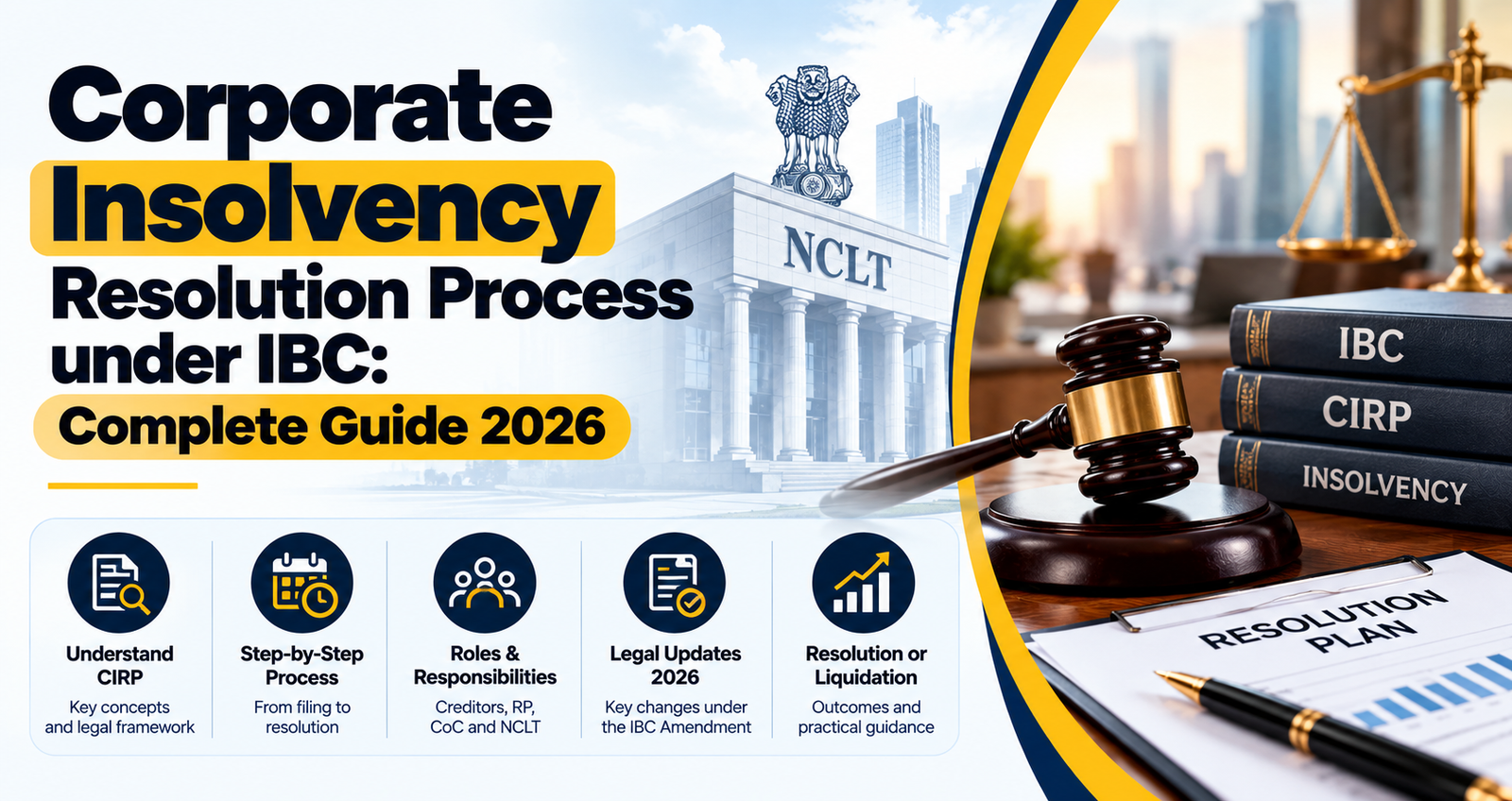
This comprehensive guide explains CIRP eligibility, the application process, the role of the National Company Law Tribunal (NCLT), the Committee of Creditors (CoC), insolvency professionals, statutory timelines, resolution plans, and key legal updates introduced in 2026.
Key Legal Updates under the IBC Amendment Act, 2026
The Insolvency and Bankruptcy Code (Amendment) Act, 2026, received presidential assent on 6 April 2026. Certain provisions became effective on 26 May 2026 through notification S.O. 2625(E), while other provisions are subject to separate commencement notifications.
The amendments address several aspects of India’s insolvency framework, including:
- Admission-related procedures and verification of default.
- Treatment and verification of creditor claims.
- Withdrawal of admitted insolvency applications.
- Corporate resolution and liquidation procedures.
- Introduction of a creditor-initiated insolvency resolution framework.
The creditor-initiated framework becomes operational only when its relevant statutory provisions are notified. Businesses and creditors should verify the latest Corporate Insolvency Resolution Process under IBC commencement notifications and IBBI regulations before relying on newly introduced procedures.
What Is the Corporate Insolvency Resolution Process under IBC?
The Corporate Insolvency Resolution Process under IBC, commonly known as CIRP, is a statutory procedure intended to resolve the insolvency of a corporate debtor before liquidation becomes necessary.
Under Section 3(12) of the IBC, default broadly means failing to pay a debt when it becomes due and payable.
The current minimum default threshold under Section 4 for initiating corporate insolvency proceedings is ₹1 crore.
The primary objectives of CIRP include preserving the value of the corporate debtor, facilitating creditor participation, identifying viable restructuring opportunities, and achieving resolution through a legally compliant process.
Who Can Initiate the Corporate Insolvency Resolution Process under IBC?
Under the Insolvency and Bankruptcy Code, CIRP may be initiated by financial creditors, operational creditors, or the corporate debtor, subject to the applicable statutory requirements.
1. Financial Creditor – Section 7
A financial creditor may initiate CIRP before the jurisdictional NCLT when financial debt and default are established.
Supporting documents may include loan agreements, financial statements, account records, security documents, acknowledgements of debt, and information utility records.
2. Operational Creditor—Sections 8 and 9
An operational creditor generally begins by issuing a demand notice under Section 8 of the IBC.
The corporate debtor has 10 days from receipt of the notice to communicate payment or the existence of a dispute.
If the statutory requirements are satisfied and there is no Corporate Insolvency Resolution Process under IBC genuine pre-existing dispute, the operational creditor may file an application under Section 9.
The Supreme Court’s decision in Mobilox Innovations Pvt. Ltd. v. Kirusa Software Pvt. Ltd. remains significant in determining the treatment of pre-existing disputes.
3. Corporate Applicant – Section 10
A corporate applicant may initiate CIRP concerning the corporate debtor itself under Section 10, subject to the requirements of the IBC.
Restrictions and Limitation
Section 11 restricts specified persons from initiating CIRP in particular circumstances.
Section 10A bars initiation of CIRP for defaults arising during the Corporate Insolvency Resolution Process under IBC protected during the COVID-19 period covered by the provision.
Section 238A applies the Limitation Act, 1963, to applicable insolvency proceedings. The limitation position may depend on the default date, acknowledgements, part payments, and related financial documentation.
Where Is a CIRP Application Filed?
The National Company Law Tribunal (NCLT) acts as the Adjudicating Authority for corporate persons under Section 60 of the IBC.
An application is ordinarily filed before the NCLT Bench having jurisdiction Corporate Insolvency Resolution Process under IBC over the registered office of the corporate debtor.
Appeals against eligible NCLT orders may be filed before the NCLAT under Section 61. A further appeal to the Supreme Court may be available under Section 62 on questions of law, subject to statutory requirements.
Step-by-Step Corporate Insolvency Resolution Process under IBC
The Corporate Insolvency Resolution Process under IBC involves several statutory stages, beginning with an insolvency application and potentially concluding with an approved resolution plan or liquidation.
Step 1: Filing and Admission of CIRP Application
An application may be filed under Section 7, Section 9, or Section 10.
The NCLT examines matters including debt and default, statutory threshold, limitation, supporting documentation, and relevant eligibility requirements.
In operational creditor applications, the existence of a Corporate Insolvency Resolution Process under IBC of a genuine pre-existing dispute is particularly important.
Applicable provisions of the IBC Amendment Act, 2026 also address admission-related procedures and the use of authenticated Information Utility records.
Step 2: Declaration of Moratorium under Section 14
Upon admission, the NCLT declares a moratorium under Section 14.
Subject to statutory exceptions, the moratorium restricts specified legal proceedings, enforcement actions, security enforcement, and asset transfers concerning the corporate debtor.
The moratorium aims to protect the company’s assets and enable creditors to consider resolution options.
It does not automatically extend identical protection to promoters, directors, or personal guarantors.
Step 3: Appointment of Interim Resolution Professional
An Interim Resolution Professional (IRP) is appointed to manage the initial stages of CIRP.
The IRP is responsible for making the Corporate Insolvency Resolution Process under IBC public announcement, receiving and verifying claims, collecting financial information, preserving assets, and constituting the Committee of Creditors.
Under Section 17, the powers of the board of directors are suspended in accordance with the Code.
Section 19 requires relevant persons to cooperate with the insolvency professional.
Step 4: Verification of Claims and Constitution of Committee of Creditors
Creditors submit their claims with supporting evidence, which may include agreements, invoices, loan documents, bank records, and other relevant financial information.
The insolvency professional verifies the claims in accordance with the applicable regulations.
The Committee of Creditors (CoC) is constituted under the Corporate Insolvency Resolution Process under IBC Section 21 and generally consists of financial creditors, subject to statutory rules concerning related parties and classes of creditors.
Operational creditors may have specified participation rights but do not ordinarily enjoy the same voting rights as financial creditors.
Step 5: Appointment of Resolution Professional and CoC Decisions
The CoC may confirm the IRP as the Resolution Professional (RP) or appoint another eligible insolvency professional.
The RP administers the CIRP, while major commercial decisions are principally taken by the CoC.
Section 28 requires prior CoC approval for certain important decisions involving financial arrangements, security interests, ownership, and other specified matters.
Step 6: Interim Finance, CIRP Costs, and Valuation
Interim finance may be obtained to preserve business operations during CIRP, subject to statutory requirements.
The resolution professional prepares an information memorandum under Section 29.
Registered valuers determine the fair value and liquidation value of relevant assets according to applicable regulations.
These valuations help creditors assess the commercial feasibility of a proposed resolution plan compared with the likely liquidation outcome.
Step 7: Expression of Interest and Resolution Applicant Eligibility
The Resolution Professional invites Expressions of Interest from prospective resolution applicants.
The process generally involves eligibility assessment, preparation of provisional and final lists, and issuance of the Request for Resolution Plan.
Section 29A specifies categories of persons who may Corporate Insolvency Resolution Process under IBC be ineligible to submit resolution plans.
Relevant grounds include specified non-performing asset situations, wilful default, convictions, director disqualifications, and connected-person relationships.
Eligible MSMEs may receive certain relaxations under Section 240A.
Step 8: Submission of Resolution Plan under Section 30
A resolution plan must satisfy Section 30(2) and the applicable CIRP Regulations.
A compliant plan generally addresses:
- Payment of CIRP costs in the prescribed priority.
- Statutory treatment of operational creditors.
- Minimum protection of dissenting financial creditors.
- Management of the corporate debtor after approval.
- Implementation and supervision of the resolution plan.
- Funding arrangements and proposed restructuring.
- Compliance with applicable laws.
A resolution plan must satisfy statutory requirements in addition Corporate Insolvency Resolution Process under IBC to be commercially viable.
Step 9: Approval by Committee of Creditors
A resolution plan requires approval by at least 66% of the voting share of the Committee of Creditors.
The CoC evaluates the viability, feasibility, financial recovery, and implementation risks associated with the proposed plan.
Judgments including K. Sashidhar v. Indian Overseas Bank and Committee of Creditors of Essar Steel India Ltd. v. Satish Kumar Gupta recognise the importance of the CoC’s commercial wisdom, subject to mandatory legal compliance.
Step 10: NCLT Approval under Section 31
After CoC approval, the resolution plan is submitted to the NCLT for statutory examination.
Once approved, the resolution plan becomes Corporate Insolvency Resolution Process under IBC binding in accordance with Section 31 of the IBC.
The Supreme Court’s decision in Ghanshyam Mishra and Sons Pvt. Ltd. v. Edelweiss Asset Reconstruction Company Ltd. is significant concerning the binding effect of an approved resolution plan and the treatment of statutory claims.
Section 32A and the Clean-Slate Principle
Section 32A provides protection to the corporate debtor in specified circumstances concerning offences committed before the commencement of CIRP.
This protection depends on statutory requirements, including a qualifying change in management or control.
However, persons individually responsible for relevant offences do not automatically receive personal immunity.
Avoidance Transactions and Wrongful Trading under IBC
During CIRP, certain transactions undertaken before insolvency may be examined to determine whether they improperly affected the corporate debtor’s assets or creditor interests.
Important provisions include:
- Sections 43–44: Preferential transactions.
- Sections 45–48: Undervalued transactions.
- Section 49: Transactions defrauding creditors.
- Sections 50–51: Extortionate credit transactions.
- Section 66: Fraudulent or wrongful trading.
Where statutory conditions are established, the NCLT may grant appropriate relief.
Withdrawal of CIRP under Section 12A
Section 12A governs withdrawal of an admitted insolvency application.
The substituted Section 12A, brought into force on 26 May 2026, provides specific restrictions and procedural requirements.
Under the amended framework, withdrawal is not permitted before Corporate Insolvency Resolution Process under IBC, the constitution of the CoC or after the RP has issued the first invitation for submission of resolution plans.
Within the permitted window, withdrawal requires the prescribed procedure and approval by 90% of the voting share of the CoC.
A private settlement between the parties does not automatically terminate CIRP after admission.
CIRP Timeline under the Insolvency and Bankruptcy Code
The Corporate Insolvency Resolution Process under IBC is intended to operate within statutory timelines.
| CIRP Stage | Timeline |
|---|---|
| Normal CIRP period | 180 days |
| Permissible extension | Up to 90 days, subject to conditions |
| Overall statutory framework | 330 days, including extensions and litigation time, subject to applicable judicial interpretation |
Actual completion may depend on legal proceedings, statutory approvals and the circumstances of the case.
Timely resolution is important because delays can affect asset value, business operations and creditor recovery.
What Happens If CIRP Fails?
If CIRP does not result in an approved and compliant resolution plan, the Corporate Insolvency Resolution Process under IBC debtor may enter liquidation under Section 33.
Liquidation may occur when:
- No resolution plan is approved within the permissible period.
- The CoC decides to liquidate in accordance with the Code.
- The NCLT rejects a resolution plan for statutory non-compliance.
- An approved plan fails in circumstances covered by the Code.
CIRP focuses on business rescue or restructuring, whereas liquidation involves asset realisation and distribution.
Liquidation Waterfall under Section 53
Section 53 specifies the priority for distributing liquidation proceeds.
Insolvency resolution and liquidation costs receive priority.Other categories of creditors and stakeholders receive distributions under the Corporate Insolvency Resolution Process under the IBC according to the statutory order, including specified secured creditors, workmen, employees, unsecured financial creditors and government authorities.
The anticipated liquidation value is also important when creditors evaluate a proposed resolution plan.
CIRP, Personal Guarantors and Other Applicable Laws
CIRP against a corporate debtor does not automatically Corporate Insolvency Resolution Process under IBC discharge the liabilities of a personal guarantor.
The Supreme Court’s decision in Lalit Kumar Jain v. Union of India is relevant to proceedings involving personal guarantors of corporate debtors.
CIRP may also interact with:
- Companies Act, 2013.
- SARFAESI Act.
- Arbitration and Conciliation Act.
- Income-tax and GST laws.
- Prevention of Money Laundering Act.
- Securities laws and sector-specific legislation.
Section 238 provides overriding effect to the IBC in cases of inconsistency with another law, subject to applicable judicial interpretation.
How ELT Corporate Can Assist with CIRP under IBC
ELT Corporate Private Limited provides regulatory, corporate compliance and documentation support to businesses and stakeholders dealing with insolvency-related matters.
Our assistance may include:
- Preliminary review of debt, default and limitation documents.
- Classification of financial and operational debt.
- Preparation and organisation of supporting documentation.
- Review of demand-notice documentation under Section 8.
- Documentation support for applications under Sections 7, 9 and 10.
- Organisation of corporate and financial records.
- CIRP compliance and deadline tracking.
- Coordination with insolvency professionals and appropriately qualified legal professionals for NCLT proceedings.
The appropriate legal and financial strategy depends on the position of the stakeholder, including whether the applicant is a creditor, corporate debtor, promoter, guarantor, employee or prospective resolution applicant.
For professional assistance, visit ELT Corporate.
Conclusion
The Corporate Insolvency Resolution Process under IBC is one of the most important mechanisms under India’s insolvency framework. It brings creditors, corporate debtors, insolvency professionals and prospective resolution applicants into a structured process focused on preserving business value and achieving viable insolvency resolution.
For creditors, understanding debt, default, limitation, statutory thresholds and supporting evidence is essential. For corporate debtors and promoters, CIRP may involve a moratorium, suspension of board powers, verification of claims, debt restructuring, changes in ownership or liquidation.
A comprehensive understanding of the Corporate Insolvency Resolution Process under IBC also requires knowledge of Committee of Creditors (CoC) governance, interim finance, valuation, resolution plan requirements, Section 29A eligibility, creditor protections, avoidance transactions, Section 32A and applicable withdrawal provisions.
Early legal and financial assessment, proper documentation and compliance with the latest IBC provisions and CIRP Regulations are essential for effective insolvency resolution and protecting stakeholder interests.
Frequently Asked Questions
1. What is the Corporate Insolvency Resolution Process under IBC?
CIRP is a statutory mechanism under the Insolvency and Bankruptcy Code, 2016 for resolving corporate insolvency before liquidation becomes necessary.
2. What is the minimum default amount for CIRP?
The minimum default threshold Corporate Insolvency Resolution Process under IBC for initiating proceedings under Part II of the IBC is currently ₹1 crore.
3. Who can file a CIRP application?
Eligible financial creditors, operational creditors and corporate applicants can initiate CIRP under Sections 7, 9 and 10, respectively.
4. What is the CIRP timeline under IBC?
The normal CIRP period is 180 days, with a possible extension of Corporate Insolvency Resolution Process under IBC up to 90 days and an overall 330-day statutory framework, subject to applicable law and judicial interpretation.
5. What happens after CIRP admission?
The NCLT declares a moratorium, an insolvency professional assumes statutory responsibilities, creditor claims are collected and the resolution process proceeds.