Call Now
◎
Invest & Expansion In India
Navigate foreign investment laws
◌
Intellectual Property
Protect your innovations
₹
Taxes
Tax planning & dispute resolution
▥
Corporate Law
Corporate governance & advisory
◈
Technology Law
Digital age legal solutions

Author name: rajul1jain@gmail.com

FEMA Compounding in India
BLOG

FEMA Compounding in India: 7 Powerful Steps, Rules & Penalties

Introduction FEMA Compounding in India provides a structured mechanism for addressing eligible FEMA contraventions through the applicable regulatory process. Most FEMA violations in India are not acts of fraud. They are missed deadlines, unreported filings, paperwork left incomplete in the press of running a business. A startup that received foreign investment and forgot to file the FC-GPR return within 30 days. An exporter whose buyer paid late, pushing the realisation beyond the permitted window. A company that restructured its shareholding without filing the FC-TRS on time. These are compliance failures, not crimes, and Indian law provides a clean, structured mechanism to resolve them: compounding. Compounding under Section 15 of FEMA allows a person who has committed a FEMA contravention to approach the Reserve Bank of India, acknowledge the violation, pay a calculated amount, and receive a compounding order that permanently closes the matter. No prosecution. No adjudication. No ongoing liability for the same contravention. For most FEMA violations, compounding is not just the best option, it is the obvious one. This article explains the complete process as it stands under the current framework: the Foreign Exchange (Compounding Proceedings) Rules, 2024, notified on 12 September 2024, and the RBI Master Direction on Compounding of Contraventions under FEMA, 1999, issued on 22 April 2025 and revised on 24 April 2025. Every fee, form, timeline, and exclusion in this article reflects the current rules, not the older 2022 framework. What Is FEMA Compounding in India? The Legal Basis: Section 15 FEMA Section 15 of the Foreign Exchange Management Act, 1999 empowers the RBI to compound any contravention under FEMA — that is, to allow the person who committed the contravention to pay a sum of money in exchange for the contravention being settled without prosecution or adjudication. The provision is voluntary: the applicant comes to the RBI, acknowledges the contravention, and applies for compounding. The RBI evaluates the application, holds a hearing, and issues a compounding order specifying the amount to be paid. A compounding order is final. Once the amount is paid within 15 days of the order, the contravention is permanently closed. No further proceedings under FEMA can be initiated for the same contravention.  The order is not subject to appeal through the normal FEMA appellate route (which applies to adjudication orders), though it can be challenged before the High Court on jurisdictional or natural-justice grounds in exceptional cases. FEMA Compounding vs Adjudication: Key Differences Factor Compounding Adjudication Who initiates Applicant voluntarily approaches RBI RBI or ED refers matter; adversarial Cost Calculated compounding amount; typically 5–15% of the amount involved Up to 3x the amount involved; higher risk Timeline Target 180 days from application Years; adversarial; appeals possible Outcome Permanent closure; no prosecution Penalty order; subject to appeal; possible ED referral Reputational risk Minimal; administrative settlement Higher; public proceedings ED referral risk Low if compounding successful Higher; serious violations go to ED Self-reporting benefit Yes; lower compounding amount Not applicable The Critical Advantage of Self-Reporting The single most important strategic point in FEMA compounding: approaching the RBI voluntarily before the RBI or ED detects the violation results in a materially lower compounding amount. The RBI’s computation matrix explicitly treats self-reporting (suo moto application) as a mitigating factor. Waiting until after a show-cause notice or an RBI memorandum of contraventions has been issued removes this advantage and typically results in a higher compounding amount. The practical message: if your compliance review discovers a past FEMA violation, the right move is to quantify it and apply for compounding immediately, not to hope it goes undetected. Who Can Apply for FEMA Compounding in India? RBI as the Compounding Authority The RBI compounds most FEMA violations through designated officers of varying ranks depending on the amount involved in the contravention. Jurisdiction within the RBI depends on the type of violation: FDI, ECB, ODI and Branch/Liaison Office violations: the RBI Regional Office having jurisdiction over the registered office of the Indian company. Liaison Office, Branch Office, Project Office, NRFAD and immovable property violations: FED Central Office Cell, New Delhi. Foreign investment contraventions: Regional Office overseeing the investee company’s registered office. All other contraventions: CEFA (Central and External Foreign Assets) Division, Mumbai. When the ED Handles Compounding Certain violations fall outside the RBI’s compounding authority and are referred to the Directorate of Enforcement for adjudication or compounding under the ED’s own powers: Violations involving amounts above the monetary thresholds prescribed for RBI compounding officers (the thresholds were revised upward under the 2024 Rules to enhance ease of doing business). Repeat violations: a contravention of the same nature within three years of a previously compounded similar contravention is not eligible for RBI compounding and may be referred to the ED. Serious contraventions: those involving money laundering, terror financing, transactions affecting national sovereignty, or cases where the applicant failed to pay a previously compounded amount. Non-quantifiable contraventions under Rule 9 of the 2024 Rules, or cases where an Adjudicating Authority order already exists. This referral to the ED converts a civil administrative matter into a potentially criminal investigation. Understanding which category your violation falls into before filing is therefore essential. Can Individuals, LLPs and Foreign Companies Also Compound? Yes. The compounding framework applies to any person resident in India or outside India who has committed a FEMA contravention. This includes Indian companies and their directors, LLPs and their partners, individuals including NRIs, and foreign entities with India-linked FEMA obligations. The process and fee matrix are the same; what varies is the relevant RBI regional office and the applicable FEMA regulation. Violations That Can and Cannot Be Compounded Common Compoundable FEMA Violations Violation Applicable Regulation Common Example Late filing of FC-GPR NDI Rules / FEMA 20(R) Shares allotted to foreign investor; FC-GPR not filed within 30 days Late or non-filing of FC-TRS NDI Rules / FEMA 20(R) Transfer of shares between resident and non-resident; FC-TRS missed Delay in share allotment after receipt of FDI NDI Rules Foreign funds received; shares not allotted within 60 days; refund also missed Late

PMLA Bail in India – Legal Guide for Accused and Businesses
BLOG

PMLA Bail in India: 10 Powerful & Essential Legal Points

PMLA Bail in India: Understanding the Legal Framework Introduction PMLA Bail in India is widely regarded as the most difficult bail in Indian law. The Act reverses the normal presumption of innocence at the bail stage. It places the burden on the accused to show they are not guilty before any trial has happened. It imposes two conditions that must both be satisfied simultaneously before a court can grant bail. And even when bail is granted, the Enforcement Directorate can challenge it. Yet PMLA bail is not impossible. Courts have developed significant jurisprudence that protects the right to liberty through the right to default bail if the ED delays filing its complaint, through the principle that prolonged incarceration without trial progress cannot be justified even under PMLA, and through specific protections for women, the elderly and the seriously ill. In 2024 and 2025, the Supreme Court issued a quartet of rulings softening the twin conditions, followed by a correction in February 2025 reminding courts to apply them with rigour. Understanding where PMLA bail stands today — and what legal strategy actually changes outcomes — is the purpose of this article. It is written for the accused, for their families, and for the businesses whose operations depend on key individuals who are in, or may soon be in, ED custody. PMLA Bail in India requires a careful understanding of Section 45, applicable bail rights, and the latest judicial approach. PMLA Bail in India: Why It Is Different from Ordinary Criminal Bail How Bail Works in Ordinary Criminal Cases In most criminal cases, bail is the rule and jail is the exception. A court granting bail asks: is there a risk of flight, tampering with evidence, or repeating the offence? The prosecution carries the burden of showing why bail should be refused. The accused does not need to prove innocence at the bail stage. How PMLA Changes Everything PMLA Bail in India is governed by a stricter legal framework than ordinary criminal bail, making proper preparation especially important. PMLA inverts this framework through Section 45. It is the prosecution that gets to oppose bail, and the court must then be satisfied on two conditions before bail can be granted. Both conditions place the burden effectively on the accused. The Supreme Court in Vijay Madanlal Choudhary v. Union of India (2022) upheld this framework as constitutionally valid, holding that the special nature of money laundering — a serious economic offence with national and transnational dimensions — justifies the stricter standard. The principle in PMLA: Bail is not the rule. The court must be actively satisfied that the accused deserves to be free, not merely that the prosecution has failed to show that they should be detained. PMLA Bail in India: The Twin Conditions Under Section 45 PMLA What the Twin Conditions Actually Say Section 45 PMLA provides that no person accused of a PMLA offence shall be released on bail unless two conditions are met: First, the Public Prosecutor must be given an opportunity to oppose the bail application. Second: where the Public Prosecutor opposes the application, the court must be satisfied that there are reasonable grounds to believe that the accused is NOT guilty of the offence AND that the accused is NOT likely to commit any offence while on bail. Both conditions must be satisfied simultaneously. A court that grants bail without addressing both or without giving the ED an opportunity to oppose has committed a legal error that the Supreme Court will correct on appeal, as it did in Union of India v. Kanhaiya Prasad (2025 INSC 210). How Courts Apply the Twin Conditions in PMLA Bail in India For PMLA Bail in India, the court carefully considers the available material before deciding whether the statutory conditions are satisfied. At the bail stage, the court does not conduct a mini-trial. It looks at the material before it, the ED’s complaint or grounds of arrest, the accused’s reply, the documents produced, and asks whether there are reasonable grounds to believe the accused is not guilty. This is not proof beyond a reasonable doubt; it is a prima facie assessment. But the word “reasonable grounds” carries real weight. A court will look at: Whether the predicate offence is credibly established or is itself contested. Whether the proceeds of crime link is clear or tenuous based on documents. Whether the accused has a plausible, document-backed explanation for the transactions in question. Whether the accused poses a flight risk or is likely to tamper with witnesses or evidence. The stage of investigation and trial, and whether continued custody is proportionate. For PMLA Bail in India, understanding the twin conditions under Section 45 is essential because both conditions play a central role in the court’s bail assessment. PMLA Bail in India: Constitutional History and Latest Judicial Approach The evolving case law makes PMLA Bail in India a matter that requires attention to the latest Supreme Court decisions. Nikesh Shah (2017) to Vijay Madanlal (2022) to the 2024–25 Arc In November 2017, the Supreme Court in Nikesh Tarachand Shah v. Union of India struck down the twin conditions as unconstitutional — a violation of Articles 14 and 21. Parliament responded within four months by amending Section 45, removing the conditions that had been found unconstitutional and replacing them with the current formulation. In Vijay Madanlal (2022), the Supreme Court upheld the amended provisions. The twin conditions were back and constitutional. Between August and September 2024, the Supreme Court issued four rulings — including Manish Sisodia and Prem Prakash — that softened the application of the twin conditions, emphasising that prolonged incarceration and unlikely trial completion could justify bail even under PMLA. Lower courts began applying this with what the Supreme Court considered insufficient care. In February 2025, Union of India v. Kanhaiya Prasad (2025 INSC 210) corrected course: the twin conditions are mandatory and must be applied rigorously, not casually. Then, in January 2026, the Supreme Court added another variable: the ED’s  Prosecutorial wherewithal —

FEMA Violation vs PMLA Offence in India
BLOG

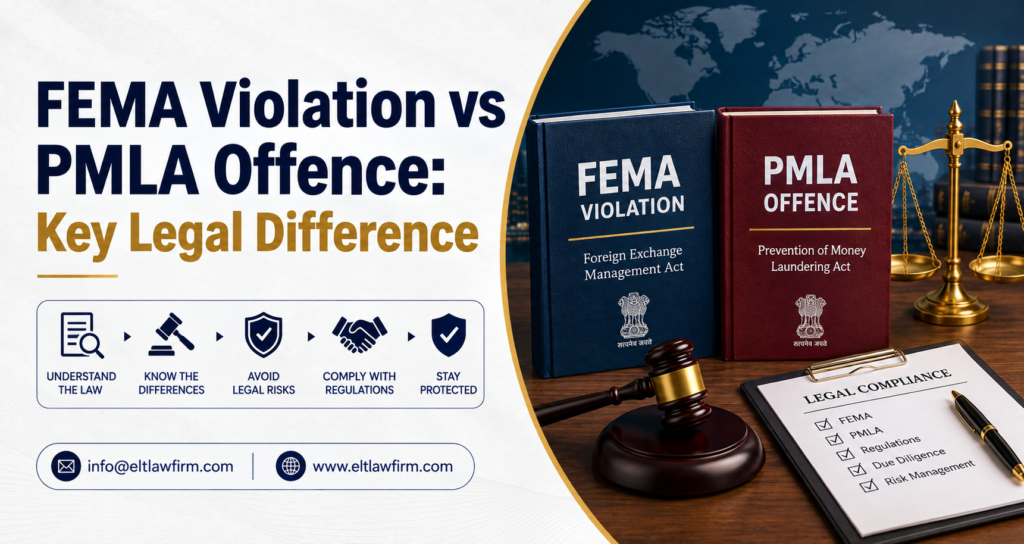
FEMA Violation vs PMLA Offence: Key Legal Difference

Introduction FEMA Violation vs PMLA Offence is an important distinction for businesses, directors, investors and individuals dealing with the Enforcement Directorate. Both FEMA and PMLA are enforced by the same agency — the Enforcement Directorate. Both can result in asset seizure. Both land in the same ED office when you receive a notice. That is where the similarity ends. FEMA is a civil law. A FEMA violation is a regulatory breach — like a traffic fine, but for foreign exchange. You pay a penalty, compound the offence if possible, and move on. The ED cannot arrest you under FEMA. Your freedom is not at risk. PMLA is a criminal law. A PMLA offence is money laundering. The ED can attach your property, arrest you without a warrant, and prosecute you before a Special Court where bail is uniquely difficult. A conviction carries imprisonment of up to seven years, extendable to ten years in certain cases. The reason this matters so much in practice is the escalation pathway: a FEMA violation, in the right factual circumstances, can become the foundation of a PMLA investigation if the ED concludes that the foreign exchange breach was part of a money laundering scheme. Understanding exactly where FEMA ends and PMLA begins — and what separates a penalty from a prosecution — is the most important thing any business, director or investor dealing with cross-border transactions should know. What Is FEMA and What Does It Cover? Understanding FEMA Violation vs PMLA Offence is essential before responding to an Enforcement Directorate notice. Nature of the Law The Foreign Exchange Management Act, 1999, deliberately replaced the far harsher Foreign Exchange Regulation Act, 1973. Parliament chose to make foreign exchange regulation a civil matter — regulatory control with monetary penalties — rather than a criminal one. The statement of objects of FEMA expressly says it is enacted to “facilitate external trade and payments and to promote the orderly development and maintenance of the foreign exchange market in India.” It is a facilitative, regulatory law. Imprisonment is not the primary remedy. Who Does FEMA Apply To All persons resident in India dealing in foreign exchange or foreign securities. All persons resident in India who hold, own, transfer or receive any foreign exchange, foreign security or immovable property outside India. Branches, offices, and agencies outside India of companies or bodies corporate incorporated in India. Any person who deals in foreign exchange transactions within India, including Authorised Dealers (banks). Common FEMA Violations Receiving foreign investment in an Indian company without RBI approval or in a prohibited sector. Failure to repatriate export proceeds within the permitted timeline. Holding foreign exchange, securities, or property abroad without a permitted purpose. Making overseas investments or remittances outside the Liberalised Remittance Scheme limits. Failure to file prescribed returns with the RBI (such as FC-GPR, FC-TRS, FLA returns). Accepting crypto or hawala-style remittances that bypass authorised banking channels. What Is PMLA and What Does It Cover? The distinction between FEMA Violation vs PMLA Offence becomes particularl Nature of the Law The Prevention of Money Laundering Act, 2002, is a criminal statute. Its stated purpose is to prevent money laundering and provide for the confiscation of property derived from or involved in money laundering. Unlike FEMA, which is about regulating transactions, PMLA is about prosecuting a crime: the act of generating proceeds from a scheduled offence and then projecting those proceeds as legitimate income. What Is a Predicate Offence PMLA jurisdiction cannot exist in a vacuum. It can only be triggered if there is an underlying “predicate offence” — a scheduled crime listed in the PMLA Schedule. The Schedule includes a wide range of serious offences: fraud, cheating, criminal breach of trust under the BNS, corruption, drug trafficking, human trafficking, tax evasion, cybercrime, and many others. The ED does not investigate the predicate offence itself — that is the job of the police or the CBI. The ED investigates what happened to the proceeds of that crime.  ⚠ Critical point confirmed by the Madras High Court in 2025 (R.K.M Powergen Private Limited, W.P.Nos.4297 & 4300 of 2025): FEMA itself is NOT a scheduled offence under the PMLA.  A pure FEMA violation, standing alone, cannot trigger PMLA proceedings or justify ED asset freezing under PMLA. The ED must establish an independent predicate offence. What “Proceeds of Crime” Means Under Section 2(u) of the PMLA, “proceeds of crime” means any property derived or obtained, directly or indirectly, by any person as a result of criminal activity relating to a scheduled offence. The ED’s entire attachment and prosecution machinery turns on whether it can establish that the property in question is the proceeds of crime from a scheduled offence. Without this link, PMLA jurisdiction fails. Common Scenarios That Attract PMLA A company director diverts loan funds through shell companies — the fraud is the predicate offence, and the diverted funds are proceeds of crime. A promoter over-invoices imports to transfer value abroad — the cheating and tax evasion are predicate offences. An individual receives funds from a narcotics network and moves them through real estate — drug trafficking is the predicate offence. A business accepts kickbacks and routes them through a chain of companies — corruption and cheating are predicate offences. FEMA Violation vs PMLA Offence: Side-by-Side Comparison Parameter FEMA PMLA Nature of law Civil / regulatory Criminal Purpose Regulate foreign exchange transactions; facilitate trade Prevent money laundering; confiscate proceeds of crime Predicate offence required? No. FEMA applies to any regulatory breach of forex rules Yes. A scheduled offence under the PMLA Schedule must exist Can ED arrest? No. No power of arrest under FEMA Yes. Section 19 PMLA — with a written, reasoned belief based on material in hand Asset attachment Section 37A: seizure of documents and equivalent assets; narrower scope Section 5: provisional attachment of any property representing proceeds of crime; very wide scope Maximum penalty Up to 3x the amount involved, or INR 2 lakh if the amount is not quantifiable, plus INR 5,000/day for continuing default Imprisonment:

ED Notice in India – Legal Steps and Compliance Guidance
BLOG

Received an ED Notice in India? Here Is What You Must Do Immediately

Introduction Getting an ED notice in India is one of the most unsettling things that can happen to an individual or a business. For most people, the first reaction is panic. The second is to call someone and start talking. Both of those reactions can cause serious damage to your case. The ED is one of the most powerful investigative agencies in India. It enforces two laws: the Prevention of Money Laundering Act, 2002, and the Foreign Exchange Management Act, 1999. It can summon you, record your statement, attach your property, freeze your bank accounts, and arrest you. Its powers have been upheld extensively by the Supreme Court, most notably in the landmark Vijay Madanlal Choudhary v. Union of India (2022) judgment. But an ED notice is not an arrest warrant. It is not a verdict. It is the beginning of a process, and how you handle the first few days will shape everything that follows. This article tells you exactly what to do, in plain language, step by step. First, Understand What Type of ED Notice in India You Have Received Not every ED notice requires the same response. Before you do anything else, read the notice carefully and identify which of the following it is: Summons Under Section 50 PMLA This is the most common notice. It requires you to appear before the ED, answer questions, and produce documents. Attendance is legally mandatory — you cannot simply ignore it. Under Section 50(3) of the PMLA, every person summoned is bound to attend and state the truth. Refusal to comply is punishable under Section 63 of the PMLA. Critically, the statement you give is recorded under oath and is admissible as evidence against you in court. This is very different from a police statement recorded under Section 180 of the Bharatiya Nagarik Suraksha Sanhita, 2023 (BNSS) — the provision that replaced Section 161 CrPC — which is not admissible as evidence against the person who made it. One important protection confirmed by the Delhi High Court: a Section 50 summons does not by itself give the ED the power to arrest you. Sections 19 and 50 are separate provisions. Arrest requires the Director to have a written, reasoned belief based on material in hand that you are guilty of a PMLA offence. Show-Cause Notice A show-cause notice under PMLA or FEMA means the ED has completed or substantially completed its investigation and is now giving you a formal opportunity to explain why action should not be taken against you. This is a critical stage. The reply you file and the documents you attach to it form the basis of the adjudication proceedings that follow. A poorly drafted reply or missing documents can be very difficult to remedy later. Provisional Attachment Order (PAO) Under Section 5 of the PMLA, the ED can provisionally attach property it believes represents proceeds of crime, without going to court first. The attachment lasts for 180 days, during which the case goes before the Adjudicating Authority. You have the right to file a reply and be heard. If you receive a PAO, do not transfer, sell, or deal with the attached property in any way. Doing so is a criminal offence. Engage a lawyer immediately to file a response before the Adjudicating Authority. Search and Seizure Notice or Warrant Under Section 17 of the PMLA, the ED can conduct a search of your home, office, or any premises without advance notice. If ED officers arrive at your door, you are legally required to allow the search. However, you have rights during this process, which are explained below. A search does not mean an arrest is imminent, but it does mean the ED has reason to believe that relevant documents or proceeds of crime may be found at the location. FEMA Notice A FEMA notice from the ED relates to foreign exchange violations rather than money laundering. FEMA enforcement is civil in nature, not criminal, and penalties under Section 13 of FEMA can reach up to three times the amount involved. However, if the ED believes a FEMA violation has a money laundering angle, it can also register an Enforcement Case Information Report (ECIR) under PMLA, escalating the matter from a civil penalty to a potential criminal investigation. What Does an ED Notice in India Mean for Your Investigation? PMLA Investigations: The Proceeds of Crime Angle Every PMLA investigation starts with a “predicate offence” — a scheduled crime listed in the PMLA Schedule, such as fraud, cheating, tax evasion, corruption or drug trafficking. The ED does not investigate the predicate offence itself; that is the job of the police or the CBI. What the ED investigates is whether the proceeds of that predicate offence were then “laundered” — that is, projected as untainted money through a transaction. This matters for you because: (1) if there is no valid predicate offence, the PMLA case itself may be challengeable; (2) the question the ED is really asking about your transactions is not just whether they happened, but whether the money involved was clean. Understanding this helps you and your lawyer identify the right documents to produce. FEMA Investigations: Civil But Serious FEMA investigations concern foreign exchange transactions — sending money abroad, receiving foreign funds, FDI compliance, overseas assets, and similar matters. These are civil proceedings, but they carry substantial penalties, can trigger freezing of accounts and assets, and, in cases involving large values or willful violation, they escalate quickly to PMLA territory. If your notice is FEMA-related, establishing that the transaction was authorised, properly reported and commercially genuine is the core of your defence. For further FEMA legal assistance, you can visit ELT Law Partners LLP’s FEMA practice. What to Do After Receiving an ED Notice in India: First 48 Hours ⚠ An ED notice in India is time-sensitive. What you do — and do not do — in the first 48 hours can determine the direction of the entire case. Step 1: Read the Notice Carefully

SEBI Updates for Investors, Brokers and Listed Companies
BLOG

SEBI Updates for Investors, Brokers and Listed Companies: What Businesses Should Track

SEBI is not a regulator you hear from once a year. Circulars, amendments and consultation papers arrive almost weekly, and 2026 opened with the biggest single change in decades: on 7 January 2026, SEBI notified the SEBI (Stock Brokers) Regulations, 2026, replacing the 1992 framework in its entirety and consolidating more than thirty years of scattered circulars into one rulebook. For most businesses, the difficulty is not finding SEBI updates; it is knowing which ones apply to you. So instead of a chronological list, this article is organised the way compliance actually works: what each of the three audiences, investors, brokers and listed companies, must track, followed by the penalties for getting it wrong and the documentation that keeps you safe. Everything is in plain language; no circular numbers are required to follow along. Track 1: SEBI Updates for Brokers and Market Intermediaries The new Stock Brokers Regulations, 2026, are the headline. They apply from notification, with transition windows for existing brokers, and they change the business in five practical ways: Higher entry bar: Registration is routed through a recognised stock exchange, and applicants must demonstrate at least two years of relevant securities experience, prescribed net worth linked to risk, NISM certification, and “fit and proper” status. Designated director: Every broking entity needs at least one designated director resident in India for at least 182 days a year, with existing brokers given six months to comply. Responsibility for compliance failures now has a named face. Codified conduct and governance: Client asset protection, cyber security obligations, risk management and surveillance duties are codified in the regulations themselves rather than scattered across circulars, and material changes such as ownership transfers must be reported to SEBI. Business purity rules: Brokers cannot accept cash from clients, and engaging in unrelated businesses is restricted, subject to prescribed exceptions and transition arrangements, pushing broking groups towards cleaner corporate structures. Sharper enforcement: A clearer inspection, enforcement and grievance redressal framework means routine inspections will test policies, records and client-asset segregation against written standards. The message to broking businesses: this is a governance reset, not a paperwork update. Boards should re-approve policies, map every obligation to an owner, and treat the transition windows as project deadlines. Track 2: SEBI Updates for Listed Companies For listed companies, SEBI compliance revolves around continuous disclosure under the LODR (Listing Obligations and Disclosure Requirements) framework, and the direction of travel is consistent: faster, more specific, harder to fudge. The areas to track: Event-based disclosures: Material events must be disclosed within tight timelines (ranging from 30 minutes to 24 hours, depending on the event and its origin), based on quantitative materiality thresholds rather than management discretion alone. Rumour verification: Larger listed companies must confirm, deny or clarify market rumours reported in mainstream media when share prices move, which makes leak management and pre-drafted response protocols essential for any sensitive transaction. Insider trading systems: Insider trading compliance now runs on a structured digital database (records of everyone with unpublished price-sensitive information, maintained with audit trails), trading window discipline and pre-clearance processes. Enforcement in this area is data-driven and unforgiving. Governance and RPTs: Related party transaction approvals, audit committee scrutiny and shareholder thresholds continue to tighten, and governance disclosures (board evaluation, ESG/BRSR reporting for larger companies) keep expanding. Cyber resilience: Cyber security and resilience obligations now extend across market participants, with incident reporting expectations, so a listed company’s CISO and compliance officer must work as one team. Compliance officers should maintain a single disclosure playbook: who decides materiality, who drafts, who approves, and how fast, tested against the shortest applicable timeline, not the longest. Track 3: SEBI Updates for Investors and Investor Protection SEBI’s investor protection push is practical, and investors (including corporate treasuries that invest) should actively use it: Direct and fast settlement: Faster settlement means money and securities reach accounts quicker, and payouts flow directly to client accounts rather than sitting with intermediaries. Verified payment channels: Verified payment identifiers for registered intermediaries help investors confirm they are paying a genuine SEBI-registered entity and not a fraudster; unregistered “advisors” on social media remain the biggest retail risk. Grievance and dispute systems: The online SCORES system routes complaints to the regulated entity with defined timelines and escalation, and the SmartODR platform provides online dispute resolution (conciliation and arbitration) without court proceedings.  Unclaimed assets: Frameworks for tracing inactive and unclaimed holdings help investors and heirs recover forgotten investments. Informed consent: Investor charters and standardised risk disclosures, particularly the stark loss statistics mandated for derivatives trading, are designed to inform you before you commit capital. The habit to build: deal only with SEBI-registered intermediaries (verify registration on SEBI’s website), keep your own records, and use SCORES early rather than negotiating endlessly with a non-responsive intermediary. Penalties: What Non-Compliance Actually Costs SEBI Updates and enforcement requirements… SEBI’s enforcement toolkit under the SEBI Act operates on top of each framework above, and it is layered: Tool What It Means in Practice Monetary penalties Adjudication penalties scale with the violation; insider trading and fraudulent trade practices can attract penalties up to INR 25 crore or three times the profit made, whichever is higher. Disclosure lapses attract per-day penalties. Exchange fines Stock exchanges levy standardised fines for LODR breaches (for example, late results or governance report defaults), debited almost automatically, with freezing of promoter shareholding for persistent defaults. Directions and debarment SEBI can restrain persons from accessing the securities market, freeze accounts, impound proceeds, and suspend registrations, remedies that hurt more than fines. Settlement mechanism Many proceedings can be settled through SEBI’s settlement regulations on payment of settlement amounts, without admission of guilt, often the commercially sensible exit. Criminal prosecution Serious violations can be prosecuted, and SEBI orders are appealable to the Securities Appellate Tribunal (SAT) and, vchexjxnxdip, dc the Supreme Court. Documentation: The Records That Decide Cases Across every SEBI matter we see, outcomes turn on whether the entity can produce contemporaneous records. In simple terms, keep these: For listed companies: materiality assessments with reasons and timestamps, disclosure approvals, structured

Crypto in India 2026: Legal, Tax and Enforcement Risks
BLOG

Crypto in India 2026: Essential Legal, Tax & Enforcement Risks

Introduction Crypto in India is legal. You can buy it, hold it, and sell it without breaking any law. But that does not mean it is simple or safe to deal in without understanding the rules. India does not have a single crypto law yet. Instead, several existing laws apply to crypto, each from a different direction: one governs the tax you pay on profits, another covers how exchanges must verify your identity and report transactions, a third deals with how money can move in and out of the country, and a fourth gives enforcement agencies the power to freeze accounts and investigate. Most investors run into trouble not because they did anything deliberately wrong, but because they did not know these rules applied to them. In 2026, that risk is higher than ever. Exchanges now report your transactions directly to the Income Tax Department. The anti-money-laundering framework has been extended to crypto platforms. The RBI has told Parliament it would prefer crypto not to be legalized. And enforcement agencies are more active than at any point before. At the same time, about 39 million Indians hold crypto, a Parliamentary Committee is working on a regulatory framework, and India is getting ready to share crypto data with other countries from 2027 under a global standard called CARF. This article explains what Indian crypto law actually means for you, whether you are an individual investor, a trader, or a business. It covers the tax rules, the KYC and anti-money-laundering requirements, the foreign exchange risks, and what happens when enforcement gets involved. It also tells you exactly which records to keep to protect yourself if any of these issues ever land at your door. Crypto in India: The Legal Position at a Glance Question Position in 2026 Governing Law Can I buy/sell/hold crypto? Yes, it is legal. No prohibition; VDAs recognized as an asset class Is crypto legal tender? No. It cannot be used as currency. RBI Act framework; only the Digital Rupee (CBDC) is legal tender Is it taxed? Yes, heavily: flat 30% plus cess, 1% TDS, no loss set-off. Income-tax Act (Sections 115BBH and 194S, carried into the Income-tax Act, 2025) Is it AML-regulated? Yes. Exchanges and VDA service providers are reporting entities. PMLA, 2002; FIU-IND registration Cross-border transfers? Grey zone: highest-risk area. FEMA (1999) and the LRS framework For the official VDA tax position, the Income Tax Department states that VDA gains are subject to a 30% tax under Section 115BBH and that Schedule VDA is used for transaction-wise disclosure. What You Can and Cannot Do Permitted: Buying, selling, and holding crypto as an investment and trading on FIU-IND-registered platforms (Indian or compliant international ones) are permitted. Not permitted: Using crypto to pay for goods, services, or salaries, operating an unregistered exchange or wallet service, and structuring anonymous transactions to evade tax or reporting are prohibited or actionable. The banking line: Banks may service crypto-related businesses under strict due diligence and monitoring conditions, but cannot hold or invest in crypto themselves. The RBI’s preferred alternative is its own Digital Rupee (e₹), which is being expanded across retail and wholesale use as the only regulated, sovereign digital currency. How India Got Here: 2018 to 2026 in Six Steps Year What Changed 2018 RBI barred banks from servicing crypto businesses, effectively shutting down Indian exchanges. 2020 The Supreme Court struck down the RBI banking restrictions, reviving crypto trading in India. 2022 The Union Budget recognized Virtual Digital Assets and introduced the 30% tax and 1% TDS regime. 2023 Crypto platforms were brought under the PMLA as reporting entities, with FIU-IND registration and KYC obligations. 2024–25 The Supreme Court urged the government to frame a comprehensive law; enforcement against offshore platforms intensified; the Digital Rupee pilot scaled. 2026 The Income-tax Act, 2025 took effect with a penalty regime for crypto reporting entities; exchange data now flows directly to the tax department; the RBI told a Parliamentary panel it opposes legalisation, while a comprehensive law remains under discussion. The trajectory is unmistakable: each step has added surveillance and formalisation, never relaxation. Planning on the assumption that enforcement will loosen is planning against the trend. For RBI’s position and its treatment of virtual currencies and digital currency, you can refer to the RBI Concept Note on Central Bank Digital Currency. The RBI has also clarified that the Supreme Court’s 2020 decision set aside its earlier banking restriction, while regulated entities must continue to comply with applicable KYC, AML, PMLA, and FEMA requirements. Risk Zone 1: Taxation, The Harshest Regime in Indian Law The VDA tax framework introduced by the Finance Act, 2022 continues under the Income-tax Act, 2025 (in force from 1 April 2026), and its design is deliberately punishing: Flat 30% on gains Every gain from transferring a VDA is taxed at 30% plus cess, regardless of your income slab or how long you held the asset. Selling for INR, swapping one token for another, and paying for goods in crypto are all taxable “transfers”. No loss set-off, ever A loss on one token cannot be set off against a gain on another, against any other income, or carried forward. Each profitable trade is taxed in full even in a losing year, which is why high-frequency trading is economically brutal in India. No expense deductions Only the cost of acquisition is deductible. Mining costs, gas fees, platform charges, and interest on borrowings do not reduce the taxable gain. TDS under Section 194S 1% tax is deducted at source on transfers above INR 50,000 a year (INR 10,000 for specified persons). Indian exchanges deduct it automatically; in P2P and foreign-platform deals the buyer must deduct and deposit it, which most P2P traders do not realise. Reporting All VDA transactions must be reported in Schedule VDA of the income tax return. Gifts of crypto above INR 50,000 from non-relatives are taxable in the recipient’s hands, and mining, staking, and airdrop rewards raise valuation questions that need documented positions. The net has also tightened around

India-EU Free Trade Agreement legal impact on Indian exporters and foreign companies
BLOG

India-EU Free Trade Agreement: Legal Impact on Indian Exporters and Foreign Companies

Introduction The India-EU Free Trade Agreement marks a significant development for Indian exporters, foreign companies and cross-border businesses. On 27 January 2026, at Hyderabad House in New Delhi, India, the European Union signed a Free Trade Agreement that had been nearly two decades in the making. The scale justifies the label it instantly earned — “the mother of all deals”: a combined market of two billion consumers, roughly 25% of global GDP, and bilateral trade already worth over €180 billion a year that the EU now aims to double by 2032. Around 96.6% of tariff lines will be liberalised in phases, opening the EU’s 27 member states to Indian goods and services on terms Indian businesses have never had before. But a signed agreement is not yet an operating one. The text must still clear legal review, the European Parliament and Council, and India’s own approval process before tariff schedules begin to bite. More importantly for businesses, the India-EU Free Trade Agreement is not just a tariff story — it is a legal event. It will change how India-EU contracts should be priced and drafted, what documentation exporters need to claim preferential duty, how brands and Geographical Indications are protected across both markets, and where disputes will be fought when the inevitable friction of expanded trade arrives. This article examines the India-EU FTA legal impact from that practical, legal standpoint: the opportunities it creates sector by sector, and the five areas — contracts, import-export compliance, intellectual property, regulatory standards and dispute risk — where Indian exporters and foreign companies should act during the ratification window, not after it closes. Where the India-EU Free Trade Agreement Stands Today Signing is not the finish line. The agreed text must still undergo legal review and translation into all EU languages, followed by approval of the Council of the European Union, the consent of the European Parliament, and completion of India’s internal approval process. Tariff reductions will then be phased in over a schedule rather than overnight. Two companion negotiations also matter for legal planning: a separate Investment Protection Agreement and an Agreement on Geographical Indications have been running on a parallel track. Businesses should therefore treat 2026 as a preparation window, not a waiting room: the obligations are known in outline, and early movers will be ready when the schedules bite. What the India-EU FTA Opens Up for Indian Businesses The FTA liberalises trade in almost all goods, covering about 96.6% of tariff lines, with EU concessions expected to eventually cover nearly 99% of India’s shipments by trade value. Both sides have protected sensitivities: India has kept dairy and cereals out of the deal, while the EU has excluded concessional access for Indian sugar, meat, poultry and beef. Textiles & Apparel Major tariff relief into the EU; benefit depends on meeting rules of origin and EU product, labelling, and sustainability standards. Pharmaceuticals Better access for generics; watch IP chapters, regulatory data provisions and EU quality (GMP) compliance closely. IT & Professional Services Service commitments plus a separate mobility pact for skilled workers; contracts must handle GDPR and cross-border data transfer obligations. Auto & Engineering Cheaper EU inputs and machinery as Indian tariffs phase down; renegotiate long-term supply pricing to capture the duty savings. Steel & Aluminium Tariff access improves, but the EU’s Carbon Border Adjustment Mechanism (CBAM) still applies, adding carbon-cost compliance from 2026. Wine, Spirits & EU Consumer Goods Indian import duties fall in phases; Indian importers and distributors should revisit distribution agreements and pricing clauses now. Five Legal Impact Areas Under the India-EU Free Trade Agreement Every Business Should Review 1. Contracts Written for a Pre-FTA World Most existing India-EU contracts were priced and drafted when high tariffs were a given. As duties phase down under the India-EU Free Trade Agreement, disputes will arise over who captures the savings: the seller, the buyer or the customer. A practical contract review should cover: Pricing and duty clauses: do prices include customs duty, and is there a mechanism to pass through tariff reductions? Incoterms and delivery terms: DDP arrangements shift duty risk to the seller; phased tariff cuts change that economics year by year. Change-in-law clauses: whether tariff changes trigger renegotiation rights. Exclusivity and territory clauses in distribution agreements, which may become commercially outdated once EU competitors enter at lower duty. Compliance warranties: EU buyers increasingly demand warranties on sustainability, labour and supply-chain due diligence; Indian suppliers should negotiate realistic, bounded versions rather than open-ended promises. 2. Import-Export Compliance and Rules of Origin FTA benefits are claimed, not automatic. To access preferential tariffs, exporters must prove that goods “originate” in India (or the EU) under the FTA’s rules of origin. This is where most India-EU FTA benefits for Indian exporters are lost in practice. Businesses should: Map product-level origin criteria and required local value addition for each tariff line they trade in. Build documentation systems for origin declarations and supplier certificates, retaining records for post-clearance audits. Align FTA claims with existing Indian frameworks: the CAROTAR rules on origin verification, customs valuation and, on the payments side, the FEMA export-import framework that took effect in 2026. Remember that wrongly claimed preferences invite duty recovery, interest, and penalties years after clearance, on both sides. 3. Intellectual Property and Geographical Indications IP was one of the issues that stalled negotiations in 2013, and the modern deal comes with meaningful IP obligations plus a parallel Geographical Indications agreement. The practical consequences: Indian exporters must clear their brands in the EU before scaling up: register EU trademarks and designs early, because entering 27 member states with an unprotected brand is an invitation to squatters. EU GIs (think protected European food, wine and spirit names) will gain stronger protection in India; Indian food and beverage businesses using European-style names should audit their labels and branding for future conflicts. Indian GIs gain reciprocal recognition opportunities in the EU, valuable for products like Basmati, Darjeeling tea and handicrafts, if producers organise registrations and enforcement. Pharma and tech companies should track

FEMA Export and Import Regulations 2026 complete compliance guide for Indian businesses
BLOG

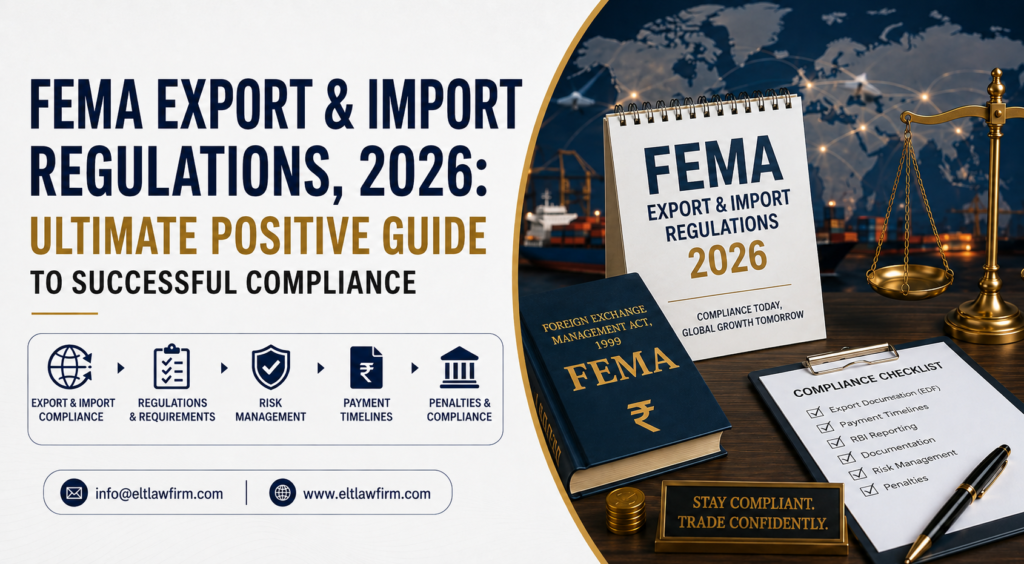
FEMA Export and Import Regulations 2026: Ultimate Positive Guide to Successful Compliance

Introduction FEMA Export and Import Regulations 2026 will govern a new compliance framework for Indian businesses involved in cross-border trade. From 1 October 2026, every export and import transaction of an Indian business will be governed by a single new rulebook. On 13 January 2026, the Reserve Bank of India notified the Foreign Exchange Management (Export and Import of Goods and Services) Regulations, 2026 (Notification No. FEMA 23(R)/2026-RB), followed by consolidated Directions to Authorised Dealer banks. Together, they replace the 2015 Export Regulations, the separate Master Directions on export and import, the merchandising trade guidelines, and dozens of circulars. For businesses, this is both a relief and a warning. The new framework is simpler, more digital, and gives banks the power to solve routine problems quickly. But the same digital consolidation means that unfilled declarations, overdue receivables and unmatched remittances are now visible to your bank and the RBI almost in real time. This article explains who the Regulations apply to, what changes in payments and reporting, what non-compliance costs, and exactly how to prepare before the 1 October 2026 deadline. Understanding the FEMA Export and Import Regulations 2026 is essential for Indian businesses to manage export transactions, import payments and cross-border compliance effectively. Legal Framework for FEMA Export and Import Regulations 2026 The 2026 Regulations are issued under the Foreign Exchange Management Act, 1999. The key building blocks of the framework are: FEMA, 1999: Section 7 governs exports, Section 13 prescribes penalties, and Section 15 allows compounding of contraventions. FEM (Export and Import of Goods and Services) Regulations, 2026, notified on 13 January 2026 and effective 1 October 2026. RBI Directions to Authorized Dealers on Export and Import of Goods and Services, dated 16 January 2026, which operationalize the Regulations for banks. Superseded framework: the FEM (Export of Goods and Services) Regulations, 2015, the Master Directions on Export (2016) and Import (2016), the Merchandising Trade Guidelines (2020), and the circulars listed in the Directions. The regulatory design is principle-based: RBI sets outcomes, while Authorized Dealer (AD) banks handle approvals, timeline extensions, write-offs and set-offs within delegated powers. Your bank, not the RBI, is now the first and usually final checkpoint for most trade transactions. Applicability: Who Is Covered? Exporters of goods: Every person resident in India exporting goods from the Domestic Tariff Area or an SEZ. Exporters of services and software: IT/ITES companies, consultants, agencies, and freelancers billing foreign clients. Service and software exports come under a unified declaration requirement, ending the earlier grey zone. Importers: Any business remitting foreign exchange for goods or services, including advance payments. Merchandising traders: Buying goods in one foreign country and selling them to another without the goods entering India is covered by the same consolidated framework. INR-settled trade: Exports invoiced or settled in Indian Rupees under permitted arrangements are covered, with an extended realization timeline. In short: if foreign exchange (or trade-linked INR settlement) moves in or out of your business, these Regulations apply to you. Key Compliance Requirements Understanding the FEMA Export and Import Regulations 2026 is essential for businesses to maintain proper export and import compliance under the updated regulatory framework. 1. One Export Declaration Form (EDF) for Everything The unified EDF replaces the old patchwork where goods used EDF, software used SOFTEX, and many service exports went undeclared. Goods exporters furnish the EDF to the specified authority (Commissioner of Customs for DTA shipments; Development Commissioner for SEZ units) at the time of shipment. Service and software exporters file the EDF with their AD bank on a periodic basis. For IT companies and freelancers, this is the single biggest operational change: unreported service income is no longer a grey area but a visible default. 2. Export Payment Timelines Standard window: Export proceeds must be realised and repatriated within 15 months of shipment (goods) or invoice (services). INR-settled exports: Exports invoiced and/or settled in Indian Rupees get an additional 3 months, i.e., 18 months in total. Extensions: AD banks can grant further extensions within delegated powers; routine cases no longer go to the RBI. Set-off: Set-off of export receivables against import payables with the same counterparty is now expressly recognised as valid realisation, provided it is routed through the AD bank. 3. Import Payment Rules Contract-linked timelines: Import remittance timelines follow the underlying contract rather than a rigid uniform deadline. Advance payments: For advance remittances, AD banks may require safeguards such as bank guarantees or letters of credit, particularly for high-value payments. Evidence of import: Every remittance must be closed with evidence of import (for example, the Bill of Entry) in the bank’s systems; unmatched entries trigger follow-up and can block future remittances. 4. RBI Reporting: EDPMS, IDPMS and FETERS Three systems drive monitoring under the new framework. EDPMS tracks every export shipment until proceeds are realised; overdue entries flag the exporter across the banking system and can lead to caution-listing. IDPMS matches every import remittance against proof of import. FETERS carries transaction-level data from banks to the RBI, where wrong purpose codes and invoice mismatches surface quickly. Businesses should obtain and reconcile their EDPMS/IDPMS statements with their AD bank at least quarterly, because restrictions operate off this data automatically. Common Violations and Mistakes Service exporters not filing EDFs is a legacy habit that becomes a clear, detectable default under the unified system. Export receivables crossing the 15/18-month window without an AD bank extension, leading to open EDPMS entries and caution-listing. Advance import payments with no shipment and no refund, leaving IDPMS entries permanently unmatched. Wrong purpose codes on remittances, creating mismatches across FETERS, invoices and GST data. Informal set-offs with counterparties or group companies without routing them through the AD bank. Treating merchanting trade as outside FEMA because goods never touch India. Continuing to follow the superseded 2015/2016 framework after 1 October 2026. Businesses should regularly review the FEMA Export and Import Regulations 2026 to identify and address potential reporting, payment and documentation issues. Penalties for Non-Compliance Monetary penalties: Section 13 of FEMA: penalty up to three times the

Director Disqualification in India: Causes, Consequences and Remedies
BLOG

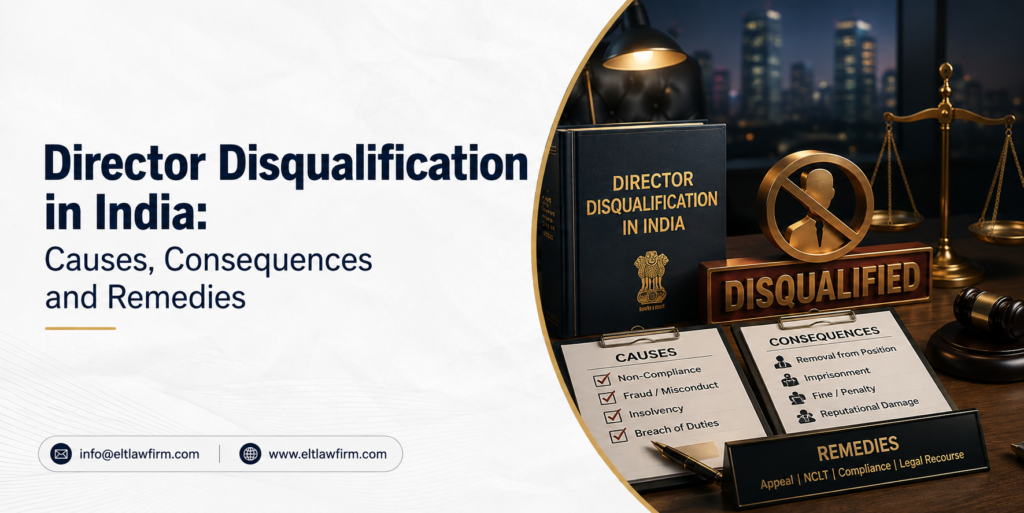
Director Disqualification in India: Causes, Consequences & Remedies

Director disqualification in India can arise from personal grounds under Section 164(1) or company default grounds under Section 164(2), and the applicable remedy depends on the nature of the disqualification. What Is Director Disqualification? Disqualification under the Companies Act, 2013 means that a person is legally barred from being appointed or continuing as a director of any company under section 164. Once a person is disqualified, they cannot accept a new directorship, cannot continue existing directorships (other than in the defaulting company itself in some circumstances), and cannot sign board resolutions or company filings in a director capacity. Disqualification is different from removal. Removal under Section 169 is an act of the shareholders — they vote a director out. Disqualification under Section 164 is a legal status that attaches to the individual automatically or by order, regardless of what the shareholders want. A disqualified director who is not removed is still legally disqualified; their signature on any board document after the date of disqualification is the signature of an unauthorised person. Two Tracks: Section 164(1) and Section 164(2) Section 164 creates two completely different disqualification tracks. Confusing them leads to wrong advice about remedies, because the cause and the cure are different in each track. Section 164(1) lists personal grounds — things the individual director did or had done to them. These include being of unsound mind as declared by a court, being an undischarged insolvent, having applied to be adjudicated as insolvent, having been convicted of an offence involving moral turpitude and sentenced to imprisonment of six months or more, having been convicted of an offence under the Companies Act and sentenced to seven years or more, having an order disqualifying them from being a director passed by a court or tribunal, not paid calls in respect of shares held in a company for six months, having been convicted of an offence dealing with related-party transactions under Section 188 in the last five years, and not complying with Section 152(3) (failure to file DIR-12 for DIN). Section 164(2) is the company default ground. A director is disqualified under this provision if they are, or have been, a director of a company that has not filed its financial statements or annual returns for any continuous period of three years. This provision applies to the director personally, regardless of whether they were responsible for the filing failure. The disqualification attaches to the individual because they held the directorship during the period of default. ⚠  The most important distinction: Section 164(1) disqualification arises from personal conduct and can sometimes be challenged on factual grounds. Section 164(2) disqualification arises from the company’s filing default — the director’s personal innocence is not a statutory defence. High Courts have accepted natural justice arguments (no notice before deactivation) but have not accepted “I did not know” as a ground to set aside the disqualification itself. Section 164(1) — Individual Grounds The most practically significant grounds under Section 164(1) for most directors are conviction for an offence involving moral turpitude with a sentence of six months or more and insolvency. These are the grounds that typically arise in criminal prosecution or personal financial failure. A director convicted under the Companies Act itself for fraud under Section 447 and sentenced to seven years or more is disqualified. This is the criminal fraud track discussed in our article on director liability in financial fraud cases. A director who has an order of disqualification passed against them by the NCLT — for example, in connection with oppression and mismanagement proceedings under Section 241 — is also disqualified under Section 164(1)(f). The IBC connection: Section 29A of the Insolvency and Bankruptcy Code creates a separate disqualification regime for resolution applicants. A person who is a promoter or director of a company undergoing insolvency resolution, or who is an undischarged insolvent, or who has been convicted of any offence with imprisonment of two years or more, cannot be a resolution applicant. This is not a Companies Act disqualification but it operates alongside Section 164 in practice. Disqualification under Section 164(1) lasts for the period specified in the relevant sub-clause — for conviction-based grounds, typically five years from the date of conviction or from release from imprisonment. The director can apply for removal of the disqualification when the specified period expires. Section 164(2) — Company Default Grounds This is the provision that has affected the largest number of directors in India and is the most misunderstood. Section 164(2) provides that no person who is, or has been, a director of a company that has not filed its financial statements or annual returns for any continuous period of three financial years shall be eligible to be reappointed as a director of that company or appointed as a director of any other company for a period of five years from the date on which the said company fails to do so. Three things about this provision that directors frequently get wrong. First, it is automatic — no court order, no notice, no hearing is required for the disqualification to take effect. The moment the three-year continuous default period is completed, the director is disqualified by operation of law. Second, it applies to every director who was on the board during the default period — not just the director responsible for compliance. A non-executive independent director who attended every meeting, raised concerns and was overruled on compliance matters is disqualified on the same basis as the MD who refused to file. Third, it affects all other companies on which the director sits, not just the defaulting company. A disqualified director cannot continue as a director of any other company — including fully compliant companies with which they have no compliance issues. The five-year disqualification runs from the date on which the company failed to file — not from the date the director found out, not from the date the MCA deactivated the DIN, and not from the date a court confirmed the disqualification. The filing history

FEMA Notice Received: Steps to Review and Respond
BLOG

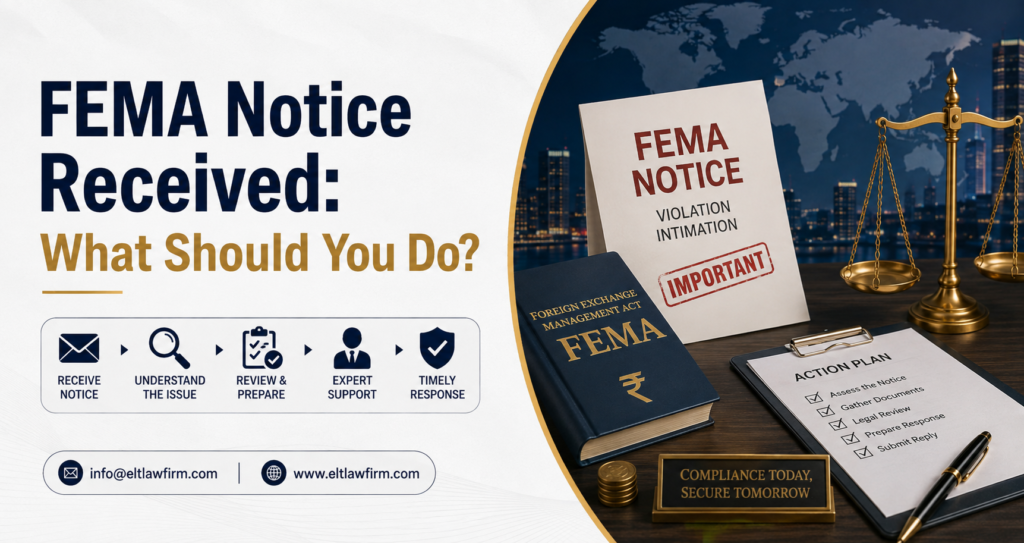
FEMA Notice Received What Should You Do?

FEMA Notice Received: What Should You Do? If you have received a FEMA notice from the ED, RBI, or another regulatory authority, it is important to understand the notice and respond within the prescribed time. A proper review of the allegations, supporting documents, and applicable FEMA provisions can help you prepare an appropriate response. The first thing to remember is: do not panic, but do not ignore the notice either. A FEMA notice does not automatically mean that you have committed a serious violation. In many situations, the authorities may simply require an explanation, additional documents, clarification about a transaction, or correction of a compliance issue. The right response depends on the authority that issued the notice, the allegations or questions mentioned in it, the transaction involved, and the documents available in your case. What Is FEMA? FEMA stands for the Foreign Exchange Management Act, 1999. FEMA provides the legal framework for regulating foreign exchange transactions in India. It covers various matters involving foreign exchange and cross-border transactions, including certain foreign investments, remittances, overseas assets, foreign accounts, imports, exports, and other transactions. For example, FEMA-related questions may arise when a person or company: Sends money outside India Receives money from abroad Makes an overseas investment Holds certain foreign assets or accounts Purchases property outside India Receives foreign investment Makes cross-border business payments Has reporting or documentation gaps Undertakes a transaction that may require regulatory approval Under FEMA, Section 3 restricts certain dealings in foreign exchange except as permitted under the law and applicable regulations. Section 13 provides for penalties for contraventions. What Does It Mean If You Receive a FEMA Notice? Question: Does receiving a FEMA notice mean I have violated the law? Answer: Not necessarily. A FEMA notice may be issued because an authority wants more information or an explanation about a particular transaction. For example, the authority may want to understand: Where the money came from Where the money was transferred Why was the transaction made Whether the required reporting was completed Whether supporting documents are available Whether the transaction complied with FEMA and applicable regulations Therefore, receiving a notice should be treated seriously, but it should not automatically be viewed as proof that you have committed a violation. Which Authorities Can Send a FEMA Notice? A FEMA-related communication may come from different authorities or institutions depending on the nature of the issue. You may receive communication from or in relation to: Enforcement Directorate (ED) Reserve Bank of India (RBI) An authorised dealer bank Other competent authorities Regulatory or investigating authorities dealing with the transaction The authority and type of communication matter because the appropriate response can differ from case to case. FEMA Notice Received: What Should You Do? If you have received a FEMA notice, follow these steps. 1. Read the Notice Carefully Do not immediately start writing a reply. First, read the entire notice carefully. Look for: Name of the issuing authority Date of the notice Reference or case number Transaction involved Questions or allegations Documents requested Date of appearance, if any Deadline for submitting a response Consequences mentioned for non-compliance Understanding exactly what the authority is asking is the first step toward preparing an appropriate response. 2. Do Not Ignore the Deadline One of the biggest mistakes you can make after receiving a FEMA notice is simply doing nothing. Your notice may provide a specific period within which you must: Submit a written reply Provide documents Attend a hearing Appear before an authority Provide additional information Your response should be prepared and submitted within the applicable deadline unless an extension or other relief is appropriately sought. ELT Law Partners also notes that FEMA notices commonly require a response within a specified period and may require supporting transaction and compliance documents. 3. Identify the Transaction Mentioned in the Notice Question: Why is identifying the transaction important? Answer: Because your response needs to explain the facts accurately. Try to identify: Date of the transaction Amount involved Sender Recipient Bank used Purpose of payment Source of funds Documents connected with the transaction Applicable filings or approvals Do not rely only on memory. Bank statements, invoices, agreements, tax documents, investment records, and other financial records can help you understand what actually happened. 4. Collect All Relevant Documents A strong FEMA notice response is usually supported by documents. Depending on your case, you may need documents such as: Bank statements Foreign bank statements Remittance records Invoices Contracts Investment documents Shareholding documents Loan agreements Property documents Tax returns Form filings RBI-related correspondence FEMA compliance documents Foreign investment records Proof of source of funds Correspondence with banks Earlier regulatory approvals or permissions Your documents should tell a clear and consistent story. 5. Understand Why the Notice Was Issued Question: What are common reasons for receiving a FEMA notice? Answer: The reason can vary significantly. Some common issues include: Foreign Investment Issues A company or individual may face questions about foreign investment, ownership, reporting, valuation, or related documentation. Overseas Investment Issues Questions may arise regarding investments or transactions involving an overseas company or asset. Foreign Bank Accounts An authority may ask for information regarding certain foreign accounts, transactions, or balances. Cross-Border Payments A payment to or from another country may require clarification regarding its purpose, source, recipient, or documentation. Reporting Delays A transaction may have been completed, but a required filing or reporting obligation may have been delayed or missed. Documentation Problems Sometimes the underlying transaction may be explainable, but the supporting records may be incomplete. This is why it is important to examine the specific facts of your case rather than assuming that every FEMA notice involves the same issue. 6. Prepare a Clear FEMA Notice Reply Your reply should be: Accurate Clear Fact-based Properly documented Consistent with your financial records Limited to relevant information Submitted within the applicable timeline Avoid emotional explanations or unnecessary statements. A FEMA notice response should directly address the questions or allegations raised by the authority. A well-prepared reply may explain: What happened → Why it

Scroll to Top