Introduction
Receiving an NCLT Notice can be worrying for a company, especially when it concerns unpaid debts, shareholder disputes, or a company-law petition. However, receiving a notice does not automatically establish wrongdoing or mean that insolvency proceedings have started. What matters is identifying the case, understanding what the National Company Law Tribunal requires, and acting within the applicable deadline.
Companies should review the notice carefully, preserve relevant documents, and seek appropriate legal advice before responding. Taking timely action can help a business understand its legal position and prepare a suitable response.
What Is an NCLT Notice and Why Does It Matter?
Constituted on 1 June 2016 under Section 408 of the Companies Act, 2013, the National Company Law Tribunal adjudicates specified company-law matters and acts as the adjudicating authority for corporate insolvency under the Insolvency and Bankruptcy Code, 2016 (IBC). Its jurisdiction includes oppression and mismanagement, compromises and arrangements, mergers, share-capital matters, and certain winding-up proceedings.
An NCLT Notice is a formal communication issued by the Tribunal or served in proceedings before it concerning a petition, application, hearing, or procedural direction. It informs the relevant party about the proceedings and provides an opportunity to respond. Notices differ according to the nature of the case, so the appropriate response depends on the applicable law and Tribunal directions.
Why Might a Company Receive an NCLT Notice?
A company may receive a notice for several reasons, depending on the nature of the dispute and the relief requested.
- Insolvency proceedings: A financial or operational creditor may seek the commencement of corporate insolvency proceedings when the statutory requirements are met under Sections 7 and 9 of the IBC. A corporate debtor may also apply under Section 10.
- Oppression and mismanagement: Eligible applicants may raise concerns about the company’s affairs under Sections 241–242 of the Companies Act, read with the applicable eligibility provisions.
- Merger, arrangement, or restructuring: Shareholders, creditors, and specified authorities may receive notices in proceedings under Sections 230–232 of the Companies Act.
- Other company-law matters: These may include share-capital reduction, rectification of registers, restoration of company names, or winding up, where the NCLT has jurisdiction.
A petition notice, hearing notice, stakeholder notice, and public advertisement do not necessarily serve the same legal purpose. In particular, a demand notice from an operational creditor under Section 8 of the IBC comes before a potential Section 9 filing; it is not a hearing notice issued by the NCLT.
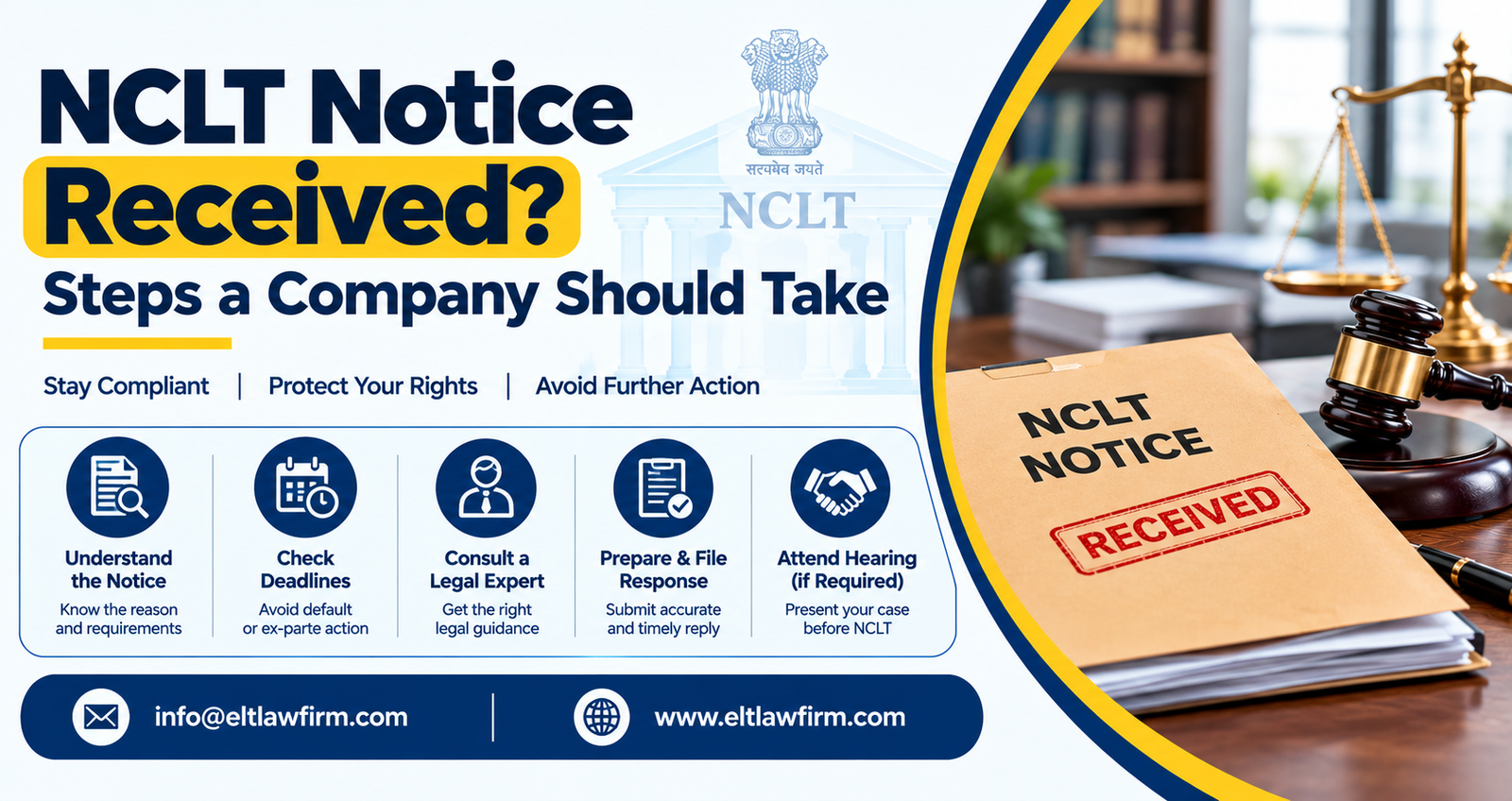
8 Steps a Company Should Take After Receiving an NCLT Notice
Step 1: Read the NCLT Notice and Identify the Case
Check the case number, parties, NCLT Bench, relief sought, hearing date, and any stated filing deadline. Read the attached petition or application rather than relying only on the covering notice.
Identify whether the matter falls under the Companies Act or the IBC because the applicable procedures and possible outcomes differ.
Step 2: Verify the Notice and Case Details
Verify the case number, hearing date, cause list, and available orders through the official National Company Law Tribunal website. If any information appears incorrect, contact the relevant Bench registry or seek professional guidance.
Under Rule 38 of the NCLT Rules, 2016, notices may be served through prescribed methods. Preserve emails, postal acknowledgements, and other proof of service, as these records may be relevant during the proceedings.
Step 3: Obtain Qualified Legal Advice
Share the documents promptly with an advocate or another professional lawfully authorised to appear in that type of proceeding. Request a case-specific assessment of jurisdiction, maintainability, evidence, interim risks, and applicable deadlines.
Representation before the NCLT is governed, among other provisions, by Section 432 of the Companies Act, 2013.
Step 4: Collect and Preserve Relevant Records
Gather relevant agreements, ledgers, bank statements, invoices, emails, board resolutions, statutory filings, and previous correspondence. Keep original records intact and prepare a dated timeline of events.
Avoid altering or destroying documents that may be relevant to the dispute. Organised records can help the company and its legal representatives assess the allegations and prepare an appropriate response.
Step 5: Prepare and File a Proper Reply
Respond to each material allegation with clear facts and supporting evidence. Under Rule 37(3) of the NCLT Rules, 2016, a respondent contesting a petition or application may file a reply supported by an affidavit and documents before the hearing, subject to the applicable procedure and Tribunal directions.
There is no single universal 30-day reply period for every NCLT proceeding. Check the notice, applicable rules, and any specific directions issued by the Tribunal before deciding when and how to file the reply.
Step 6: Attend the Hearing
Ensure appropriate representation on the scheduled date and comply with the Tribunal’s filing and appearance directions. Be prepared to address preliminary objections, answer questions, and seek necessary procedural relief.
Under Rule 49(1) of the NCLT Rules, 2016, non-appearance may lead the Tribunal to adjourn the matter or hear and decide it in the respondent’s absence.
Under Section 420 of the Companies Act, 2013, the NCLT may pass orders after giving the parties a reasonable opportunity of being heard. Section 424 further provides that the Tribunal follows the principles of natural justice while regulating its proceedings, subject to the applicable statutory framework. Companies should use this opportunity to present relevant facts, documents, and legal submissions.
Step 7: Consider Settlement Where Legally Available
The Insolvency and Bankruptcy Code (Amendment) Act, 2026 introduced changes to Section 12A, stated to be effective from 26 May 2026, affecting the withdrawal of admitted corporate insolvency proceedings.
Under the amended provision described in your draft, an insolvency application admitted under Sections 7, 9, or 10 may be withdrawn only after the Committee of Creditors (CoC) has been constituted and before the Resolution Professional (RP) issues the first invitation for submission of resolution plans.
Withdrawal requires an application by the Resolution Professional and approval of at least 90% of the CoC’s voting share. The NCLT is required to dispose of the withdrawal application within 30 days or record reasons for any delay.
Therefore, even if a company reaches a settlement with its creditor, the insolvency proceedings will not automatically close. Companies should consider these statutory restrictions before negotiating a settlement after admission of an insolvency application.
The applicability of the amended provision to proceedings initiated before its commencement should be assessed in light of the relevant facts, transitional provisions, and applicable judicial decisions.
Step 8: Track Orders, Dates, and Compliance
Obtain and read the Tribunal’s orders, record future hearing dates, and complete all directions within the applicable time. If an adverse order is passed, obtain immediate advice on the appropriate appeal or other available remedy.
Assign one internal person to coordinate documents, communicate with legal representatives, and track deadlines. This can help the company avoid missed hearings and incomplete filings.
What Happens If a Company Ignores an NCLT Notice?
Ignoring an NCLT Notice may cause a company to lose an important opportunity to challenge allegations or present evidence. The consequences depend on the nature of the case and the applicable law.
- Ex-parte proceedings or orders: Rule 49(1) permits an adjournment or a decision in the respondent’s absence. Rule 49(2) provides a route to seek the setting aside of an ex parte hearing where notice was not duly served or sufficient cause prevented appearance, subject to the Tribunal’s satisfaction.
- Adverse orders and additional costs: Delay can complicate the defence, extend litigation, and increase legal expenses. No particular outcome is automatic.
- Insolvency risk: If an insolvency application satisfies the applicable legal requirements, the NCLT may admit it. Following commencement of the corporate insolvency resolution process, Section 14 of the IBC provides for a moratorium, while Section 17 addresses the vesting of management powers in the Interim Resolution Professional. These consequences arise from commencement of the insolvency process, not merely from receiving or ignoring a notice.
- Commercial and governance
- impact: Depending on the order, a dispute may affect management decisions, financing, counterparties, and stakeholder confidence.
Can an NCLT Order Be Appealed?
Many, but not all, NCLT orders are appealable before the National Company Law Appellate Tribunal (NCLAT).
Under Section 421 of the Companies Act, 2013, the usual appeal period is 45 days from the date a copy of the order is made available to the aggrieved person, with a possible further 45 days upon sufficient cause. Consent orders are excluded under Section 421(2).
Under Section 61 of the IBC, the usual appeal period is 30 days, with a possible further 15 days for sufficient cause.
The applicable deadline, appeal rights, and grounds must be checked against the specific order, statutory provisions, amendments, and relevant judicial interpretation. A company should obtain advice promptly rather than assume that the same appeal period applies to every case.
How ELT Corporate Can Help With an NCLT Notice
ELT Corporate Private Limited can support businesses with an initial review of NCLT-related correspondence, preparation and organisation of corporate and financial records, compliance assessment, deadline tracking, and coordination with appropriately qualified legal professionals for replies, filings, and hearings.
The scope of engagement and any representation should be confirmed for each matter. For professional assistance, visit ELT Corporate.
Conclusion
An NCLT Notice deserves prompt and careful attention, not panic. Companies should verify the case, understand the applicable law, preserve evidence, respond within the prescribed time, and attend hearings as directed.
Early, organised action can help a company understand its legal position, present relevant evidence, and protect its rights during the proceedings.
Frequently Asked Questions
Q1. Does an NCLT notice mean the company is bankrupt?
No. The NCLT hears various company-law matters. Receiving a notice does not mean that an insolvency application has been admitted or that the company is bankrupt.
Q2. What should a company do first after receiving a notice?
Check the case number, Bench, attached petition, hearing date, and immediate deadlines. Then seek appropriate professional advice to understand the case and prepare a response.
Q3. How can we check whether an NCLT notice is genuine?
Use the official NCLT website to check available case details, cause lists, and orders. Contact the relevant registry if clarification is needed.
Q4. Is a reply mandatory within 30 days?
Not in every proceeding. The deadline depends on the applicable rules and Tribunal directions. Rule 37(3) addresses a contesting respondent’s reply before the hearing.
Q5. What documents are usually useful?
Depending on the allegations, useful documents may include contracts, invoices, ledgers, payment proof, financial statements, board records, statutory filings, and correspondence.
Q6. What happens if the company misses a hearing?
Under Rule 49, the Tribunal may adjourn the matter or proceed in the respondent’s absence. The availability of a remedy depends on the circumstances and applicable procedure.
Q7. Is an IBC Section 8 demand notice the same as an NCLT notice?
No. A demand notice under Section 8 of the IBC is issued by an operational creditor before initiating proceedings under Section 9. Under Section 8(2), the corporate debtor must communicate any existing dispute or provide the prescribed evidence of payment within 10 days of receiving the demand notice. This is different from a notice issued in proceedings before the NCLT.
Q8. Can an NCLT matter be settled?
Sometimes. However, settlement, withdrawal, or closure must comply with the law and the stage of the proceedings. The applicable requirements should be assessed before finalising an agreement.
Q9. Can a company challenge an NCLT order?
Appealable orders may be challenged before the NCLAT, subject to Section 421 of the Companies Act or Section 61 of the IBC, as applicable, and the relevant limitation period.
Q10. Must a company hire an advocate?
Not in every case. Section 432 of the Companies Act permits specified authorised representatives, but competent legal advice is strongly recommended for complex disputes.