Introduction
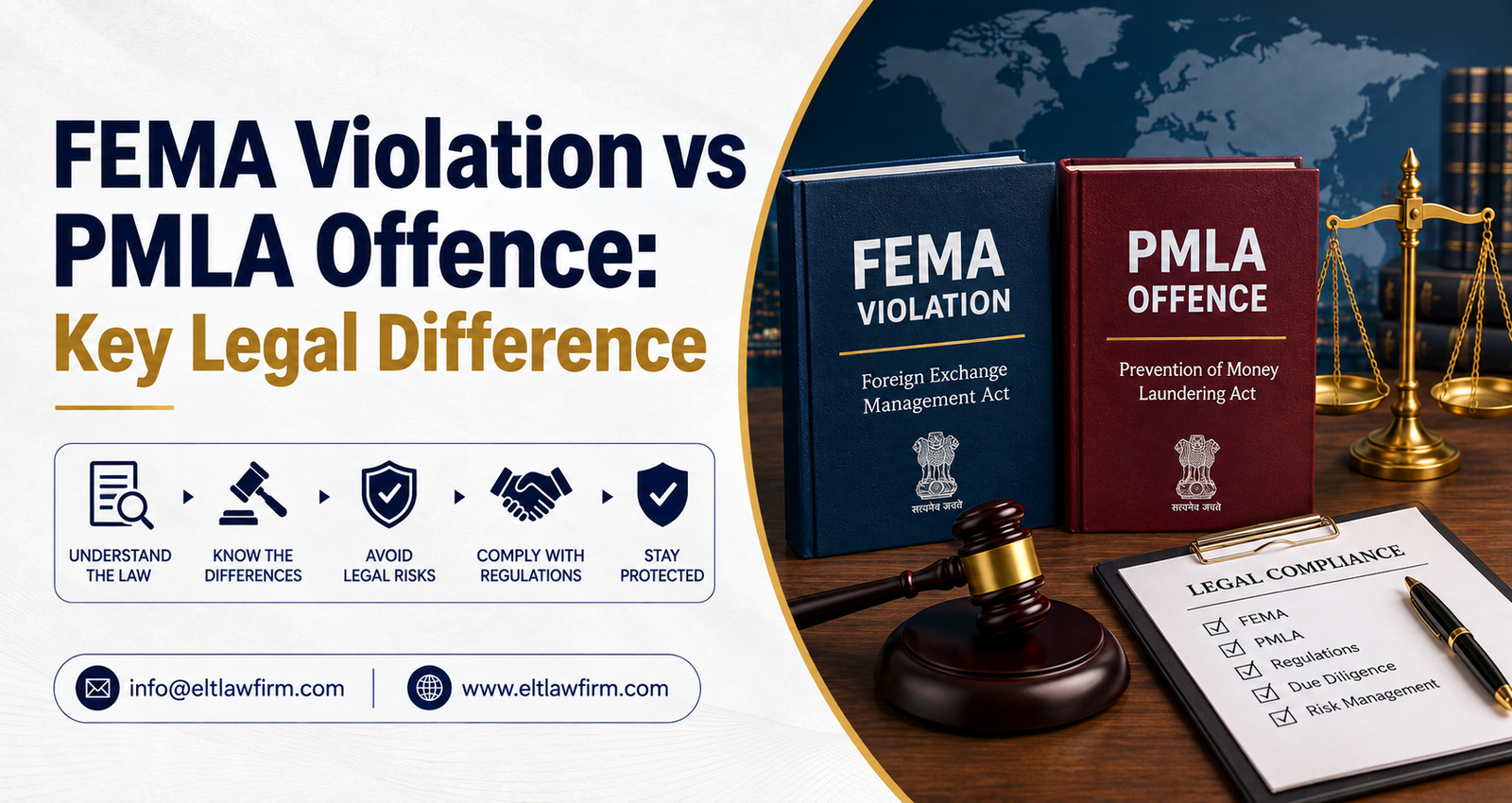
FEMA Violation vs PMLA Offence is an important distinction for businesses, directors, investors and individuals dealing with the Enforcement Directorate.
Both FEMA and PMLA are enforced by the same agency — the Enforcement Directorate. Both can result in asset seizure. Both land in the same ED office when you receive a notice. That is where the similarity ends.
FEMA is a civil law. A FEMA violation is a regulatory breach — like a traffic fine, but for foreign exchange. You pay a penalty, compound the offence if possible, and move on. The ED cannot arrest you under FEMA. Your freedom is not at risk.
PMLA is a criminal law. A PMLA offence is money laundering. The ED can attach your property, arrest you without a warrant, and prosecute you before a Special Court where bail is uniquely difficult. A conviction carries imprisonment of up to seven years, extendable to ten years in certain cases.
The reason this matters so much in practice is the escalation pathway: a FEMA violation, in the right factual circumstances, can become the foundation of a PMLA investigation if the ED concludes that the foreign exchange breach was part of a money laundering scheme. Understanding exactly where FEMA ends and PMLA begins — and what separates a penalty from a prosecution — is the most important thing any business, director or investor dealing with cross-border transactions should know.
What Is FEMA and What Does It Cover?
Understanding FEMA Violation vs PMLA Offence is essential before responding to an Enforcement Directorate notice.
Nature of the Law
The Foreign Exchange Management Act, 1999, deliberately replaced the far harsher Foreign Exchange Regulation Act, 1973. Parliament chose to make foreign exchange regulation a civil matter — regulatory control with monetary penalties — rather than a criminal one. The statement of objects of FEMA expressly says it is enacted to “facilitate external trade and payments and to promote the orderly development and maintenance of the foreign exchange market in India.” It is a facilitative, regulatory law. Imprisonment is not the primary remedy.
Who Does FEMA Apply To
All persons resident in India dealing in foreign exchange or foreign securities.
All persons resident in India who hold, own, transfer or receive any foreign exchange, foreign security or immovable property outside India.
Branches, offices, and agencies outside India of companies or bodies corporate incorporated in India.
Any person who deals in foreign exchange transactions within India, including Authorised Dealers (banks).
Common FEMA Violations
Receiving foreign investment in an Indian company without RBI approval or in a prohibited sector.
Failure to repatriate export proceeds within the permitted timeline.
Holding foreign exchange, securities, or property abroad without a permitted purpose.
Making overseas investments or remittances outside the Liberalised Remittance Scheme limits.
Failure to file prescribed returns with the RBI (such as FC-GPR, FC-TRS, FLA returns).
Accepting crypto or hawala-style remittances that bypass authorised banking channels.
What Is PMLA and What Does It Cover?
The distinction between FEMA Violation vs PMLA Offence becomes particularl
Nature of the Law
The Prevention of Money Laundering Act, 2002, is a criminal statute. Its stated purpose is to prevent money laundering and provide for the confiscation of property derived from or involved in money laundering. Unlike FEMA, which is about regulating transactions, PMLA is about prosecuting a crime: the act of generating proceeds from a scheduled offence and then projecting those proceeds as legitimate income.
What Is a Predicate Offence
PMLA jurisdiction cannot exist in a vacuum. It can only be triggered if there is an underlying “predicate offence” — a scheduled crime listed in the PMLA Schedule. The Schedule includes a wide range of serious offences: fraud, cheating, criminal breach of trust under the BNS, corruption, drug trafficking, human trafficking, tax evasion, cybercrime, and many others. The ED does not investigate the predicate offence itself — that is the job of the police or the CBI. The ED investigates what happened to the proceeds of that crime.
⚠ Critical point confirmed by the Madras High Court in 2025 (R.K.M Powergen Private Limited, W.P.Nos.4297 & 4300 of 2025): FEMA itself is NOT a scheduled offence under the PMLA.
A pure FEMA violation, standing alone, cannot trigger PMLA proceedings or justify ED asset freezing under PMLA. The ED must establish an independent predicate offence.
What “Proceeds of Crime” Means
Under Section 2(u) of the PMLA, “proceeds of crime” means any property derived or obtained, directly or indirectly, by any person as a result of criminal activity relating to a scheduled offence. The ED’s entire attachment and prosecution machinery turns on whether it can establish that the property in question is the proceeds of crime from a scheduled offence. Without this link, PMLA jurisdiction fails.
Common Scenarios That Attract PMLA
A company director diverts loan funds through shell companies — the fraud is the predicate offence, and the diverted funds are proceeds of crime.
A promoter over-invoices imports to transfer value abroad — the cheating and tax evasion are predicate offences.
An individual receives funds from a narcotics network and moves them through real estate — drug trafficking is the predicate offence.
A business accepts kickbacks and routes them through a chain of companies — corruption and cheating are predicate offences.
FEMA Violation vs PMLA Offence: Side-by-Side Comparison
| Parameter | FEMA | PMLA |
| Nature of law | Civil / regulatory | Criminal |
| Purpose | Regulate foreign exchange transactions; facilitate trade | Prevent money laundering; confiscate proceeds of crime |
| Predicate offence required? | No. FEMA applies to any regulatory breach of forex rules | Yes. A scheduled offence under the PMLA Schedule must exist |
| Can ED arrest? | No. No power of arrest under FEMA | Yes. Section 19 PMLA — with a written, reasoned belief based on material in hand |
| Asset attachment | Section 37A: seizure of documents and equivalent assets; narrower scope | Section 5: provisional attachment of any property representing proceeds of crime; very wide scope |
| Maximum penalty | Up to 3x the amount involved, or INR 2 lakh if the amount is not quantifiable, plus INR 5,000/day for continuing default | Imprisonment: 3 to 7 years (up to 10 years for drug-related cases); plus a fine |
| Burden of proof | The prosecution proves the violation on the balance of probabilities | Accused must prove the property is NOT proceeds of crime (reverse burden under Section 24 PMLA) |
| Bail | Arrest not possible; bail question does not arise | Twin conditions under Section 45 PMLA — very difficult to obtain |
| Compounding | Available under Section 15 FEMA — apply to RBI or ED; case closed on payment | Not available. No compounding mechanism under PMLA |
| Statement admissibility | ED can summon under Section 37(3); statements used in civil adjudication | Section 50 PMLA — statement recorded on oath, admissible as evidence in criminal proceedings |
| Adjudicating authority | Adjudicating Authority under FEMA; appeal to Appellate Tribunal (ATFERA) and High Court | Special Court under PMLA; appeal to Appellate Tribunal (ATPML), High Court and Supreme Court |
| Investigation agency | Enforcement Directorate | Enforcement Directorate (PMLA); predicate offence investigated by police / CBI separately |
| Typical timeline | Months to 2–3 years for adjudication | 3 to 10+ years from ECIR to trial conclusion |
| Can they run together? | Yes — ED frequently investigates the same transaction under both laws simultaneously | Yes — same transaction, same ED team, two separate proceedings |
FEMA Violation vs PMLA Offence: The Escalation Pathway
When Does FEMA Become PMLA
A FEMA violation on its own cannot trigger PMLA — the Madras High Court confirmed this clearly in 2025, quashing an ED asset freeze of INR 901 crore precisely because there was no independent predicate offence. However, the same set of facts that constitutes a FEMA violation often also constitutes a separate scheduled offence that attracts PMLA. This is the escalation pathway:
An exporter over-invoices goods to shift money abroad: the FEMA breach is a failure to repatriate the correct proceeds, but the over-invoicing also constitutes cheating (a scheduled offence), making the excess funds proceeds of crime under PMLA.
A company receives FDI from a shell company at an inflated valuation without RBI approval: the FEMA breach is unauthorised foreign investment, but the share premium received through fraud is proceeds of crime under PMLA.
An individual invests abroad beyond LRS limits using funds that also involve income tax evasion: the FEMA breach is straightforward, but tax evasion is a scheduled offence, and the undisclosed income becomes proceeds of crime.
The Role of Proceeds of Crime
The link between the FEMA violation and the PMLA case is always the money. ED asks: Where did this money come from, and where did it go? If the answer traces back to a scheduled offence, PMLA attaches. If the money is foreign exchange that was not reported or repatriated correctly but came from a legitimate source, FEMA alone applies. This is why source-of-funds documentation is the single most important paper in any ED investigation.
Real-World Scenarios
| Situation | FEMA Angle | PMLA Angle |
| The exporter does not repatriate proceeds in time | Section 7 FEMA — penalty up to 3x the amount | No PMLA unless funds derive from a scheduled offence |
| Director diverts company funds abroad through shell companies | Section 4 FEMA — holding foreign assets without permission | Cheating / criminal breach of trust = predicate offence; PMLA attaches |
| Startup takes FDI in a prohibited sector | FEMA FDI regulations violated; civil penalty | No PMLA unless the investment structure involves fraud |
| Hawala transaction to move money out of India | Section 3 FEMA — dealing in foreign exchange without authorisation | If funds are from a scheduled offence, full PMLA exposure |
Investigation: How the ED Handles FEMA vs PMLA
FEMA Investigation Process
Notice: The ED issues a notice under Section 37(3) of FEMA requiring you to produce documents and give information.
Enquiry: The ED examines documents, statements and evidence and may conduct searches under Section 37 of the FEMA.
Adjudication: If a violation is found, the ED issues a show-cause notice and the matter goes before the Adjudicating Authority under FEMA.
Order: The Adjudicating Authority hears both sides and passes an order imposing a penalty or confiscating the foreign exchange involved.
Appeal: Appeals lie to the Appellate Tribunal (ATFERA) and then to the High Court.
Compounding: At any stage before adjudication, the violation can be compounded by applying to the RBI (or the ED for larger cases) and paying the compounding amount.
PMLA Investigation Process
ECIR registration: The ED registers an Enforcement Case Information Report (ECIR) — not an FIR — on receiving information about a scheduled offence.
Summons and statements: The ED issues summons under Section 50 of the PMLA, records statements on oath, and calls for documents. These statements are admissible as evidence in court.
Provisional attachment: If the ED finds property it believes represents proceeds of crime, it passes a Provisional Attachment Order under Section 5 of the PMLA, without court approval, for 180 days.
Adjudication of attachment: The PAO is placed before the Adjudicating Authority (PMLA). If confirmed, the property remains attached pending trial.
Arrest: If the ED believes there are grounds for arrest (written, reasoned belief based on material in hand — three conditions under Section 19 of the PMLA), the accused can be arrested without a warrant.
Special Court trial: The ED files a complaint before the Special Court. The trial proceeds, and on conviction, the attached property is permanently confiscated.
Can Both Run Simultaneously
Yes, and they frequently do. The ED often investigates the same transaction under both FEMA and PMLA simultaneously because the same facts may give rise to both a regulatory breach and a money laundering angle. This means you may receive notices under both laws at the same time, face both civil penalties and criminal prosecution for the same underlying transaction, and need a coordinated legal strategy across both proceedings. Settling the FEMA matter through compounding does not close or affect the PMLA case.
Penalties: What You Actually Face
FEMA Penalties
Monetary penalty (Section 13 FEMA): Up to three times the sum involved in the contravention, or up to INR 2 lakh where the amount is not quantifiable.
Daily continuing penalty: A further penalty of up to INR 5,000 for every day the contravention continues after the first day.
Recovery mechanism: Adjudication orders are recoverable as arrears of land revenue, meaning the government can enforce them without a separate civil suit.
No arrest: No imprisonment under FEMA; personal liberty is not at stake in a pure FEMA matter.
PMLA Penalties
Imprisonment (Section 4 PMLA): Rigorous imprisonment for a term of not less than 3 years, extendable up to 7 years; up to 10 years where the scheduled offence is under the Narcotic Drugs and Psychotropic Substances Act.
Fine: Fine in addition to imprisonment, as the court may impose.
Permanent confiscation: Permanent confiscation of all property found to be proceeds of crime — this is over and above the criminal sentence.
Procedural rights update (2025): The Supreme Court confirmed in May 2025 that PMLA-accused have the right to a complete list of all investigative materials in the ED’s possession, improving defence preparation — but the reverse burden of proof and tough bail conditions remain.
The Arrest Question: Only PMLA, Not FEMA
The ED has NO power to arrest under FEMA. Arrest is only possible under Section 19 of the PMLA, and only when the Director has a written, reasoned belief — based on material already in possession — that the person is guilty of a PMLA offence. If someone tells you the ED can arrest you for a FEMA violation alone, that is incorrect.
Your Options to Respond and Defend
Compounding Under FEMA
Compounding is the most practical and cost-effective resolution for most FEMA violations. Under Section 15 of FEMA, a contravention can be compounded by the RBI (for most cases) or by the ED (for cases involving amounts above prescribed limits or serious violations). On payment of the compounding amount, the contravention is settled and no further proceedings continue for that specific violation. Compounding is available even if the violation was discovered by the ED rather than self-reported, though self-reporting generally attracts a lower compounding amount.
Compounding is not available for wilful, malafide or fraudulent violations, which is another reason why source documentation and commercial intent matter so much.
Adjudication and Appeal Under FEMA
If compounding is not available or not pursued, the matter goes to the Adjudicating Authority, where you have the right to file a reply, produce documents and be heard before any penalty order is passed. Penalty orders can be appealed to the Appellate Tribunal for Foreign Exchange (ATFERA) and then to the High Court. Stay of penalty during the appeal period can be sought if there are reasonable grounds.
Defence Under PMLA
PMLA defence is fundamentally more difficult because the burden of proof is reversed: once the prosecution establishes that property is linked to a scheduled offence, the accused must prove it is not proceeds of crime. The key elements of a strong PMLA defence are:
Challenging the existence or validity of the predicate offence — if the predicate offence is discharged, the PMLA case collapses.
Establishing that the property is from a legitimate, documented source that predates and is independent of the scheduled offence.
Challenging the provisional attachment order before the Adjudicating Authority with documentary evidence of lawful origin.
Producing the complete set of investigative materials — which the Supreme Court confirmed in May 2025 must be provided to the accused — and identifying inconsistencies in the ED’s case.
Filing a well-prepared bail application that directly addresses the twin conditions under Section 45 of the PMLA.
Does Settling FEMA Close the PMLA Case?
No. Compounding or settling a FEMA violation has absolutely no effect on a PMLA investigation or prosecution arising from the same facts. The two proceedings are legally independent. ED routinely allows FEMA compounding while continuing the PMLA case. Do not assume that resolving the FEMA matter gives you any protection in the PMLA proceedings.
How ELT Law Partners LLP Can Help
ELT Law Partners LLP advises businesses, directors, investors and individuals across the full FEMA-PMLA spectrum. Because both laws are enforced by the same agency but require completely different strategies, we handle them as a coordinated whole rather than separately:
FEMA compliance audits: identifying violations before the ED does, and structuring voluntary disclosure or compounding to minimize exposure.
Compounding applications: preparing and filing RBI and ED compounding applications with full documentation to achieve the lowest possible compounding amount.
FEMA adjudication: drafting replies to show-cause notices and representing clients before the Adjudicating Authority.
PMLA defence strategy: analysing the predicate offense, building a source-of-funds defence, challenging attachment orders before the Adjudicating Authority.
Bail applications: preparing and arguing bail in Special PMLA Courts, including twin-condition compliance strategy.
High Court and Supreme Court: writ petitions challenging ECIR registration, attachment orders and illegal arrests; constitutional challenges.
Coordinated FEMA-PMLA strategy: where both proceedings run simultaneously, we ensure positions taken in one do not prejudice the other.
Conclusion
FEMA Violation vs PMLA Offence involves two different legal frameworks occupying the same space — cross-border money and the ED — but they are fundamentally different in nature, consequence and remedy. FEMA is a regulatory framework; breach it, and you pay a penalty. PMLA is a criminal statute; breach it, and you risk your freedom, your assets, and years of litigation. The line between them is the predicate offence and the source of the money involved.
Most businesses and individuals who receive ED notices are dealing with FEMA at the outset. The question their lawyers must immediately answer is whether the facts also give the ED a PMLA angle — and if so, what the defence strategy must be across both proceedings simultaneously. Getting that analysis right at the beginning, before statements are given and documents are produced, is what separates a manageable FEMA compounding from a decade-long PMLA trial.
If you have received an ED notice under FEMA or PMLA, or if you are uncertain which law applies to your situation, contact ELT Law Partners LLP immediately for a confidential assessment.
Frequently Asked Questions
Q1. Can the ED investigate me under both FEMA and PMLA at the same time?
Yes, and it frequently does. The same transaction can give rise to both a FEMA violation (civil) and a PMLA offence (criminal) if the funds involved trace back to a scheduled offence. Both proceedings run independently and simultaneously.
Q2. Is a FEMA violation a criminal offence?
No. FEMA is a civil law. A FEMA contravention results in monetary penalties, not imprisonment. There is no criminal conviction possible under FEMA itself.
Q3. Can I be arrested for a FEMA violation?
No. The ED has no power of arrest under FEMA. Arrest is only available under Section 19 of the PMLA, and only when specific written conditions are met. Anyone telling you the ED can arrest you for a FEMA violation alone is incorrect.
Q4. What is the maximum penalty under FEMA vs PMLA?
Under FEMA: up to three times the amount involved, plus INR 5,000 per day for continuing defaults. Under PMLA: rigorous imprisonment of 3 to 7 years (up to 10 years in narcotics cases), plus fine, plus permanent confiscation of proceeds of crime.
Q5. Can a FEMA violation directly lead to a PMLA case?
Not directly. FEMA is not a scheduled offense under the PMLA, as confirmed by the Madras High Court in 2025. However, the same transaction that constitutes a FEMA violation may also involve a separate scheduled offense such as fraud, cheating or tax evasion, which can independently trigger PMLA jurisdiction.
Q6. What is compounding and is it available under PMLA?
Compounding is a settlement mechanism under Section 15 FEMA where the violation is closed on payment of a compounding amount to the RBI or ED. It is available under FEMA. It is not available under PMLA — there is no compounding mechanism for money laundering offenses.
Q7. What is the difference between FEMA adjudication and a PMLA trial?
FEMA adjudication is a civil proceeding before the Adjudicating Authority under FEMA, resulting in a monetary penalty order. A PMLA trial is a criminal prosecution before a Special Court, resulting in conviction or acquittal, with potential imprisonment, fine and permanent confiscation of property.
Q8. Does the ED need an FIR to start a PMLA investigation?
No. The ED registers its own Enforcement Case Information Report (ECIR), which is not an FIR. However, the ED does need a predicate offense to have been committed — the information about that offense (which may come from a police FIR, a CBI report or other source) is what triggers the ECIR.
Q9. What happens to my property under FEMA vs PMLA?
Under FEMA, the ED can seize documents and equivalent assets under Section 37A in limited circumstances. Under PMLA, the ED can provisionally attach any property it believes represents proceeds of crime under Section 5, without court approval, and pursue permanent confiscation through the Special Court.
Q10. If I settle my FEMA case through compounding, does the PMLA case also close?
No. Settling a FEMA matter through compounding has absolutely no effect on a PMLA investigation or prosecution. The two proceedings are legally independent. The ED regularly allows FEMA compounding while continuing the PMLA case.